Verse 51847aa;Nke liye
G9
In this meter the next-to-last long syllable may be replaced by two shorts.
1 a
sky/heaven, don't keep me far from her, for I am not the only one
1 b
sky/heaven, don't keep me far from her, for I alone am not the one
1 c
sky/heaven, don't keep me far from her, for emphatically I am not one
2
for the test of the oppression/'long-handedness' of the slayer
'Oppression, tyranny'.
| References | |
|---|---|
| Arshi, Imtiyaz Ali | Ghazal# 211 |
| Raza, Kalidas Gupta | 388-89 |
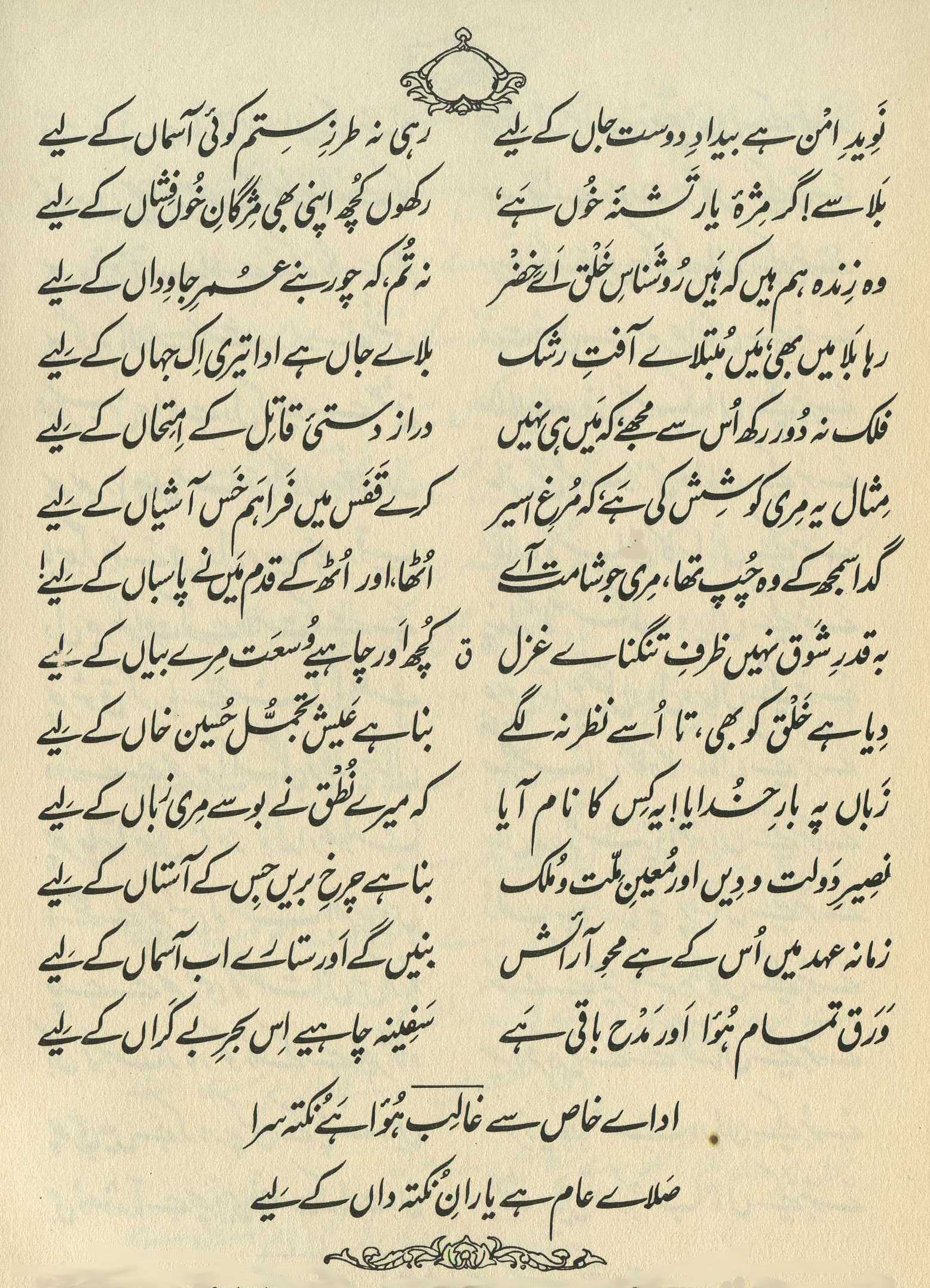
| Hamid Ali Khan | Open Image |
It's true that a test of tyranny can take place when the prey or victim of the swordplay would be far off, but am I the only one who remains for this test? There are other victims too! If it's through the insistence of the murderer that you keep me far off, then keep them far off too. (266)
== Nazm page 266

He says, oh sky, why have you placed me and left me far from that murderer? I'm not the only one who's become singled out for her tyranny and cruelty! Others too are there for the test of her oppression. How is it necessary that the moment she sees me, she would murder me? (324)
A lover, far away, is restless in the pain of separation. In his heart the thought comes that the sky has separated me from the beloved's feet because it wants to test the effect of the beloveds airs and graces. That is, it wants to see whether the effect of her airs and graces is the same on faraway ones as on nearby ones, or not. Thus he says to the sky, am I the only one left for this test? For the Lord's sake, have mercy on me! After all, others too are her lovers. If you have to make this test, then make it by means of someone else-- why are you causing me mortal harm? The pain of separation is killing me. (504)
A test is being arranged. The commentators are sure that it's a test arranged by the sky, and that what it's testing is the power of the beloved's deadly charm to exert its effect at a distance. But it might also be such a test arranged not by the sky but by the beloved herself. Or the beloved might have arranged it to test not her own power, but the lover's devotion and steadfastness. (See 43,2 for one of many examples of the beloved as an arranger of complex or ambiguous tests.) If the beloved is arranging the test, then the lover complains to the sky in its role as a giver of destiny, fate, disasters, etc., and demands to be allowed to participate in the test.
In any case, the test involves the power of the beloved's . In a general way this idiom means 'oppression, tyranny' (see the definition above), but literally of course it means 'long-handedness'. (Think not so much of 'high-handedness' as of the 'long reach' through which a powerful person can cause things to happen even at a distance.) And our attention is drawn to the very specific, literal meaning of her long (and deadly) reach, by the injunction 'don't keep me far from her' in the first line. (In fact, we only really-- retrospectively-- understand the injunction in the light of the , and the in the light of the injunction.)
But the verse is also a display of the multi-faceted possibilities of the innocent-looking little word . Here are some of the readings that can generate:
='I am not the only one' (1a)-- that is, the speaker is not the only one who is available or suitable for the test described in the second line. As Bekhud Mohani points out, this claim could be a way for the speaker to seek to avoid the test, on the grounds that lots of others are available instead, and he wants to avoid the ordeal of being far from the beloved.
='I alone am not the one' (1b)-- that is, everybody else is available and/or suitable for the test, and the speaker alone is not, so he doesn't need to be kept in readiness for it.
='emphatically/particularly I am not one' (1c)-- that is, regardless of who else may or may not be available and/or suitable for the test, the speaker is definitely not, so he shouldn't be bothered with it.
Why is the lover so eager to avoid the test, or so particularly or uniquely unsuitable for it? Perhaps he's passed it already, countless times, and already has the beloved's seal of approval. Perhaps he's so weakened by passion that he would collapse before the test even got fairly under way. Perhaps the nature of the test, since it requires him to remain at a distance from her, is just too excruciating to even consider. Perhaps he and the beloved contemplate other tests for him-- ones that involve nearness instead of distance, or ones that might have nothing to do with geography.
Or perhaps the lover is just speaking with rueful humor: he doesn't want to incur her wrath by seeming to avoid her-- he doesn't want to be the one she tests her 'long-handedness' on! As usual, we're left to figure this sort of thing out for ourselves. And thanks to the good (?) offices of and , the process of thinking and rethinking is potentially endless.
graphics/longreach.jpg