Verse 91847aa;Nke liye
G9
In this meter the next-to-last long syllable may be replaced by two shorts.
1
He has given it even/also to people/creation, so that the evil eye would not afflict him/it
2
enjoyment has {come into being / developed} for the sake of Tajammul Husain Khan
'Life; animal life'; a life of pleasure and enjoyment, pleasure, delight, luxury; gratification of the appetites, sensuality; carnal intercourse'.
| References | |
|---|---|
| Arshi, Imtiyaz Ali | Ghazal# 211 |
| Raza, Kalidas Gupta | 388-89 |
| Hamid Ali Khan | Open Image |
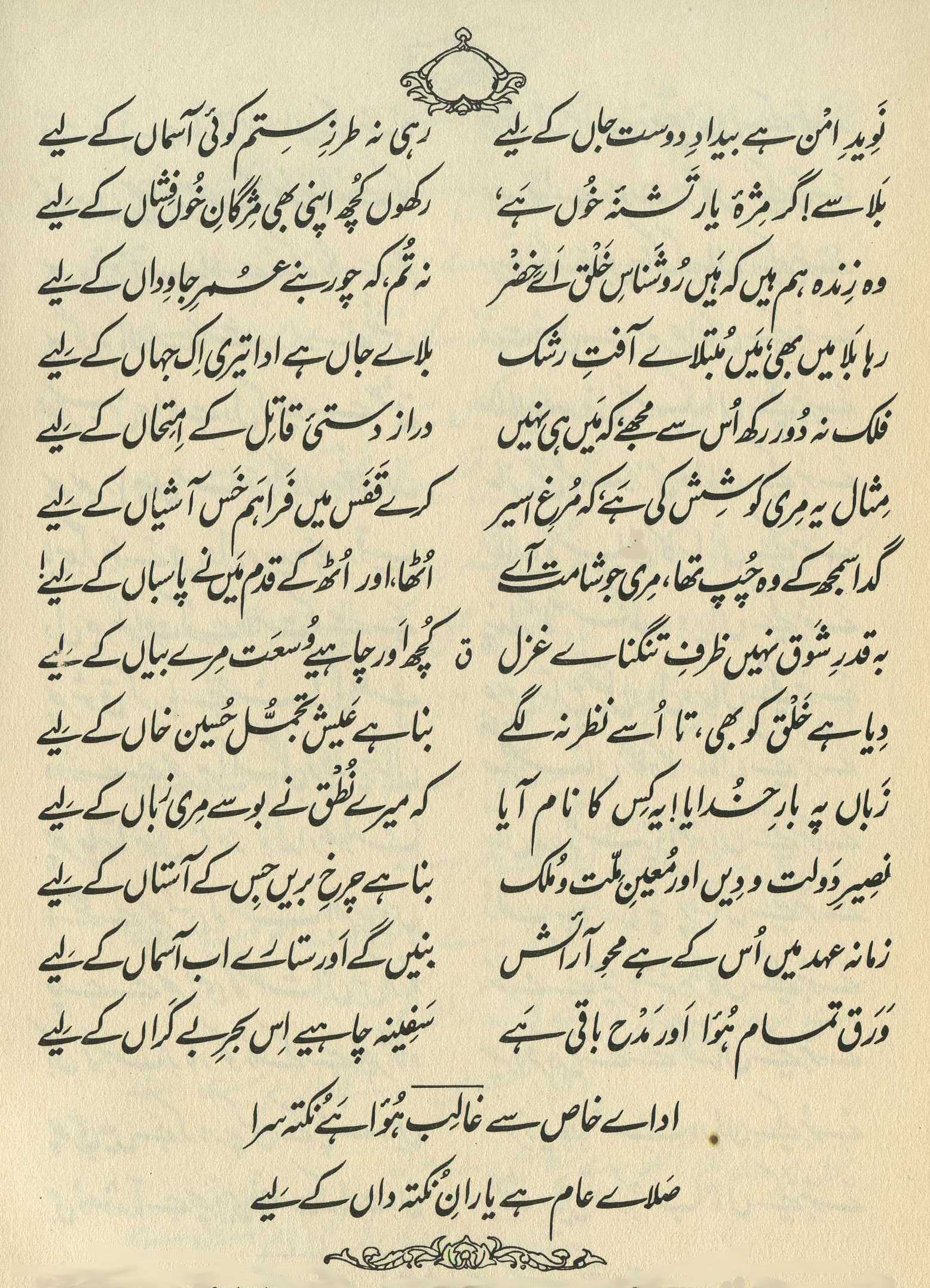
[1861, to Taftah:] Anyone praised by me, doesn't survive. [The Navabs of Avadh] Nasir ud-Din Haidar and Amjad Ali Shah passed away after one ode apiece. Vajid Ali Shah stood up to three odes, then he couldn't take it any longer. Anyone in praise of whom I've composed ten or twenty odes, has arrived even beyond Nonbeing [].
==Urdu text: Khaliq Anjum vol. 1, p. 368
[1862, to Surur:] First some matters are recorded that will appear, at a cursory glance, irrelevant to the discussion. I was five years old when my father died, nine years old when my uncle died. In place of his estate [], ten thousand rupees a year were allotted to us from the estate of Navab Ahmad Bakhsh. He didn't give them, [but gave only] three thousand rupees a year; from out of that, my own personal share was seven hundred fifty rupees a year. I made clear this failure [to pay] to the English government. Colebrooke Sahib Bahadur, Resident of Delhi, and Stirling Sahib Bahadur, Secretary of the Government at Calcutta, were in agreement about giving me my rights. The Resident was dismissed, the Secretary died an untimely death. After a considerable time, the King of Delhi appointed for me fifty rupees a month; the Heir Apparent, four hundred rupees a year. Two years after appointing this, the Heir Apparent died. From the court of Vajid Ali Shah, the King of Avadh, in reward for my praise-poetry, five hundred rupees a year were appointed. He too lived no longer than two years-- that is, although he lives to this day, his kingship departed, and was gone within those two years. The kingdom of Delhi was a little more tenacious of life []-- only after providing me with bread for seven years was it destroyed. Where [else] are born such inauspicious-fortune-bringers and benefactor-destroyers [as I am]? Now if I would turn my attention toward the Ruler of the Deccan [the Nizam of Hyderabad], keep in mind that my go-between will die, or be dismissed. And if neither of these things happens, then his attempt will be vain, and the Ruler will give me nothing. And if by any chance he [the Ruler] would treat me kindly, then his kingdom will be brought down into the dust and the land will be plowed by donkeys.... If I ignore these things and form the purpose of writing a 'purpose-poem' [=an ode []-- well, the purpose I can form, but who will carry it out? Except for a single/particular/unique/excellent mastery [] that's the result of fifty or fifty-five years of practice [], I have no strength left. Sometimes when I look at my earlier poetry and prose, I know that this is my composition, but I remain astonished-- how did I write [] this prose, and how did I compose/'say' [] this poetry? It's as if this [Persian] line of 'Abd ul-Qadir Bedil 's comes from my own tongue: 'The whole world knows my story--and I am nothing'. ==Urdu text: Khaliq Anjum vol. 2, pp. 609-10 ==Azad's version: Pritchett and Faruqi , pp. 482-83 ==another trans.: Russell and Islam , pp. 236-37
[1862, to Surur:] First some matters are recorded that will appear, at a cursory glance, irrelevant to the discussion. I was five years old when my father died, nine years old when my uncle died. In place of his estate [], ten thousand rupees a year were allotted to us from the estate of Navab Ahmad Bakhsh. He didn't give them, [but gave only] three thousand rupees a year; from out of that, my own personal share was seven hundred fifty rupees a year. I made clear this failure [to pay] to the English government. Colebrooke Sahib Bahadur, Resident of Delhi, and Stirling Sahib Bahadur, Secretary of the Government at Calcutta, were in agreement about giving me my rights. The Resident was dismissed, the Secretary died an untimely death. After a considerable time, the King of Delhi appointed for me fifty rupees a month; the Heir Apparent, four hundred rupees a year. Two years after appointing this, the Heir Apparent died. From the court of Vajid Ali Shah, the King of Avadh, in reward for my praise-poetry, five hundred rupees a year were appointed. He too lived no longer than two years-- that is, although he lives to this day, his kingship departed, and was gone within those two years. The kingdom of Delhi was a little more tenacious of life []-- only after providing me with bread for seven years was it destroyed. Where [else] are born such inauspicious-fortune-bringers and benefactor-destroyers [as I am]? Now if I would turn my attention toward the Ruler of the Deccan [the Nizam of Hyderabad], keep in mind that my go-between will die, or be dismissed. And if neither of these things happens, then his attempt will be vain, and the Ruler will give me nothing. And if by any chance he [the Ruler] would treat me kindly, then his kingdom will be brought down into the dust and the land will be plowed by donkeys.... If I ignore these things and form the purpose of writing a 'purpose-poem' [=an ode []-- well, the purpose I can form, but who will carry it out? Except for a single/particular/unique/excellent mastery [] that's the result of fifty or fifty-five years of practice [], I have no strength left. Sometimes when I look at my earlier poetry and prose, I know that this is my composition, but I remain astonished-- how did I write [] this prose, and how did I compose/'say' [] this poetry? It's as if this [Persian] line of 'Abd ul-Qadir Bedil 's comes from my own tongue: 'The whole world knows my story--and I am nothing'. ==Urdu text: Khaliq Anjum vol. 2, pp. 609-10 ==Azad's version: Pritchett and Faruqi , pp. 482-83 ==another trans.: Russell and Islam , pp. 236-37
At the end of this ghazal he has written some verses in praise of the Navab of Farrukhabad, who with extreme eagerness had invited Mirza to Farrukhabad. But probably [] Mirza's journey there didn't take place.
==Urdu text: Yadgar-e Ghalib , p. 167
'He has given even/also to the people'-- in this sentence the subject, that is, 'the Lord' [], and the direct object, that is, 'enjoyment', are omitted . With regard to the word 'enjoyment' two verbs, and , are at odds. (266)
== Nazm page 266

In the first line there is ; in the second, ; in this too there is a kind of pleasure.
Other people in the world have enjoyment, and so does Tajammul Husain Khan. But the poet has shown the reason for others' enjoyment to be that the Lord had made enjoyment for Tajammul Husain Khan alone; he gave some to others as well, only lest the evil eye might afflict him. (506-07)
Tajammul Husain Khan: a famous amir of the Bangash clan of Farrukhabad, who died in 1262 AH (1846 AD). (739)
The nature of this verse as the first in a kind of four-verse verse-set is discussed in 234,8 , the verse that introduces it.
Since we are approaching the end of the divan , this seemed a good place to include some of Ghalib's typically bleak, but also typically witty, thoughts about his relationships with princely patrons. In the letters quoted above, Ghalib humorously complains that every patron whom he praises seems to die of the shock pretty quickly. Apparently his praise had the same effect on Tajammul Husain Khan as well, who seems to have died (if Mihr's date is correct) right around the time this ghazal was composed.
What Nazm criticizes-- and therefore Bekhud Mohani makes a point of praising-- is the fact that at the beginning of the first line, and at the beginning of the second line, look to be grammatically parallel, but they're quite different. The first line has the implied subject 'He' or 'God', though we can't possibly tell that except by later guesswork; the subject can indeed be omitted in Urdu, but this should only be done where it's readily apparent what the subject is. This line doesn't follow that practice, since in the second line there's no reference to 'God'.
The first line also offers us the confusing -- its antecedent might be the unspecified subject of the first clause, or the , or something or somebody else entirely. Then the at the beginning of the second line (for more on this see 234,11 ) is the present perfect of and has 'enjoyment' [] as its subject, so it's entirely unlike in the first line; their seeming parallelism proves to be an illusion. In short, this is trying to be a mushairah verse-- but it can only be said to succeed at all if 'Tajammul Husain Khan' can work as a sort of 'punch-word' to activate all the earlier confusion and misdirection. And how can it? Even in Ghalib's own day, his was not a name to conjure with.
The verse is thus awkwardly structured and lumpy, so that we have to struggle to resolve it. And then what is our reward? Basically, nothing at all. We merely learn the hyperbolic, labored, and unmotivated information that God has created all the enjoyment and luxury in the world for one of Ghalib's patrons, and has given bits of it to others only so as to protect that one fortunate person from the 'evil eye' effects of their envy. Once we've learned that, there doesn't seem to be anything else going on in the verse. If we made a prose paraphrase, what would we lose?
graphics/graphic1872princes.jpg