Verse 71847aa;Nke liye
G9
In this meter the next-to-last long syllable may be replaced by two shorts.
1
having considered me a beggar he was silent; {so that / in that} my misfortune/disgrace would come about
2
I/he rose; and, having risen, I grasped/'took' the Gatekeeper 's feet
'Ill-luck, mischance, adversity, misfortune, disaster; disgrace, infamy'.
'To touch the feet (of); to kiss the feet (of); to pay (one's) respects (to); to bow (to), to acknowledge the superiority (of)'.
| References | |
|---|---|
| Arshi, Imtiyaz Ali | Ghazal# 211 |
| Raza, Kalidas Gupta | 388-89 |
| Hamid Ali Khan | Open Image |
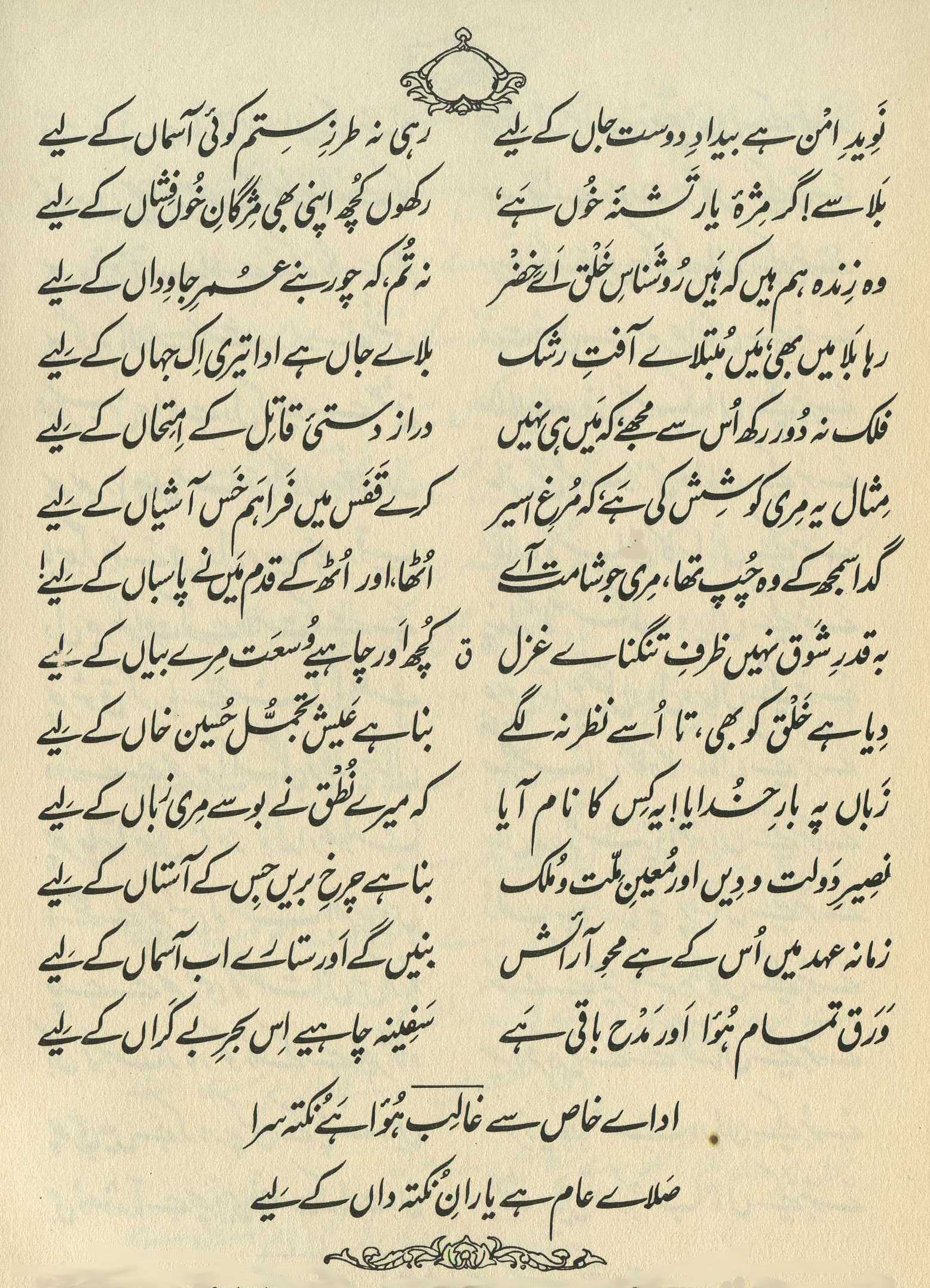
In Urdu ghazal there can't be more than three or four more such rhetorically effective [] verses. Maulana Azurdah too, who used to criticize Mirza's style, was a moth to [the candle-flame of] this verse's manner of expression. I too have made some remarks [] in the about this verse. Here, attention is drawn to one more excellence of it. Two things about the event that Mirza mentioned in this verse must certainly be explained. One is how the Gatekeeper treated the speaker; the other is what the speaker wanted from the Gatekeeper. Neither of these things have been mentioned in detail; they have been presented only through suggestion. But with further explication they immediately become understandable. The word 'misfortune/disgrace' clearly signifies the first thing; and 'to seize the feet', the second. In addition to this, to present with so much excellence in two lines such placement of colloquial language and verbal constructions and an extended thought, which even in prose would be hard to achieve-- all these things are worthy of extreme praise.
==Urdu text: Yadgar-e Ghalib , pp. 166-67
[Reading :] By 'he' the Gatekeeper is meant-- that formerly, considering him a beggar, he did not prevent his coming to the beloved's door. But when his misfortune/disgrace occurred, then he fell at his feet. From this he understood his purpose, and placed a hand on his neck. This verse has attained a construction [] that has no equal. (266)
== Nazm page 266

[Reading :] The greatest pleasure in this verse is that the lover's state had become so altered that even the Doorkeeper, who knew him very well, didn't recognize him. But the lover's absorption, and his immersion in the thought of the beloved, were such that he didn't even realize that his clothing and his appearance had become like that of faqirs, and for this reason the Doorkeeper had considered him a beggar, and had remained silent. Rather, he considered that today the Doorkeeper was gracious, and he pulled together his courage-- with this result [as described in the second line].
And there's also this: that the Doorkeeper, having considered him a beggar, recognized him as a lover when he saw him falling at his feet, and expressed anger. In the force of this anger he must also have said, 'I had considered you a beggar-- otherwise, I would have put you out long ago!' In short, such a composition is, for poetry, a cause of pride. (506)
Most (though not all) of the commentators take the verb at the end of the first line to be , and interpret the grammar accordingly (the disgrace 'came about'). As always I follow Arshi, who (along with Nazm, Hamid, and one or two others) gives . That verb form can here can here be only a subjunctive (the disgrace 'would come about'). The grammar of the second half of the line is governed by ; on its colloquial flexibility see 12,2 . This does feel a bit awkward: it leaves us with a sequence of actions consisting of a perfect, a subjunctive, then in the second line two more perfects. Perhaps we are meant to feel that the speaker is reporting his disgrace as a form of fate, so that it was more or less predestined to occur. Common sense would favor the , but I'm not going to get sidetracked into manuscript research. After all, if we know anything about Ghalib, we know that he often warped his grammar for his own idiosyncratic purposes.
Why does the lover first 'rise, get up', and then, 'having risen, having gotten up', bend or fall down to touch the Gatekeeper's feet? Do we see an unnecessary repetition , a redundancy, here? (For a discussion of 'padding', see 17,9 .) I think we can save the verse by arguing that the repetition achieves a useful purpose: it separates the lover's behavior into two distinct actions. First he stands up, then he bends or falls down again to grasp the Gatekeeper's feet in supplication. Thus he perhaps makes two separate mistakes: he gets up as though he actually hopes to be admitted, which perhaps a beggar might not do; and then, perhaps after noticing the Gatekeeper's ominous expression, he bends or falls back down again to touch the Gatekeeper's feet in extreme humility, which also a beggar might perhaps not do (after all, there are other havelis to beg from). For apparently the idea that a 'beggar' would do both these things in quick sequence is sufficient to alert the Gatekeeper and arouse his suspicions.
It's also grammatically possible that it was the Gatekeeper who got up, and that the lover then himself rose and (presumably) bent over again to touch the Gatekeeper's feet. But would the beloved's Gatekeeper be so lax and casual as to be sitting down on the job? On the whole it seems more likely that the lover is reporting his own actions.
Note for meter fans: This verse offers what feels like a case of ' contrived rhyme ', though perhaps technically it's not; I haven't really figured out all the nuances of the concept. The whole ghazal has the refrain of ('for', 'in order to'), which acts, as usual, as a single grammatical unit. This verse breaks it in half, using the as a possessive for the Gatekeeper's feet, and the as a masculine plural perfect verb. It feels daring, it feels a bit shocking; it's certainly part of the (limited) pleasure of the verse. The unity of is so deeply engrained in our colloquial sense of the language that we can hardly help but read the line that way; it takes an effort of will to break it apart. A very similar case: 234,10 .
On as 'to consider', see 90,3 .
graphics/beseeching.jpg