Verse 2after 1826aaniimerii
G11
In this meter the first long syllable may be replaced by a short; and the next-to-last long syllable may be replaced by two shorts.
1
the pricking/anxiety of blood-scattering side-glances-- don't ask!
2
{look / having looked} at my pure-blood-shedding
'Pricking, pain; care, solicitude, anxiety; apprehension, suspicion, misgiving; -- putting a stop to, interruption'.
'Pouring, scattering, dropping, shedding, infusing, applying, &c.'
'Scattering, strewing; shedding; spreading, expanding, diffusing'.
| References | |
|---|---|
| Arshi, Imtiyaz Ali | Ghazal# 200 |
| Raza, Kalidas Gupta | 374-75 |
| Hamid Ali Khan | Open Image |
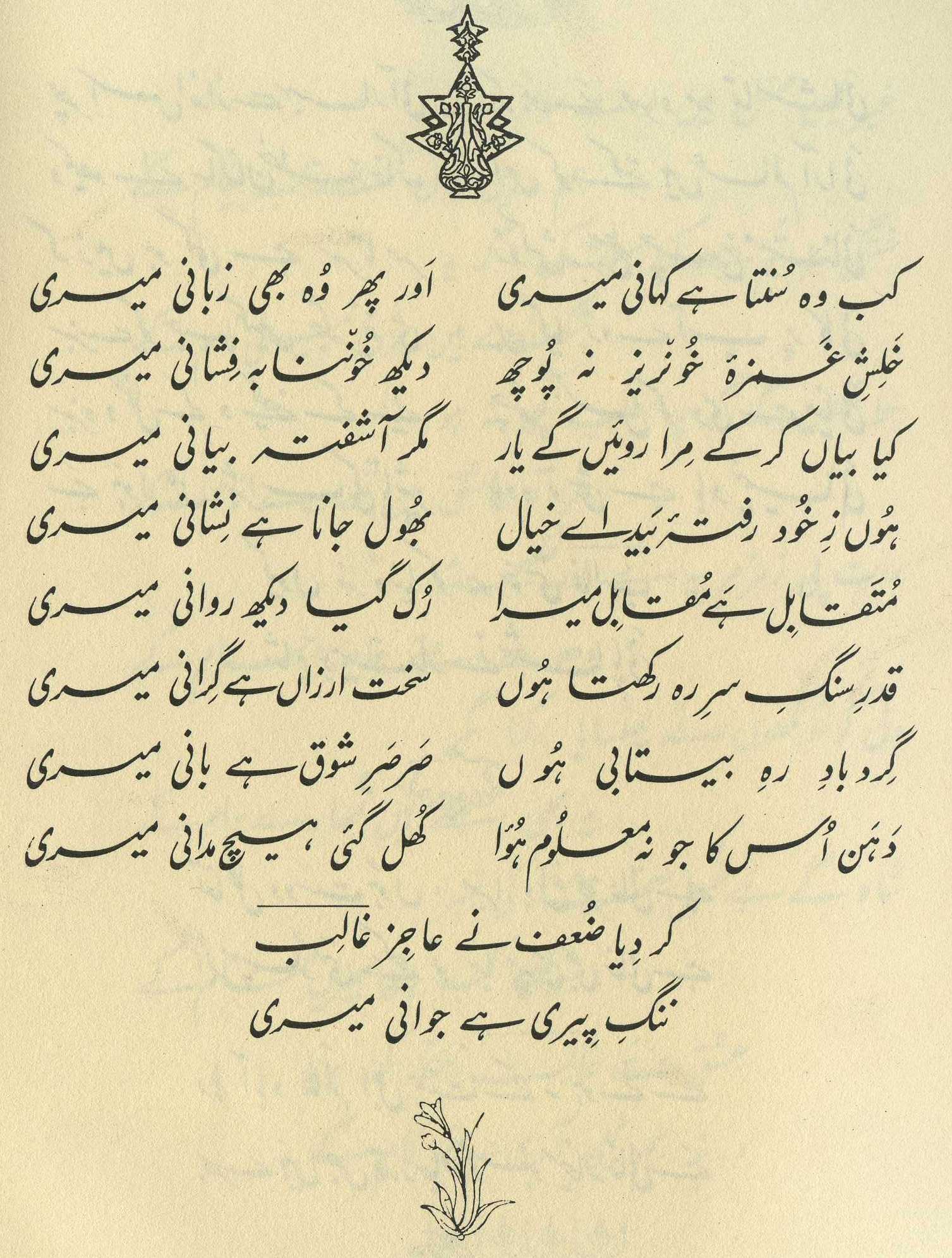
That is, the blood-scattering of the side-glances has created a wound in the liver, so that I am weeping with tears of blood. (205)
== Nazm page 205

He says, 'Why do you ask me about the state of the scratching of the blood-scattering side-glances? How can I express the pricking/anxiety of it? It has made a wound in the heart, and an abcess in the liver. Seeing this, I am weeping tears of blood.' (265)
He says to the beloved, all right, don't ask what the pricking/anxiety of the blood-scattering side-glances has done. Just look at the spectacle of my blood-shedding. (361)
Here is the 'inexpressibility trope'-- something in the first line is so far beyond words, so inconceivably extreme, that it's beyond not only explanation but even any attempt at explanation. Thus you shouldn't 'ask'-- instead, you should 'look'. But just what kind of contrast is intended? Here are some possibilities:
=Don't ask with your lips-- instead, use your eyes and look.
=Don't ask about her behavior-- instead, consider my behavior.
=Don't ask about the pricking/anxiety-- instead, if you want to understand it, look at the results of it.
=Don't ask about the blood-scattering-- instead, look at the blood-shedding.
Then in the second line, the -- which is primarily and most obviously an intimate imperative-- could also be read as , with the colloquially omitted. This reading creates a reversed time sequence: instead of 'don't ask, look!' we would have 'having looked, don't ask!'.
There's also the piquant similarity-and-contrast between the way the beloved's side-glances are 'blood-scattering' and the lover is-- through his tears and/or wounds-- 'blood-shedding'. The two actions are almost synonymous (see the definitions above). Are the beloved and the lover thus in cooperation (engaged in the same activity), or are they in competition (based on some minute difference in the activity)? Or is the lover merely an utterly vulnerable victim, with the beloved's side-glances as arrows? The verse is so stingy with its information that it doesn't even tell us whose side-glances they are (though of course we can guess).
The verse is entirely focused on replacing speech ('don't ask!') with sight-- and that too a horrifyingly vivid sight, a vision of two sprays of bright blood. Beyond that basic physical image, what is the mood or emotion of the verse? Proud, rueful, agonized, matter-of-fact, melancholy? As so often, it's been left up to us to interpret the feeling-tone for ourselves.
graphics/bloodshed.jpg