Verse 9after 1826aaniimerii
G11
In this meter the first long syllable may be replaced by a short; and the next-to-last long syllable may be replaced by two shorts.
1
weakness made me helpless/powerless, Ghalib
2 a
my youth is a disgrace/honor to old age
2 b
the disgrace/honor of old age is my youth
'Weakness, feebleness, debility, infirmity, imbecility (of mind or body), unsoundness; feeble action (of the heart, &c.); fainting, a fainting-fit, swoon'.
'Lacking strength or power, or ability, powerless, impotent, unable (to do), unequal (to); weak, feeble, helpless; brought low, overcome; lowly, humble; exhausted; dejected; in despair, hopeless; baffled, frustrated'.
'Old age, senility, decrepitude; —the status or condition of a priest, or of a saint; —rule, authority, power, influence'.
'Youth; adolescence, manhood, age of discretion, puberty; the season of youth'.
'Honour, esteem, reputation; —shame, disgrace, infamy, ignominy'.
| References | |
|---|---|
| Arshi, Imtiyaz Ali | Ghazal# 200 |
| Raza, Kalidas Gupta | 374-75 |
| Hamid Ali Khan | Open Image |
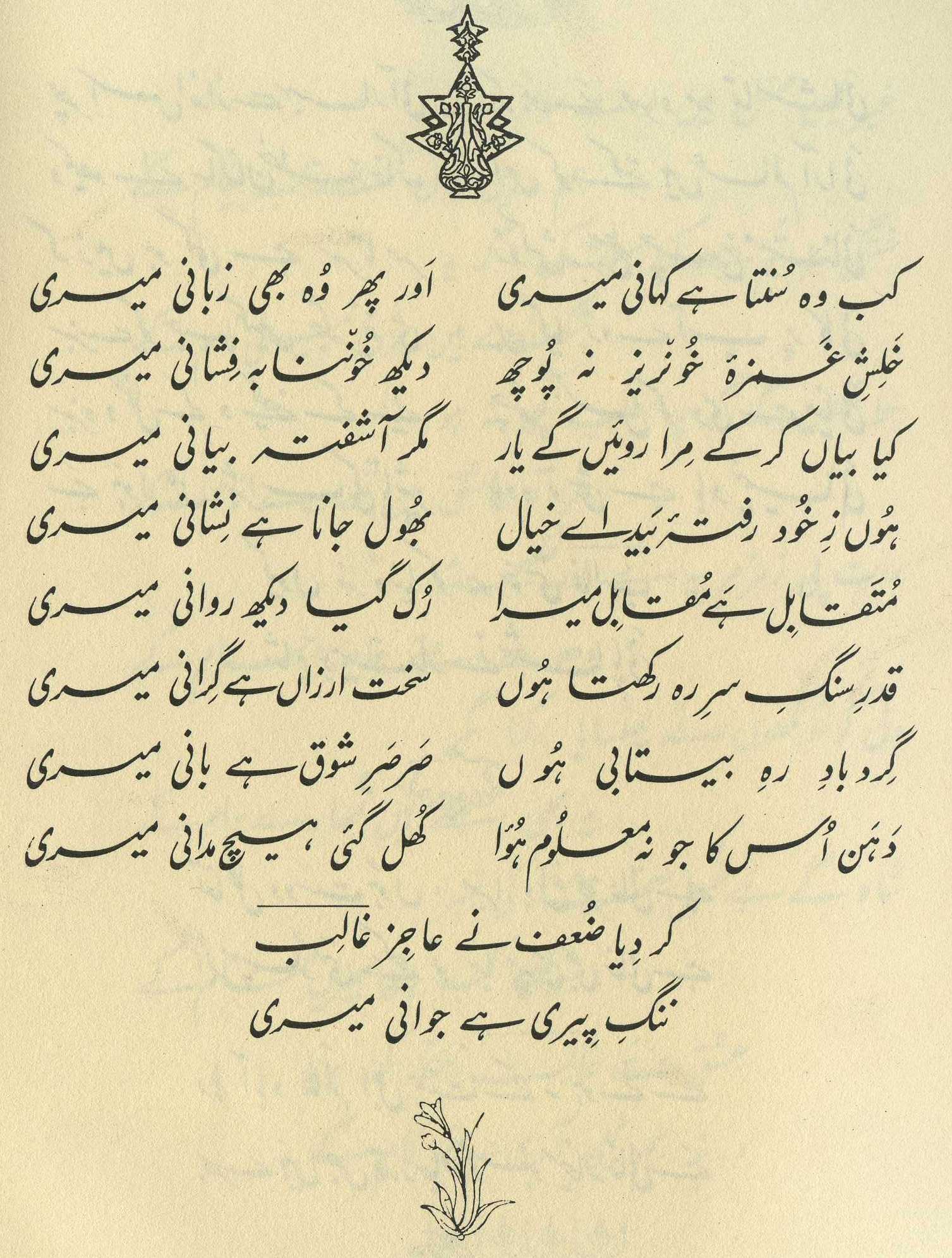
That is, in youth there is such weakness that if someone had this weakness even in old age, then he ought to be considered a disgrace to old age. (206)
== Nazm page 206

He says, 'Oh Ghalib, in youth I have become weak and strengthless to such an extent that even old men are not so feeble and frail. My youth is a disgrace to old age.' (266)
In youth, weakness has made me so oppressed that old age would be better than my youth. (363)
As the commentators explain, it might be that the lover's youth is a time of such feebleness that it is a 'disgrace to old age': even an old man would be ashamed to be such a helpless wretch as the lover has become. Or else, thanks to that versatile , the lover's youth brings down upon him 'the disgrace of old age'-- his youth is marked, prematurely, by the kind of humiliation, shame, and 'disgrace' that old age would have brought at its own distant time.
But then-- look at the alternative meanings gesturing from the sidelines. For can also mean (see the definition above) something like 'venerability' (as of course in ) or 'authority' (such as a senior elder should have). And , which indeed means 'disgrace' or 'shame', participates in the doubleness that shame-words often have, and can also mean 'honor' (see the definition above); for discussion of this question, see 3,5 .
Thus the sarcastic sense of 'My weakness is so extreme that it would be a credit to old age' is also quite possible. Or perhaps 'Because I move and act like an elder, in my youth I receive the tributes (honor, respect) due to old age'. This kind of ironic (?) meaning may be secondary, but how can it be ruled out? A phrase like , of which both members have pairs of opposed meanings, is like a beacon that flashes on and off, demanding attention. And especially so in a verse in such a short meter, where adjectives and adverbs and other qualifiers rarely fit in. At the very least, the phrase invites us to reflect on the complex relationships between youth and age, and among various kinds of weakness and power.
graphics/weakness.jpg