Verse 7after 1826aaniimerii
G11
In this meter the first long syllable may be replaced by a short; and the next-to-last long syllable may be replaced by two shorts.
1
I am a whirlwind/demon of the road of restlessness
2 a
a cold-boisterous-wind of ardor is my quality/voice
2 b
my quality/voice is a cold-boisterous-wind of ardor
'A whirlwind, a devil or a demon'.
(from , 'to sound') 'A cold boisterous wind'. .
'A cricket; a cold, boisterous wind'. (Steingass, p.785)
'Peculiar disposition or mental constitution; natural temper... any property or virtue, &c. upon which one prides or plumes oneself; fabric, structure'.
'Sound, note, voice; speech, word, language, discourse; precept, doctrine'.
| References | |
|---|---|
| Arshi, Imtiyaz Ali | Ghazal# 200 |
| Raza, Kalidas Gupta | 374-75 |
| Hamid Ali Khan | Open Image |
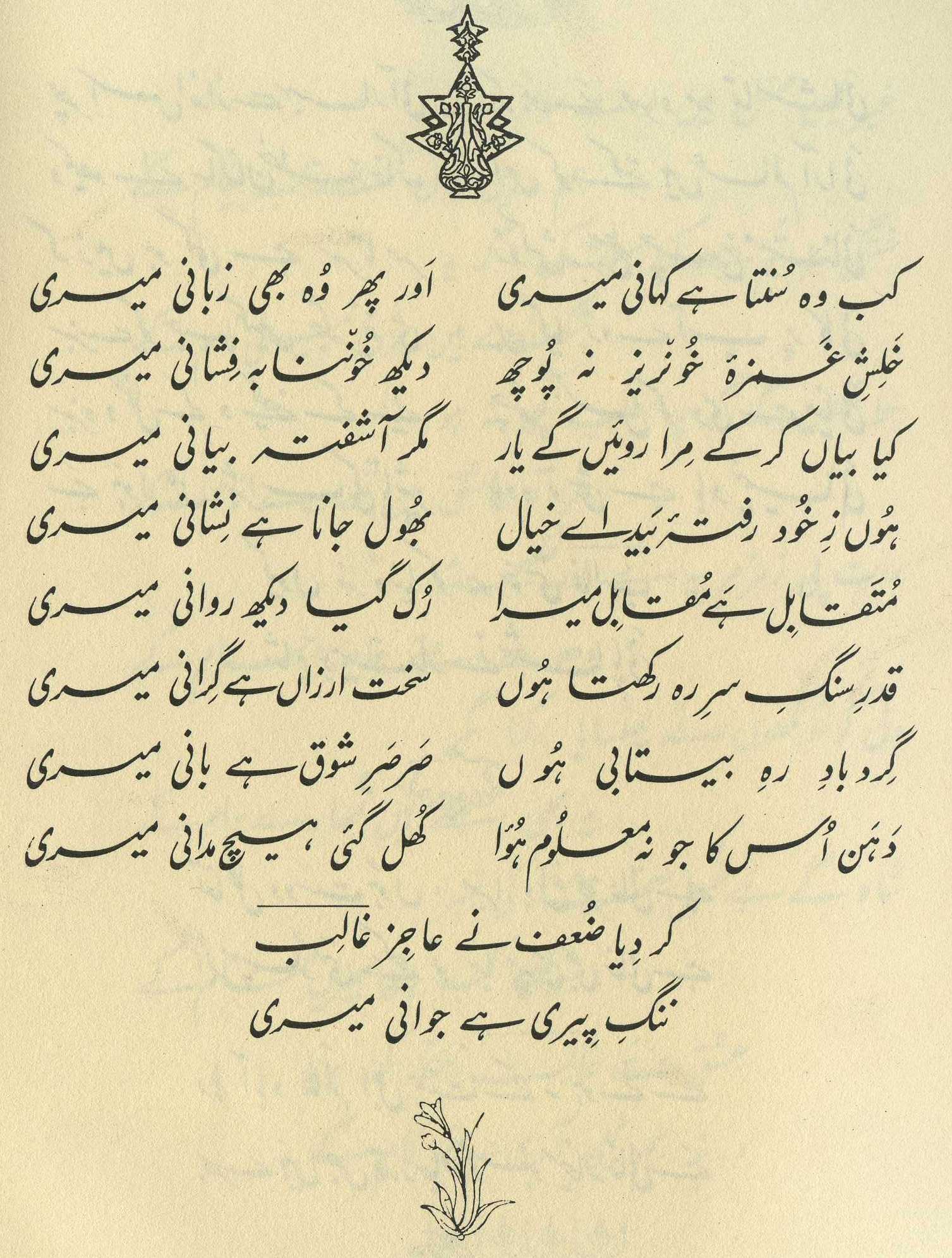
I am restless like a whirlwind [], and am a of the roadway of restlessness; and the quality [] of that skill/craft [] is the 'cold-boisterous-wind of ardor'. (205)
== Nazm page 205

He says, 'I am restless like a whirlwind, and am a of the roadway of restlessness. The quality of my restlessnesses is the 'cold-boisterous-wind of ardor'.' (266)
I am a whirlwind of the road of restlessness, which has arisen through the windstorm of ardor. That is, excess of ardor has made me severely restless. (363)
The assertions here are so simple, flat, and multivalent that they can be connected in various ways. For can mean either a whirlwind or a demon, and nothing in the verse enables us to rule out either meaning. If the speaker is a whirlwind, then his characteristic quality/disposition is the 'cold-boisterous-wind of ardor'; and if he's a demon, then his voice is the sound of the 'cold-boisterous-wind of ardor'. Intriguingly, in English idiom we have the whirling funnel-shaped 'dust-devil', which seems to conflate the two possibilities.
And what is a whirlwind or demon 'of' the road of restlessness? Given the multivalence of the , here the 'of' can mean 'generated by', or 'living in', or 'equivalent to', or merely 'associated with'. Since all those possibilities are crammed into an extremely short and simple verse, we have no means of resolving them.
Then in the final 'punch-word' position we have , which has two separate Indic-side meanings (see the definitions above) that are-- as usual, for Ghalib-- both excellently appropriate in this context. (The Arabic one related to 'builder' can't work because it's masculine.) For more examples of such 'double activation', see 120,3 .
The verse has a lingering, chilly after-effect of mood . Its resonance is not due to any precise meaning, but rather to its starkness, its evocative imagery, and its very ambiguity.
graphics/whirlwind.jpg