Verse 4after 1826aaniimerii
G11
In this meter the first long syllable may be replaced by a short; and the next-to-last long syllable may be replaced by two shorts.
1
I am a gone-from-myself one, of the desert of thought
2
to forget is my mark/sign/memorial
'A desert, an uninhabited dangerous region; name of a flat and extensive tract between Mecca and Madina'. (Steingass p. 217)
'A mark, sign, token, model; a distinctive mark; —a catch-word; —a token of remembrance, keepsake, memorial, souvenir'.
| References | |
|---|---|
| Arshi, Imtiyaz Ali | Ghazal# 200 |
| Raza, Kalidas Gupta | 374-75 |
| Hamid Ali Khan | Open Image |
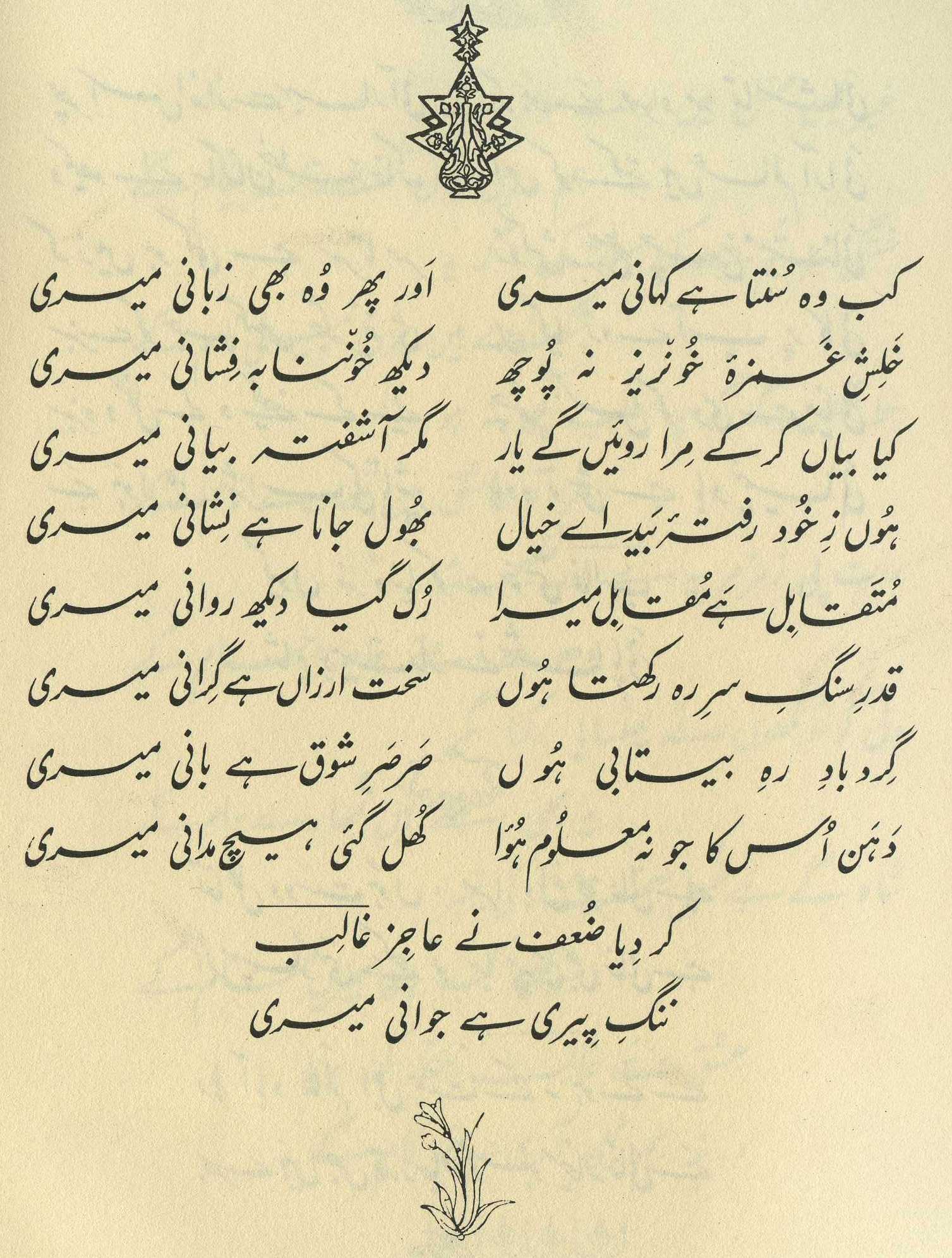
That is, I go out of thought, and that my friends forget me is also my sign/token. By 'thought' is meant 'the friends' thought'; and he has imagined this to be a field, and has described himself as being 'carried away from himself' from this field. (205)
== Nazm page 205

The meaning is that I go out of my friends' thought, and for my friends to forget me is itself my sign/token. (265)
I have become carried away from myself in the desert of thought, and my self-lessness proves this-- that is, my falling silent like young people. My remaining deeply lost says that I'm always absorbed in some thought.
[Or:] I am lost in the desert of thought; those people who forget themselves, find me. That is, I'm always absorbed in my own thoughts and preoccupations, and only those people can understand my state who are in this state themselves. (362)
How much richer and more provoking can an be, than the one in the first line? It's like a pivot around which the various meanings of the line keep turning. Here are some of the possibilities:
=The speaker is one who is gone from himself into the desert of thought-- somehow he can't keep his mind from wandering off into that desolate, abstract wilderness.
=The speaker is one who is gone-from-himself by means of the desert of thought-- the desert of thought itself swoops down upon him, seizes him, and transports him away from himself into its own strange landscape.
=The speaker is one who is gone from himself away from the desert of thought-- somehow he has been lured or dragged away from the desert of thought where he was wandering.
=The speaker is the gone-from-himself one who is of the desert of thought-- that's how he can be distinguished from all the other gone-from-themselves ones.
This remarkable range of possibilities is Ghalib's reward for cleverly and tantalizingly hooking up one abstraction to another, so that it's impossible (without arbitrariness) to narrow down the ways in which the is to be construed.
Then the second line sets up one of his magnificent plays with paradox . A is exactly what is used to find, or identify, or remember somebody (see the definition above)-- and the speaker's sign/token is 'to forget'. Who is to do the forgetting? Nazm is quite sure that it's the speaker's friends; but nothing in the verse gives us that information. It's obviously very plausible that a gone-from-himself one might do his own forgetting. He might even lose himself completely, as in 161,8 .
For an even more unforgettable example of a paradoxical negative , consider the empty finger in 50,2 .
On the power of thought in relation to the desert, there's also the haunting 5,4 .
graphics/desert.jpg