Verse 6after 1826aaniimerii
G11
In this meter the first long syllable may be replaced by a short; and the next-to-last long syllable may be replaced by two shorts.
1
I possess the worth/magnitude/fate of a stone beside the road
2
it is severely cheap/abundant, my heaviness/expensiveness/vexation
'Greatness, dignity, honour, rank, power; importance, consequence; worth, merit; estimation, appreciation, account; value, price; —measure; degree; quantity; magnitude; bulk, size; portion, part; —whatever is fixed or ordained of God, divine providence, fate, destiny'.
'Very, intensely, violently, severely, excessively, extremely, &c.'
'Cheap; abundant'.
'Weight, burden; heaviness; gravity; importance ;—scarceness, scarcity, dearth, dearness; rise (in price); —heaviness of spirit; depression; grief, vexation'.
| References | |
|---|---|
| Arshi, Imtiyaz Ali | Ghazal# 200 |
| Raza, Kalidas Gupta | 374-75 |
| Hamid Ali Khan | Open Image |
means heaviness, and also expensiveness. He says that my worth is like that of the stone that would lie beside the road, and everyone, coming and going, steps on it in passing. That is, I am indeed of 'heavy' worth, but like that stone I am worthless; thus, how cheap is my heaviness/expensiveness! (160)
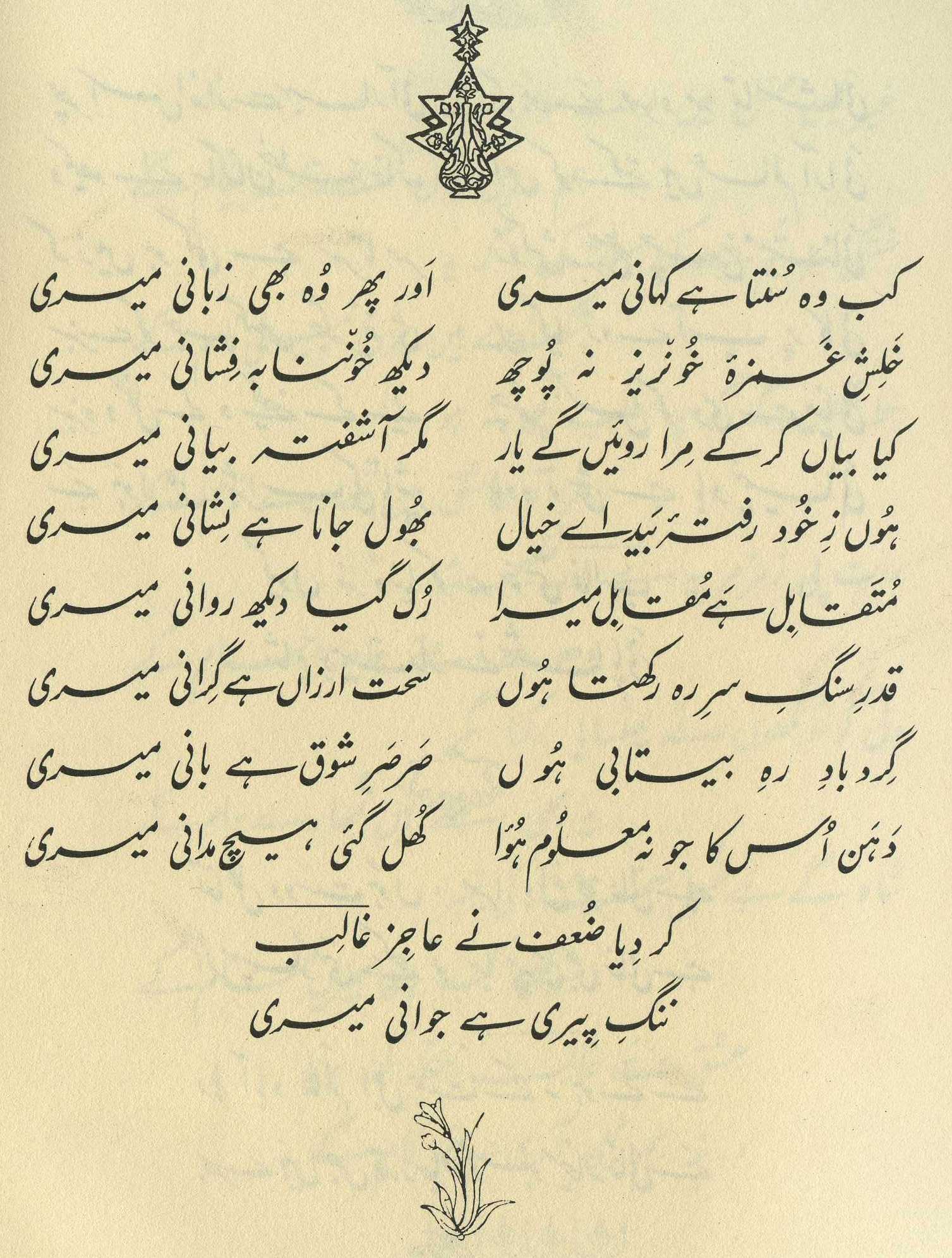
Urdu text: Yadgar-e Ghalib , p. 160
The way in a stone on the road there is 'heaviness' but also extreme 'abundance/cheapness', in that they receive the kicks of travelers, the same is the situation of my 'heavy/expensive' worth. (205)
== Nazm page 205

I'm a possessor of honor and worth, but extremely low/base, like the stone lying in the roadway, that constantly receives kicks from travelers. He laments his worthiness, and complains against the movement of time. (363)
The first line is piquant, but we can't tell where the verse is going-- why do es the speaker possess the (negligible) 'worth' of a stone in the road? Surely he is more valuable than that, at least in his own eyes? It almost sounds like a riddle.
The second line, in classic mushairah performance style, withholds the answer to the riddle until the last possible moment. Not until we hear can we make the connections. Then we are rewarded with a delightfully elegant show of wordplay: stones beside the road are both 'heavy' [] and 'abundant' []; while the speaker, in a beautifully engineered paradox, is both 'expensive' [] and 'cheap' []. The multivalent word is actually triply activated-- the literal meaning of 'heaviness' is activated by the reference to the 'stone' []; the meaning of 'expensiveness, dearness' is activated by the presence of 'cheap' []; and the meaning of 'gravity, importance' is activated by the presence of 'worth, magnitude' []; for more such complex cases see 120,3 .
Moreover, also means 'grief, vexation' (see the definition above), which is very much the impression given by comparing oneself to a wretched stone on the road. And on another reading, the speaker's problem may be that his very worthiness, his 'heaviness' in value, is all too 'abundant'. He prides himself on his (poetic?) worth-- but similar claims are made by all too many others.
The final touch of wordplay is , which can refer to either physical hardness or unyieldingness-- exactly the qualities of a stone-- or a sort of moral harshness or severity, as in 167,2 . In this latter sense it imparts a tone of melancholy, bitterness, or lament about the stone-like 'cheapness' and 'abundance' of the speaker's worth.
For more verses of 'stone' wordplay, see 62,5 .
graphics/thoreauscabinrocks.jpg