Verse 8after 1826aaniimerii
G11
In this meter the first long syllable may be replaced by a short; and the next-to-last long syllable may be replaced by two shorts.
1
{when / since / in that} her mouth did not become apparent/'known'
2
my 'knowing-nothing-ness' was revealed/'opened'
'Knowing nothing, perfectly ignorant; --an ignoramus'.
| References | |
|---|---|
| Arshi, Imtiyaz Ali | Ghazal# 200 |
| Raza, Kalidas Gupta | 374-75 |
| Hamid Ali Khan | Open Image |
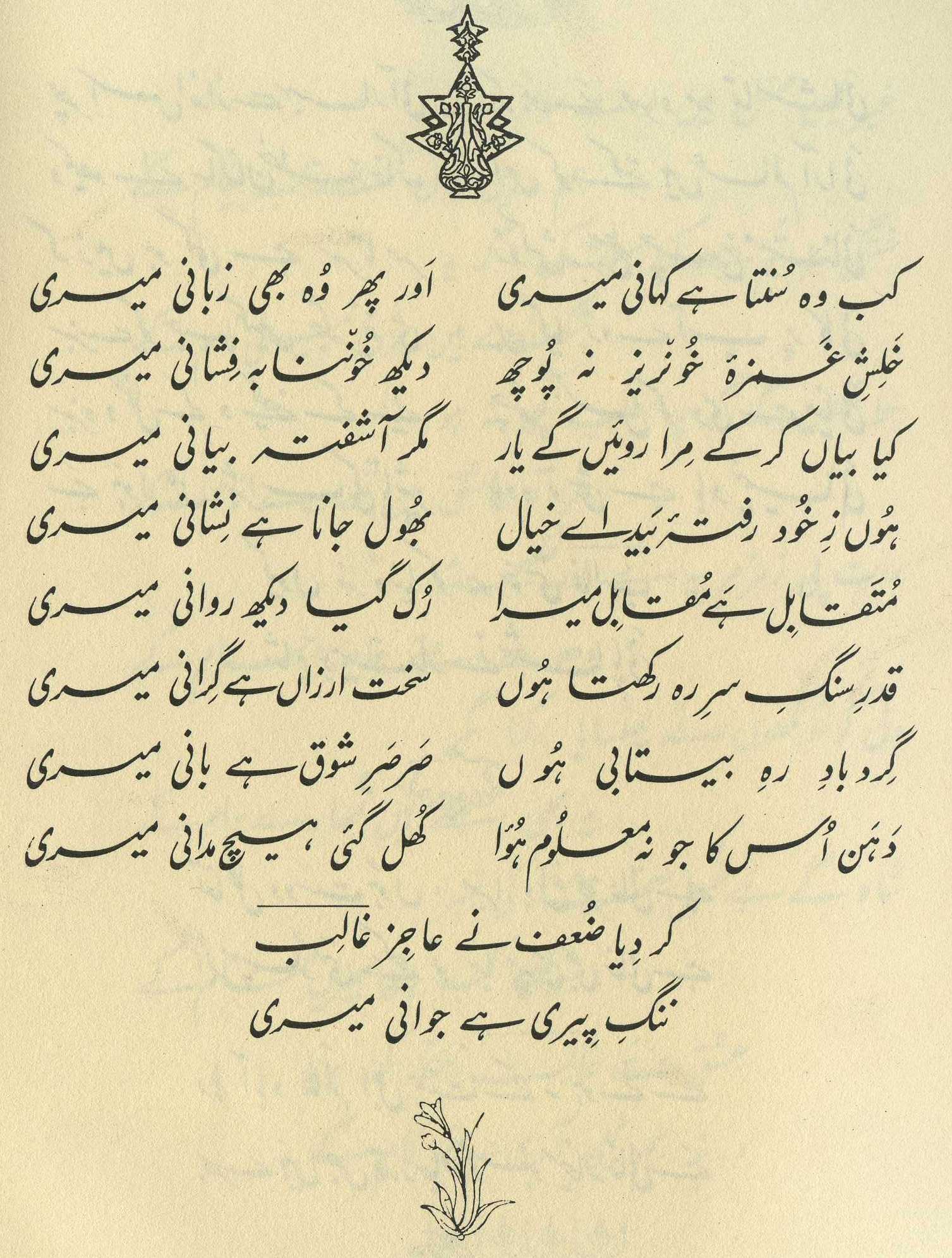
Since the beloved's mouth is nonexistent/nothing [], the person who would not know her mouth is a 'nothing-knower' []. (205)
== Nazm page 205

He says, 'Her mouth is nonexistent/nothing []. Thus it didn't become apparent to me, and I don't know it; and the one who would not know her mouth is a 'nothing-knower' []. Thus my 'knowing-nothing-ness' became apparent to everybody.' (266)
When the beloved's mouth was not able to be known by me, then the secret of my 'know-nothing-ness' became apparent. (363)
[See his comments on Mir's M 1039,1 .]
This verse offers a spectacular display of paradox . If the speaker doesn't know something as crucial and desirable as the beloved's mouth, then he is a hopeless 'know-nothing', an ignoramus, one who doesn't know what should be known. (This is the general reading of the commentators.) On the multivalence of , see 12,2 .
In the ghazal world, the beloved's rosebud mouth is so exquisitely small that it's in fact nonexistent; on this 'beloved has no mouth' motif, see 91,4 . So that if the speaker indeed knows her mouth, which itself is 'nothing', then he is a 'know-nothing' in exactly the opposite sense: he is one who knows what is there to be known-- namely, that same 'nothing'.
There's also a lovely secondary word- and meaning-play: the juxtaposition of and . This clever pairing exploits the fact that means not only for something to be 'known', but often, colloquially, for something to 'appear' or 'seem' or 'be apparent' (think of ...). Whereas means not only 'to open' but also 'to be revealed', 'to be apparent', 'to become known'. So the not-becoming-apparent of her mouth results in the becoming-apparent of the speaker's 'knowing-nothing-ness'. Which invites us to ask, apparent to whom? Are there observers present, who are testing or judging his degree of knowledge of her mouth?
And of course as a final flourish, is something that a mouth does. Her mouth is so small, so ultimately 'closed', that it is invisible or nonexistent-- which caused the speaker's 'knowing-nothing-ness' to become 'open'. How he longed to see her mouth itself become 'open', for words or even for a kiss! Instead, the radical 'closedness' of her mouth was what 'opened' the knowledge of his own state. For more examples of extreme wordplay involving , see 14 .
graphics/nomouth.jpg