Verse 5after 1826aaniimerii
G11
In this meter the first long syllable may be replaced by a short; and the next-to-last long syllable may be replaced by two shorts.
1
confronting/opposite is my opposite/resembler
2
she/he stopped, having seen my motion/ flowingness
'Opposite; face to face'. (Steingass p. 1165)
'Fronting, confronting; opposing, contending; opposite; --comparing; collating; --corresponding, matching; resembling, like; --in opposition (to, - ); in front (of), over against; face to face (with), in the presence (of); --in comparison (with)'.
'Going, proceeding; course; running; currency; flowing, flow, flux; effusion; fluency; reading; briskness (of market)'.
'A fellow-worker (in one's craft or ordinary occupation), an associate, a partner, a mate;--a rival, opponent, adversary, antagonist; an enemy'.
| References | |
|---|---|
| Arshi, Imtiyaz Ali | Ghazal# 200 |
| Raza, Kalidas Gupta | 374-75 |
| Hamid Ali Khan | Open Image |
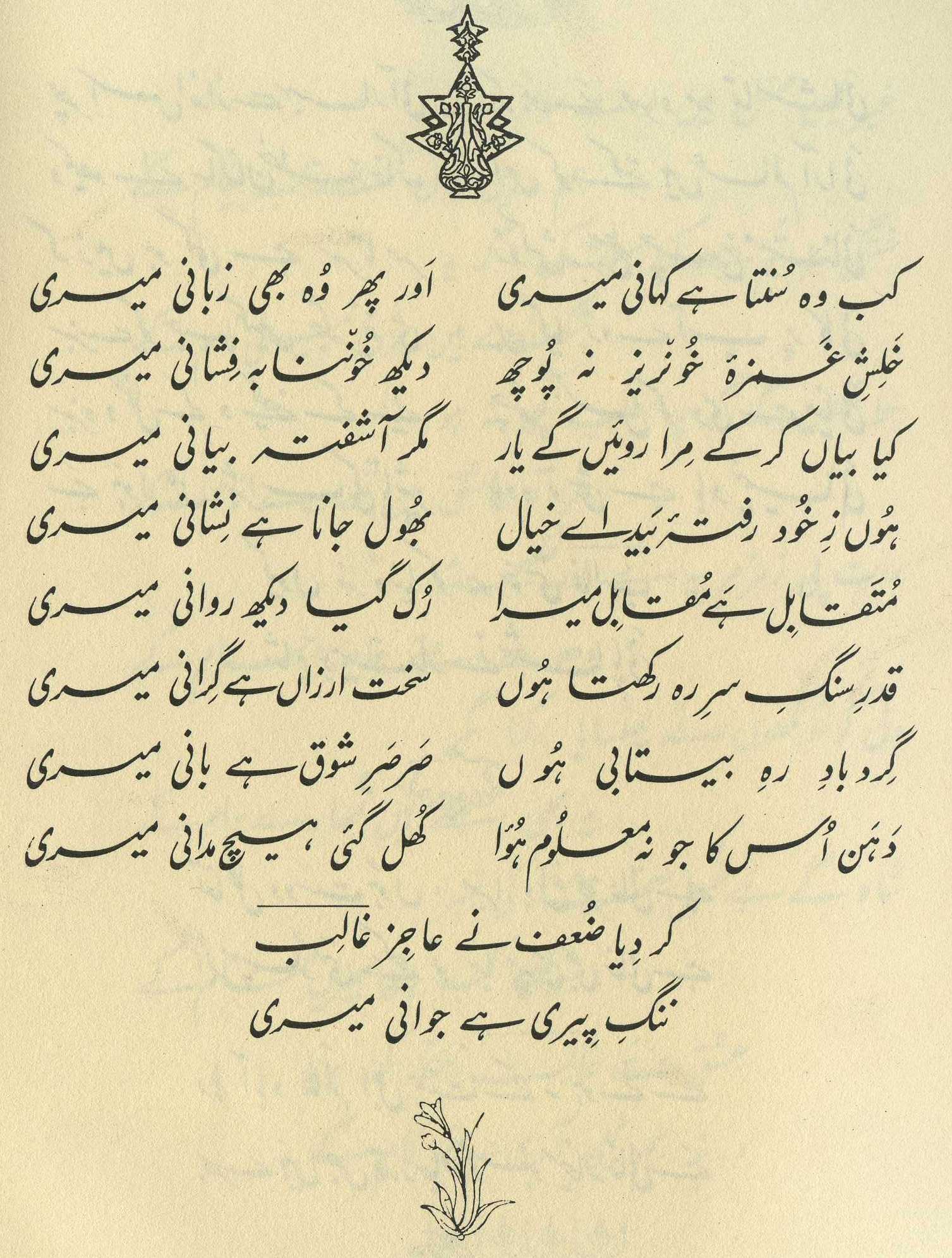
[1866, to Shakir:] Who would't know opposition [] and contradiction []? Light and darkness, joy and grief, comfort and misery, and existence and nonexistence. The word in this line means 'returning-place, refuge, source, goal' []; like ['rival, enemy'], in which the meaning of 'friend' is also comprised. The interpretation of the verse is that we and the friend, through temperament and habit, are opposites of each other. She, seeing the flowingness of my temperament, stopped. (Arshi 304)
==Urdu text: Khaliq Anjum vol. 2, p. 844
==another trans.: Daud Rahbar , p. 275
The meaning of this verse the late author himself has expressed, the gist of which is that by is meant the beloved, who stopped because of his flowingness of temperament-- that is, she became angry. His quickness at repartee and witty anecdotes displeased her, and between flowingness and stopping there is an opposition. In short, the beloved-- my opposite and contradiction-- and I are mutually contradictory. (205)
== Nazm page 205

My is not my , but rather my . That is, he doesn't have the strength to confront [] me. He becomes a . Finally, seeing my flowingness (speech), he is compelled to fall silent. (362)
The complex relationships between oppositeness and resemblance are so strongly established that we run into them every time we do a 'compare-and-contrast' analysis. Here, they're delicately embedded in a kind of dancing mobile of wordplay. To juxtapose two things, to set one of them 'over against' the other, is to prepare them for a demonstration of either similarity or difference-- or usually both.
In English we say, 'So-and-so is my opposite number', meaning someone who has a corresponding position in a different organization. A 'face-off' is a competition. People who resolve to confront each other 'face to face' might be planning a duel; but might also be working to achieve reconciliation and trust. Consider also the excellent neologism 'frenemy'. In Urdu, Ghalib points in his letter to the word , which can mean 'rival' but also 'partner'. He does this to elucidate the word , which has exactly the same dual possibilities (see the definitions above).
So having seen the speaker's movement or ' flowingness ' (which of course is also a literary term), why does the then stop? Here are some possible reasons:
=Because he's the speaker's rival and is intimidated by the speaker's superior (poetic? conversational?) abilities.
=Because he's the speaker's stubborn opposite and is determined to do the opposite of whatever the speaker does.
=Because he resembles the speaker, so he knows that the speaker is speaking just the way he himself would speak.
=Because the two are companions, and he knows that they have to take turns holding the floor, so that when the speaker speaks he falls silent and listens.
=Because she, the beloved, is reacting (positively? negatively?) to the speaker's flow of words.
In short, the wordplay and meaning-play in the first line provides a number of possible explanations that might account for the 'oppositional' behavior in the second line.
The first part of Ghalib's letter seems to be evoking these multiple possibilities, especially through its invocation of the multivalance of . But then suddenly Ghalib shifts his ground, and announces to his correspondent what he calls 'the interpretation'. Does this represent a friendly concession to a questioner who is confused by the verse's complexity? It's impossible to tell.
Pasha Mohamad Khan also points out (Jan. 2006) that the first line is very flowing , while the second one seems to stop. That's an excellent observation. In the first line the long vowels and the smooth velar l-sounds, and the convergence of word boundaries with foot boundaries, all work for a melodious effect. Then the second line immediately stops the movement with-- very appropriately-- ; and then again with . Thus the sound effects cleverly echo, and reinforce, the semantic ones.
Compare Mir's brilliantly subtle meditation on the same idea: M 1185,4 .
graphics/magrittedecalcomania.jpg