Verse 21816arangusht
G13
1
it's enough of a token/memento, your not-giving of a ring
2 a
having shown me, at the time of departure, an empty/unadorned finger
2 b
only/merely/idly having shown me, at the time of departure, a finger
'A mark, sign, token, model; a distinctive mark;... --a token of remembrance, keepsake, memorial, souvenir'.
'A plain ring (of gold, silver, or other metal, worn on a finger or toe)'.
'Empty, vacant, void, desert; hollow, having nothing in it, blank, not filled up, not full; unoccupied, unemployed, free...; --pure, unmingled; mere, only, sole, single, unaccompanied; --adv. Alone, by oneself, singly; --idly, unemployed'.
| References | |
|---|---|
| Arshi, Imtiyaz Ali | Ghazal# 50 |
| Raza, Kalidas Gupta | 171-172 |
| Nuskhah-e-Hamidiyah | 87-88 |
| Asi, Abdul Bari | 97-99 |
| Gyan Chand | 171-173 |
| Hamid Ali Khan | Open Image |
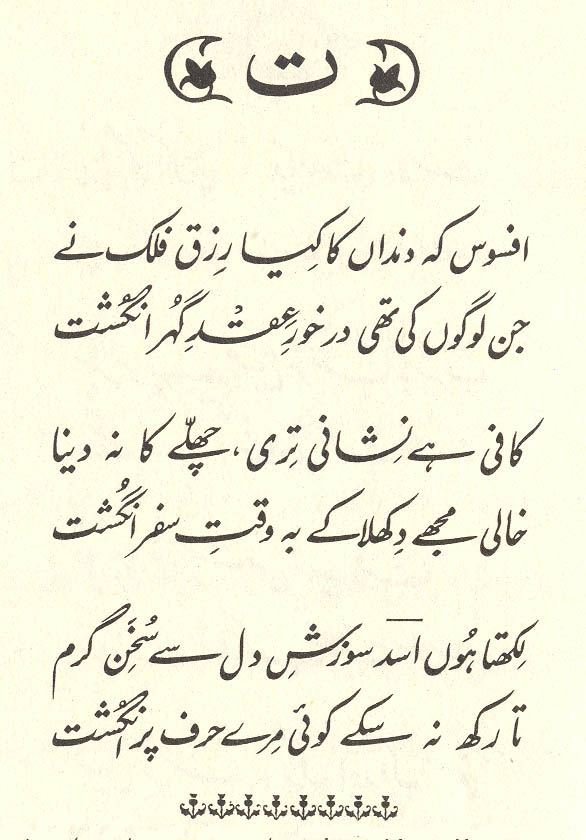
A token is for the purpose of causing its giver to be constantly remembered. Your kind gesture is that at the time of departure, as an excuse for not giving a token, you showed me your little finger: 'Look, even though this is empty, I will never forget. Enough-- this is sufficient for remembering.' Or think of it like this-- that out of mischief she hid the ring and showed an empty finger. (47)
== Nazm page 47

The rule is that at the time of departure, usually a ring is given as a token, to keep memory fresh. Mirza Sahib says, at the time of departure, to keep memory alive, instead of a ring, she showed me an empty finger, and this became, to me, more than the mark of a ring. I will remember this token of her: that she didn't even give me a ring as a token. (90)
Solution 1: At the time of departure, he had asked the beloved for a ring as a token. She showed her empty finger. Mirza says, 'The coquetry of that reply is itself a token that will keep reminding me of you'. In this verse it's also necessarily apparent that the beloved is fond of simplicity; she doesn't wear jewelry.
Number 2: At the time of departure, on being asked for a ring as a token, the beloved showed her thumb [in mockery]. He says that I'll never forget this coquetry of mischievousness. (114)
He says that when you were going on a journey without me, you didn't give me a ring as a token-- rather, when leaving you showed me an empty finger: 'Look, I don't have a ring, otherwise I would certainly have given you a ring'. Oh my friend, this token of yours is enough for me, that you showed me an empty finger. Showing an empty finger gives rise to two ideas: first, that she showed me a thumb [in mockery] out of mischievousness. Of which the meaning is, 'You aren't getting a ring at all, so just get used to it'. The second idea is that I will remember this very thing-- that you didn't give me a token. (148)
In the first line Nazm has , as do Hamid and Bekhud Dihlavi; this feminine reading would make it modify ('it's enough of a token of you-- not giving a ring'). As always, I follow Arshi.
It's an irresistible verse-- either very funny, or very sad, or quite matter-of-fact, or even cheerful. As so often, tone and mood are everything. Baqir summarizes the situation very nicely. Who is the speaker's beloved, and how does he remember her? That's easy-- she's the one who (ostentatiously?) didn't give him a ring when she left. And what was she implicitly saying, as she showed him her empty finger? Look at some of the possibilities:
=You and I don't need rings, our hearts are one already.
=Without you, I'm like a finger without a ring.
=Whenever you see an empty finger, you'll remember me.
=Oh dear, I'm so sorry, I forgot to bring a ring that I could give you!
=You think you'll get a ring from me?!
=I make a gesture of mockery with my finger, as my token to you.
Any or all of the above, of course. Since can be either an adjective ('empty, vacant'), as in (2a), or an adverb ('only, merely, idly') as in (2b), the act can be either the showing of an empty finger, or merely the casual showing of a finger (see the definition above).
For what gives the verse a sense of mystery and depth is the lover's expressing contentment with the empty finger-- it's enough, her not giving him a ring; it's enough of a token of her. So we can imagine the lover's side too, of all the possible interpretations above. Either it's enough because he's so assured of her love, and so satisifed with it-- who needs a ring? Or it's enough because such a non-giving evokes her so perfectly, and what could he want more than that? Or it's enough because at least she took the trouble to notice him and offer him this (ultimately uninterpretable) 'gesture' at the time of parting.
In short, not only do we not know her feelings toward him, we also don't know how he interprets her feelings, and what feelings he himself is expressing as he recalls her emblematic gesture. This kind of radical indeterminacy makes the verse what I call a 'fill-in' one, in which-- even more radically than usual-- we are left to supply and savor our own romantic fantasies (or jealous nightmares).
The beloved not only has a ringless finger-- in 248x,1 , she also has an uninscribed signet-ring. For another kind of paradoxical negative , see 183,4 . And the 'empty finger' also evokes the 'empty glass' of 154,5x .
graphics/khali.jpg