Verse 6x1816arangusht
G13
1
the heat of the tongue is a cause of the burning of the life
2
every candle is, here, entirely/'head to head' a 'finger of testimony'
'Heat, warmth; ... glow; fervour, fervency, ardour; activity, briskness, ... ;—heat of temperament; heat of system, morbid heat; fieriness, vehemence; passion, rage, anger, excitement; attachment, warm affection; sexual passion, lust'.
'The fore-finger (lit. 'the finger of testimony or profession,' — so called because the Mohammadans hold it up when making a profession of faith'.
'Evidence, testimony, witness; martyrdom'.
| References | |
|---|---|
| Arshi, Imtiyaz Ali | Ghazal# 50 |
| Raza, Kalidas Gupta | 171-172 |
| Nuskhah-e-Hamidiyah | 87-88 |
| Asi, Abdul Bari | 97-99 |
| Gyan Chand | 171-173 |
| Hamid Ali Khan | Open Image |
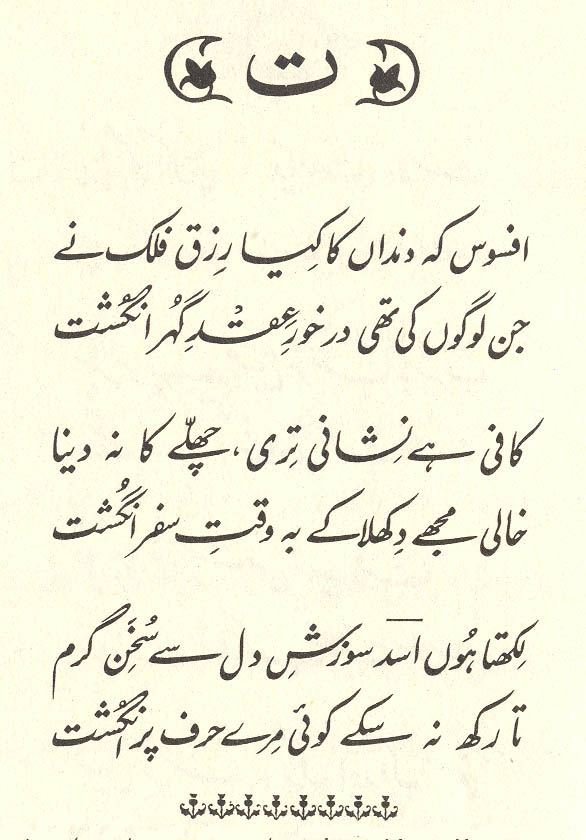
Poets always call the flame of a candle the 'tongue' of the candle. Thus the author says that the heat of the tongue becomes a cause of the burning of the life, and in order to testify to my words the candle is a finger that is constantly giving testimony that undoubtedly the heat of the tongue becomes a cause of the burning of the life. And it's clear that the candle, in the capacity of a tongue, is a hot tongue, and in it is present the burning of the life.
== Asi, p. 98
That is, in my tongue is such disastrous burning that it burns up my life, the way the tongue of a candle is what burns up its life. This is the reason that the candle that was to testify to my condition became entirely a 'finger of testimony'.
== Zamin, p. 141
= sharp, heart-troubling speech. In one verse Ghalib has said: 231,8 .
The flame of a candle is called the 'tongue' of the candle. For there are two meanings: testimony, and martyrdom. Here the first meaning is intended, and through the context there is also a mental suggestion of the second one. By lifting the 'finger of testimony' one points to someone, or testifies to something.
'The heat of conversation is a cause of the burning of life.' The tongue of a candle is obviously hot, since it burns. By lifting a finger the candle is testifying to the truth of this statement. Since the candle has similarity with a finger, it has been established as a 'finger of testimony'. Since through the heat of its tongue it burns down into a puddle, its testimony has been verified.
== Gyan Chand, p. 172
For background see S. R. Faruqi's choices . This verse is NOT one of his choices; I thought it was interesting and have added it myself. For more on Ghalib's unpublished verses, see the discussion in 4,8x .
The obvious foundation of the verse is the excellent, doubly-grounded invocation of the 'finger of testimony'. As usual, Ghalib uses such idioms in as many senses as possible. The candle is a 'finger of testimony' because it has a 'tongue' that testifies and bears witness to its passion; it is also a finger of in the sense of martyrdom (see the definitions above) because its fiery tongue burns out its own life.
That little 'here' could of course mean 'here' in this world, but it could also particularly mean 'here' where the lover is. The lover too has a tongue, and it's a 'hot' one. If from the 'burning of the heart' he composes verses-- for which the usual verb is -- then they too can be 'hot' (as in 50,3 ). But still his hot tongue, like that of the candle, comes at a high price. Edna St. Vincent Millay's candle may even more extravagantly burn at both ends , but even if the lover's candle burns at only one end, the intensity of the flame is such that it can hardly last out the night.
graphics/flame.jpg