Verse 7x1816arangusht
G13
1
when/since in my heart no blood is left, then her
2
every finger writhes, like a fish without water
'To roll or toss about restlessly or uneasily; to flounder, flounce; to be agitated; to flutter, beat, palpitate, throb; to quiver, vibrate, writhe, wriggle; to jump, spring, bound; to be anxiously eager (for), be eagerly desirous, to long (for)'.
| References | |
|---|---|
| Arshi, Imtiyaz Ali | Ghazal# 50 |
| Raza, Kalidas Gupta | 171-172 |
| Nuskhah-e-Hamidiyah | 87-88 |
| Asi, Abdul Bari | 97-99 |
| Gyan Chand | 171-173 |
| Hamid Ali Khan | Open Image |
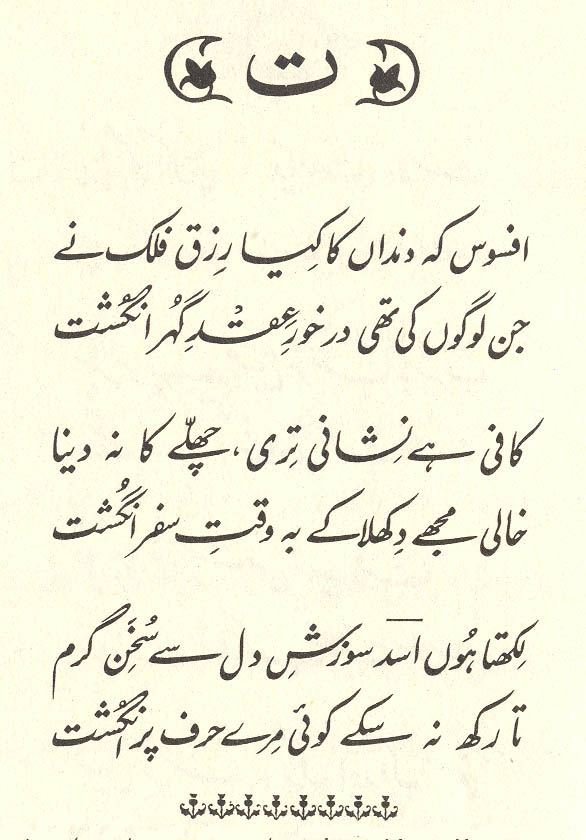
Formerly, the beloved's fingers used to be colored with the blood of my heart; and now, in my heart no blood has remained. For this reason, her fingers writhe like a fish without water. There is another verse of Ghalib's of just the same kind: 57,4 .
== Asi, p. 98
That is, for the murderer's fingers being like a fish without water (to be constantly dancing) the reason is that the blood of the heart has dried up. The convention is that in a state of anxiety and uncertainty, one keeps on twisting the hands, fidgeting with the fingers. He has construed this state as like that of a fish without water, and the drying up of the blood of the heart is from grief and anxiety.
== Zamin, p. 141
The beloved used to wet her fingers in the blood of my heart and give them the color of henna. Now there's no blood left in my heart; for this reason the beloved's every finger is writhing like a fish without water. The blood resembles water; and the finger, a fish.
== Gyan Chand, p. 172
For background see S. R. Faruqi's choices . This verse is NOT one of his choices; I have added it myself, partly because Ghalib chose it for inclusion in Gul-e ra'na (c.1828). For more on Ghalib's unpublished verses, see the discussion in 4,8x .
Asi points to 57,4 , which specifically identifies the lover's heart's blood with the henna the beloved uses to redden her fingers and hands. That's part of it, no doubt, but it can't be the whole story.
For in order to make the 'fish out of water' image work, we have to imagine that the beloved's fingers have constantly been submerged in, bathed in, the blood of the lover's heart. Heart's blood was her fingers' natural medium, and they used to swim in it. Now without it they are left 'writhing' like fish out of water, apparently in their death throes. This seems more serious than just a lack of a red cosmetic color.
Note for grammar fans: The enjambment between the lines isn't exactly gracefully done: 'then her like a fish without water writhes every finger'. The at the end of the first line is left unmoored until the last possible moment. Perhaps this could be considered a way to create suspense?
graphics/fish.jpg