Verse 31816arangusht
G13
1
I write, Asad , from/with the pain/'burning' of the heart, 'hot' poetry
2
so that no one would be able to criticize/'put a finger on' my writing/letter/word
'Burning; inflammation; ardour, fervour; smart, pain; solicitude; vexation; chafing, fretting'.
'Hot, warm; in a state of heat; burning; glowing: fervid; ardent, zealous, fervent; excited; eager, intent on; fiery, choleric, virulent; active, lively, brisk (as a market, &c.)'.
'Nib (of a writing-reed) obliquely cut; a crooked pen; writing obliquely; --a letter of the alphabet; (in Gram.) an indeclinable word, a particle; --a word (so used in lexicons, &c.); --blame, censure, reproach, stigma, animadversion'.
'To blame, censure, criticise'. (Steingass p.114)
| References | |
|---|---|
| Arshi, Imtiyaz Ali | Ghazal# 50 |
| Raza, Kalidas Gupta | 171-172 |
| Nuskhah-e-Hamidiyah | 87-88 |
| Asi, Abdul Bari | 97-99 |
| Gyan Chand | 171-173 |
| Hamid Ali Khan | Open Image |
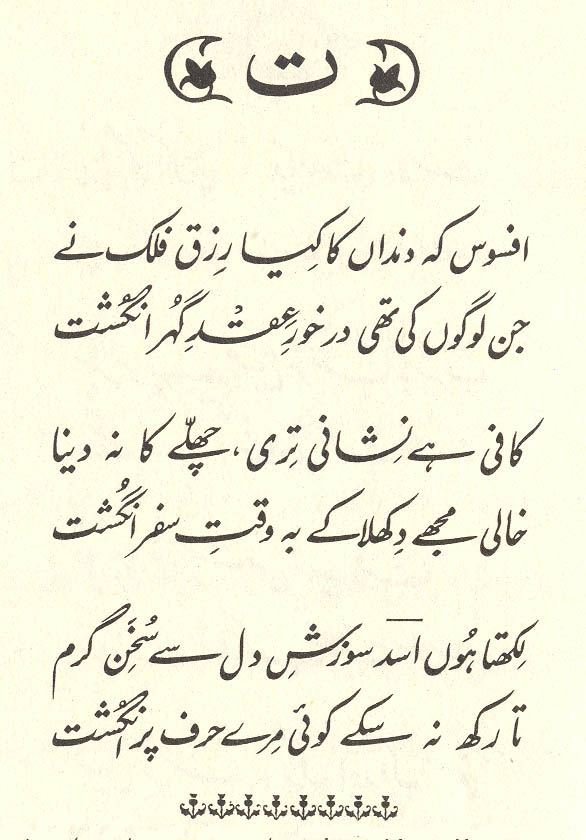
'Heat of poetry' has the meaning of 'excellence of poetry', and 'to put a finger on' has the meaning of 'to point out a flaw'. (47)
== Nazm page 47

He says, 'Oh Asad, I write such delicate and pure verses that in my poetry opponents can't even point out a flaw'. (90)
The verse has become lofty through wordplay . The literal interpretation is that because of the burning of the heart, my poetry is so hot that nobody can even put a finger on it. (148-49)
The objection can be made, that this closing-verse is ostentatious-- thinking of the regularity of the refrain , the author has been forced to replace [the common word for finger] with [the Persianized] , and to ignore the unpleasing effect that this creates on the idiom. (125)
This verse has been written only for the sake of the wordplay . It's nothing special. (403)
The basic idea is so clear, universal, and witty that it comes through very well even in translation. Thanks to Asad's 'burning' heart, his writings, and of courses his verses in particular, are so literally 'hot' in temperature that no one can put a finger on them for fear of being burned; and also so metaphorically 'hot' and brilliant that no one can reproach or criticize them. In English we similarly say 'to lay a finger on', meaning to touch with some (usually harmful) intention, and 'to point a finger at', meaning to reproach or blame.
In the Persian idiom, 'to put a finger of reproach on' [] is to blame or criticize (see the definition above). Ghalib has transcreated this idiom, and as usual has evoked it in both its colloquial and its literal senses. (The counterpart Hindi-side idiom, 'to lift a finger [of blame]' [], doesn't contain the idea of touch, and so wouldn't permit the wordplay with 'heat'.)
Through this evocation, the verse has also become a kind of riff on the beautifully central word -- a term that has a number of meanings, of which the relevant ones include both 'word' and 'blame, reproach' (see the definition above). We are required to read as 'on my words', but the of the original idiom, meaning 'reproach', is also impossible to overlook-- so that the word becomes doubly activated. The result is an amusingly grandiloquent closing-verse .
graphics/hotwords.jpg