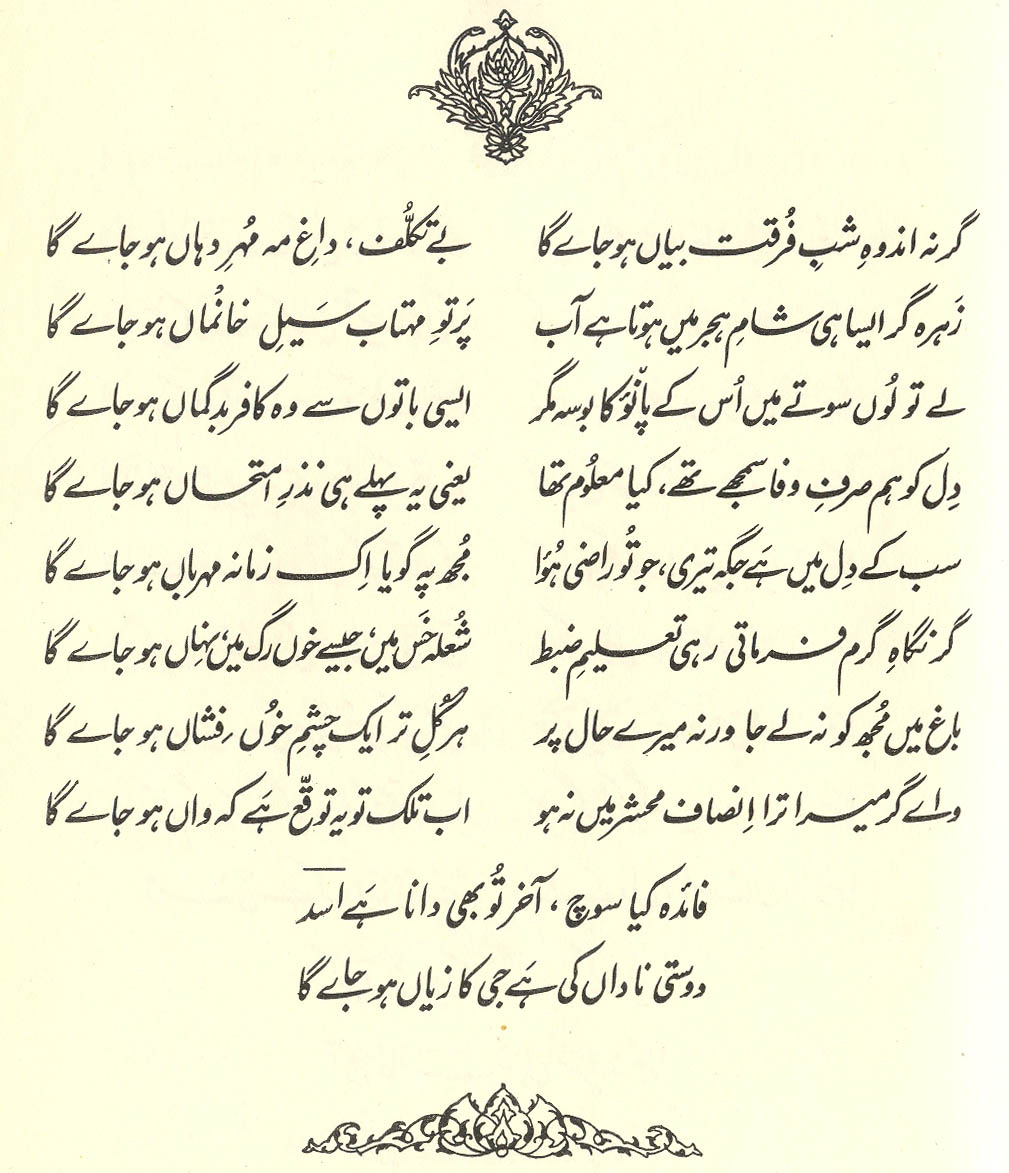
Verse 91816aa;Nho jaa))egaa
G1
1
what gain is there? think! after all, even/also you are wise, Asad
2
it's 'a fool's friendship', it will be a harm/loss to the inner-self'
'Wise, learned;-- a wise man, a sage'.
'Ignorant, unlearned; simple, silly; innocent'.
| References | |
|---|---|
| Arshi, Imtiyaz Ali | Ghazal# 24 |
| Raza, Kalidas Gupta | 155-156 |
| Nuskhah-e-Hamidiyah | 70-71 |
| Gyan Chand | 106 |
| Hamid Ali Khan | Open Image |
It's a proverb, 'A fool's friendship: harm to the inner-self' []. (27)
== Nazm page 27

The pleasure created in this verse is that he wants to deceive his heart and thus turn aside from passion. And this matter is out of th e lover's control, that he would renounce passion in fear for his life. (53)
'A fool's friendship: harm to the inner-self' [] is a famous proverb. (64)
The verse of course is energized by the use of the proverb . The addressee is reminded (by himself or by a companion) that as a wise [] person he ought not to cultivate 'a fool's friendship', and he'll suffer for it if he does.
Since can refer to love as well as friendship, it's also part of the usual prudent advice that is always given to the lover by well-meaning friends. Thus the affinity of 'gain' in the first line and 'loss' in the second-- for a cost-benefit analysis is being urged. The beloved is reckless, unreliable, mischievous, silly, and radically . Nobody with any brains would get involved with somebody like that! So the lover would be foolish to cultivate such 'a fool's friendship'-- the friendship of such a fool.
But of course, can mean not only friendship 'with' a fool, but also the friendship 'of' a fool. A person ought not himself to act like a one, by cultivating such an unsuitable friendship: on this reading, both and are made to apply to the lover. And what a perfect double description it is. The lover in some sense knows better, but does that ever stop him? As we all know, it doesn't even give him pause.
The children's comic below illustrates one such story about 'a fool's friendship': the man in blue has asked his friend the monkey to keep the flies away from him while he takes a nap. The well-meaning monkey sees a fly settle on his friend's nose, and prepares to take action.
graphics/nadandosti.jpg