Verse 41816anme;N
G2
1
{how / to whom} would be expressed, the darkness-diffusing of my bedchamber?!
2
it would be a moonlit night, if I would put cotton in the crevice-work of the walls
'Spreading, scattering, strewing; diffusing; dispensing'.
| References | |
|---|---|
| Arshi, Imtiyaz Ali | Ghazal# 91 |
| Raza, Kalidas Gupta | 209-210 |
| Nuskhah-e-Hamidiyah | 158-159 |
| Asi, Abdul Bari | 166 |
| Gyan Chand | 268-269 |
| Hamid Ali Khan | Open Image |
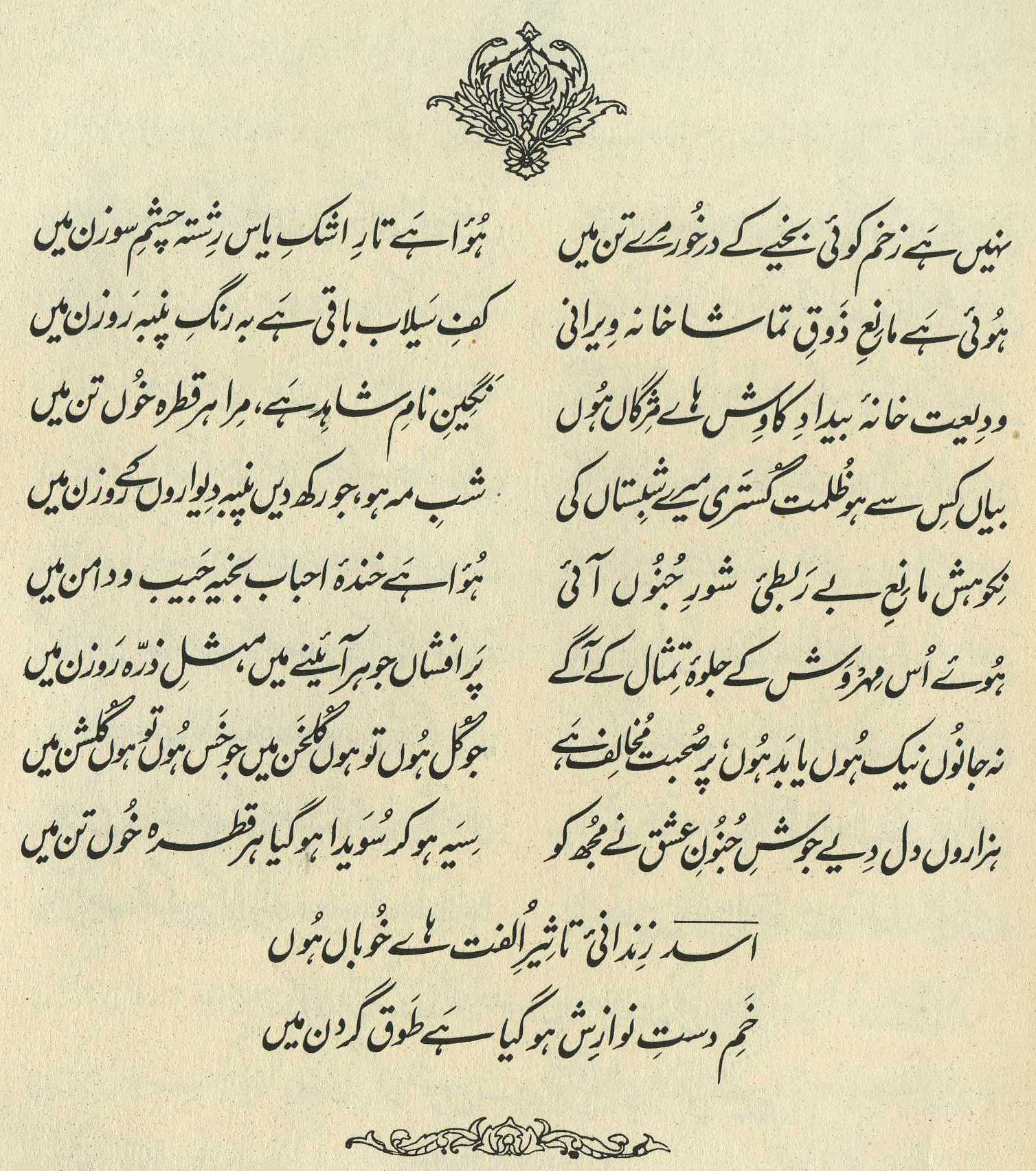
That is, in my black room a bit of cotton would seem to be the moon. (122)
== Nazm page 122

The night of difficulty in my house is so dark that no one can express it. In short, if cotton would be put in the crevice-work, then it would seem that the moon had come out.
The word is worthy of praise. That is, darkness has spread around, has pervaded. Crevice-work is closed with cotton so that light would not come in. The thing through which darkness occurs, here it itself is giving light, and that too, such light-- as if the moon had come out. (229)
Compare 87,4 . (221)
[See also his comments about this verse in conjunction with 87,4 .]
In the verse it's not merely the pervasive darkness in the house that is being mentioned; rather, it's being said that my house is diffusing darkness.... From my house darkness is emerging and keeps spreading all around outside. This outward-spreading darkness is emerging from the crevice-work of my walls. If the crevice-work were closed up with cotton, then the darkness wouldn't spread outward from my house and make the atmosphere outside dark. When the spreading outward of darkness from my house through the crevice-work is stopped, then outside will be the state of a moonlit night. Outside-- not in my bedchamber....
It's clear that in this situation, who can tell from where this darkness is coming? And if anyone would even want to tell, then to whom would he tell it? Who would believe that there can be a fountain of darkness, and darkness too, like light, can emerge from one place and spread for long distances? [The only way to prove it would be by putting cotton into the crevice-work and observing the results.] (170-73)
For more on the nature of 'crevice-work' and the general themes of this verse, see 113,2 (and 64,4 ). For the closest possible parallel verse, see 87,4 . On the use of cotton in crevice-work, see 87,4 .
In his excellent analysis, Naiyar Masud has provided the real key to the verse. The commentators all agree that the verse describes (or suggests, since it's actually indescribable) the darkness within the lover's 'bedchamber'-- which in Urdu is literally, and very appropriately, a 'night-place' []. But only Naiyar Masud takes the necessary further step-- a step not only warranted, but even in fact required, by the phrase 'darkness-diffusing' []. (Consider the definition above; if we don't adopt Naiyar Masud's reading, we have no use for the word .) His analysis is so persuasive, it makes such a rich and enjoyable meaning, that the moment we grasp it, we can't not read the verse through its lens. His reading turns what might otherwise appear (as it does to Nazm and the other commentators) to be a straightforward, rather conventional verse, into a fresh, powerful, vivid, and astonishing one.
He envisions the bedchamber as the opposite of a lamp: as something that actually diffuses darkness beyond its own walls and into the whole outer world. What a chilling, even terrifying vision! Thus we can read 'it would be a moonlit night' literally (as describing the outside world) as well as metaphorically (as describing the speaker's bedchamber). Closing up the crevice-work with cotton would then become a gesture of protection toward the larger world. Although, as Naiyar Masud points out, who would believe it? In view of the science-fiction and/or gothic-horror power of that bedchamber, the inexpressibility trope works brilliantly here.
graphics/moonlitnight.jpg