Verse 11816anme;N
G2
1
there is no wound suitable/fit for stitching up, in my body
2 a
the thread in the eye of the needle has become a string of tears of despair
2 b
the string of tears of despair has become the 'thread' in the eye of a needle
'Stitching; back-stitch; sewing with long stitches, basting, tacking; sewing very thick and strong; quilting'.
'Suitable, proper, fit, becoming'.
| References | |
|---|---|
| Arshi, Imtiyaz Ali | Ghazal# 91 |
| Raza, Kalidas Gupta | 209-210 |
| Nuskhah-e-Hamidiyah | 158-159 |
| Asi, Abdul Bari | 166 |
| Gyan Chand | 268-269 |
| Hamid Ali Khan | Open Image |
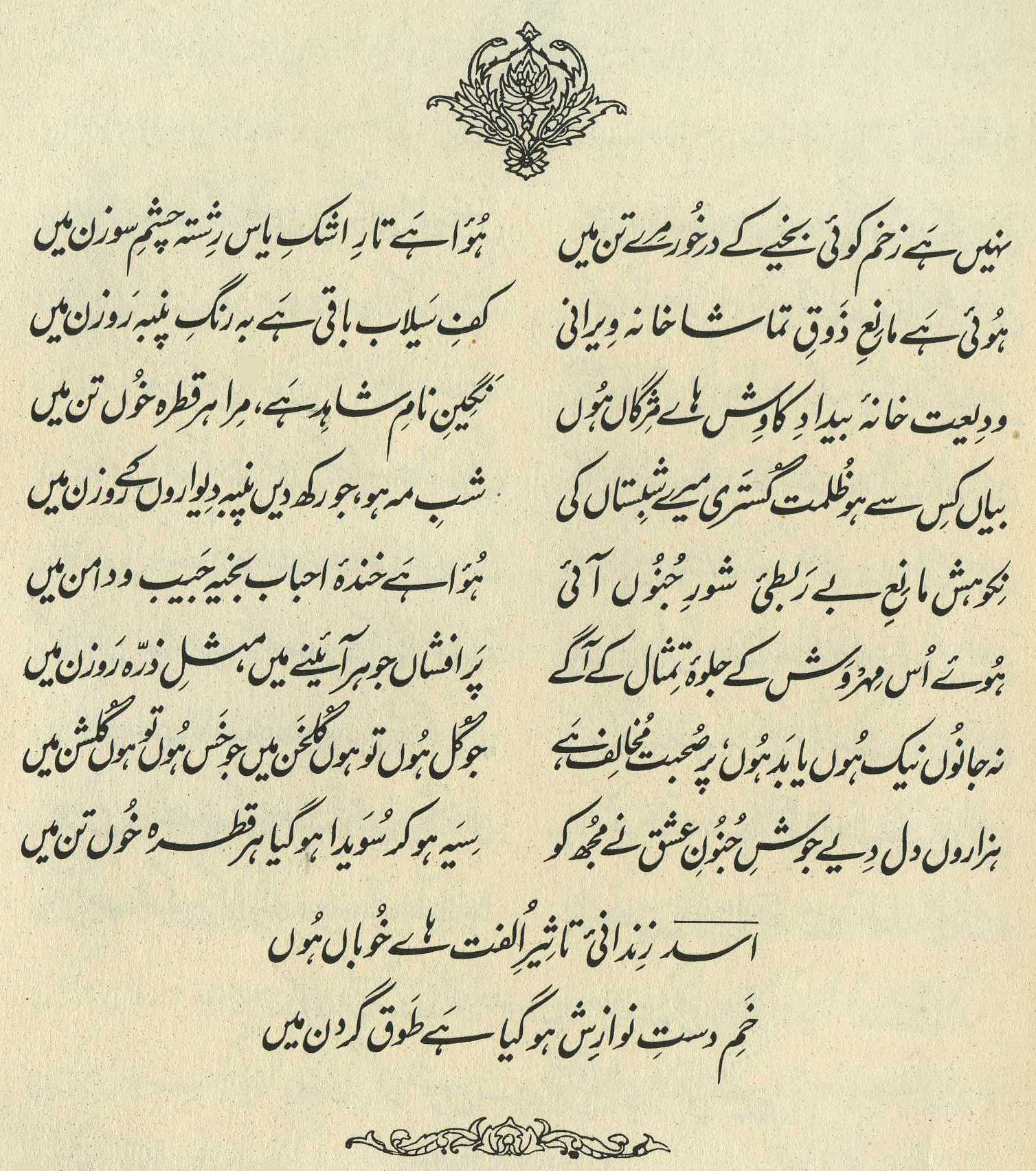
That is, when the needle despaired of the stitching up of the wound, then its thread became the string of tears of despair. (121)
== Nazm page 121

He says, in my body no wound is worth stitching up-- that is, there are such big and deep wounds that a needle can't be used in them. For this reason, the thread in the eye of the needle has, out of despair, become a string of tears. (171)
In my body no wound is such that it can be stitched up. That is, every wound is incurable. This is the reason that the thread that was in the needle became a string of tears of vain longing. That is, even the eye of the needle weeps at my situation. That is, the helper wanted to to stitch up the wound, but seeing that the wounds were incurable, he gave up. (227)
It's pretty startling and evocative wordplay, isn't it? The speaker's wounds are so deep, so incurable, so un-close-uppable, that from the 'eye' of the needle flows a long 'string' of tears, expressing both its sympathy with his pain, and its sorrow at its own inability to be of any help.
Thus far (2a), which the commentators insist upon. But thanks to the 'symmetry' built into Urdu grammar, also quite possible is (2b). None of the lover's wounds needs stitching up any more, because he's already used his endless 'string' of tears to thread the 'eye' of a needle, and has thus been able, after his own preferred fashion, to attend to them. Between the sting of the tears and the burning [] and piercing of the needle [], the lover has made sure that the wounds are in exactly the state they should be in.
Which means either that they're no longer fit for being stitched up because he's already given himself over to 'despair', and thus has so hopelessly deepened and irritated them; or else that they're no longer in need of being stitched up, since in his madness he's already 'fixed them' to his (fatal) satisfac tion, with stitches made from tears of 'despair'. In short, a 'thread' made from tears of despair is all the stitching-up they'll ever get (or will ever need?).
Compare 111,11 , in which the rips in the lover's torn collar are 'stitched up' by his suppressed, but constantly recurring, sighs.
graphics/sewing.jpg