Verse 21816ilpasand aayaa
G2
1
thanks to dejection/'heart-lessness', eternal hopelessness is easy
2
'Opening' found our difficult knot pleasing
'Heartlessness [i.e., being disheartened], dejection; dissatisfaction, discontent'.
'Dissatisfied, displeased; heartless, dispirited, dejected, sad'.
'Opening, loosening, solving, breaking (a fast); expansion, enlargement; ...clearness, serenity, cheerfulness'.
| References | |
|---|---|
| Arshi, Imtiyaz Ali | Ghazal# 3 |
| Raza, Kalidas Gupta | 141 |
| Nuskhah-e-Hamidiyah | 28 |
| Asi, Abdul Bari | 50-51 |
| Gyan Chand | 63-64 |
| Hamid Ali Khan | Open Image |
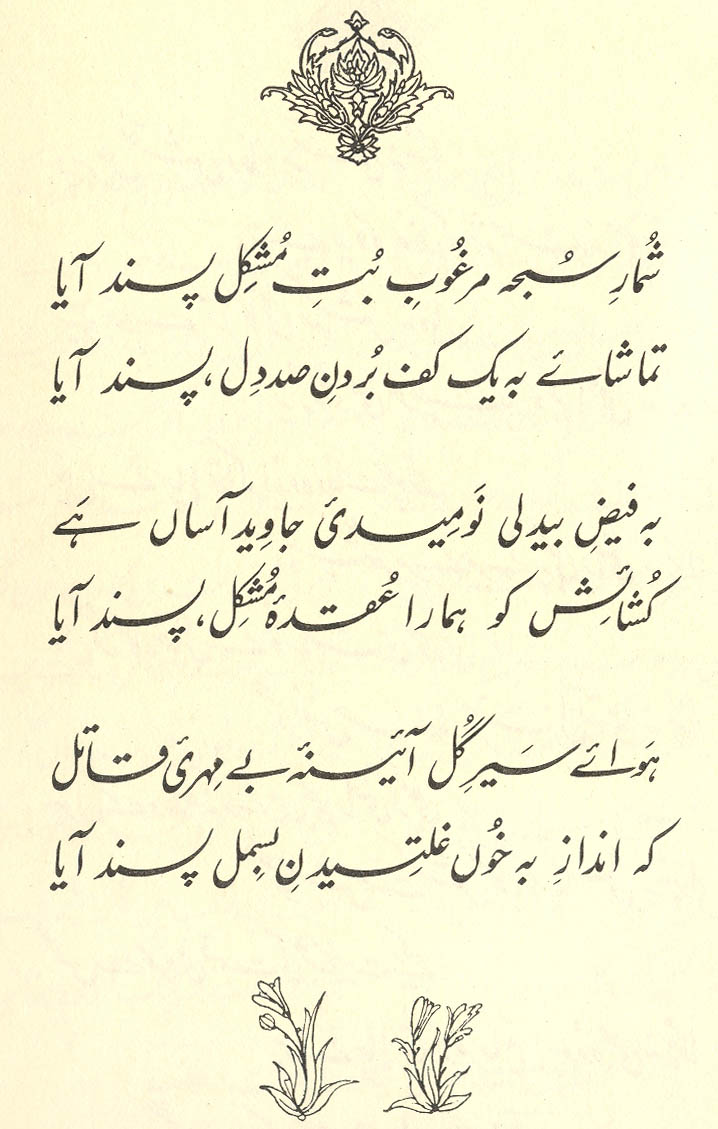
That is, thanks to the distaste and disaffection that I feel toward the world, it's easy for me to endure the shock of hopelessness and despair .... Now it [=our difficult knot] will never be opened, because Opening is pleased that it should remain knotted-- pleased because we don't care, and why wouldn't such indifference be pleasing to Opening? (9)
== Nazm page 9

Urdu text: Vajid 1902 {8}
Here also is used to mean . Mirza Sahib says, only thanks to hopelessness has perpetual failure become easy .... In the second line the meaning has been expressed that our difficult knot has become pleasing to Opening. The rule is that when something suits someone's temperament, and pleases him, then he tries to keep it established, and as much as possible busies himself in protecting it. When Opening became pleased by our difficult knot, why would he allow it to open? (20)
The result is that the mood [] of peace that we had obtained thanks to hopelessness, then came to an end. And Opening, in its attempt to solve our difficult knot, gathered material for more difficulties. (15)
ABOUT : The awkward hyphen in 'heart-lessness' is there to try to block the usual modern English meaning of cruelty and coldness. (But to Platts, 'heartlessness' apparently meant having no 'heart' in the sense of courage or spirit, or else having a 'dissatisfied, displeased' heart; see the definitions above.) In the ghazal world, this state of is a Sufistic one of literally possessing no heart, because one has lost it, given it away, dissolved it into blood, or the like. (The complexities are somewhat like those of , 'self-lessness'; on this see 21,6 .) In addition, Ghalib often uses to create wordplay on the pen-name of his early hero and role model, the Indo-Persian poet Bedil ; for discussion see 8,5x . For an unusually complex example of the resulting possibilities, with thorough discussion, see 423x,5 .
ABOUT KNOTS: Knots make for fine Persian metaphors: for example, one section of Jami's famous 'Yusuf and Zulaikha' is entitled 'The Knotting with Perplexity of the Rope of Anxiety of her Maids from their seeing the Change in the Condition of Zuleikha, and the unloosing by her Nurse with the Point of the Finger of Enquiry of the Knots of that Rope' ( 194,5 ). More often, the lover's heart itself is imagined to be a knot-- one that is 'disordered, entangled' [], and is to be opened (or not) by the 'fingernails' of whatever abstraction suits the poet. Other 'knot' verses: 13,6 *; 29,5x ; 30,3 ; 48,3 ; 105,4x ; 128,2x ; 190, 11x ; 214,4 ; 222,4x ; 230,12x , // 253x,6 , the 'fingernails' of a sword; 257x,5 ; 292x,7 ; 297x,1 ; 308x,1 ; 317x,1 ; 318x,4 ; 350x,2 ; 377x,6 , the 'knot' of the beloved's sash; 421x,3 , the 'fingernails of a sword.
To personify 'Opening' must be pretty close to the height of abstraction; Ghalib is fond of such madly metaphysical personifications . This verse also reminds me of the extremely abstract 157,5 . The question is not how hard we have to work to 'get' the verse, but whether what we then 'get' is sufficiently rewarding. This verse always exasperates me a bit because the game doesn't seem worth the candle.
And how are the two lines related to each other? The usual Persian/Urdu image, parallel to the English metaphor of 'unravelling' a 'knotty' problem, is that one 'loosens the knot' of the problem with the 'fingernails of thought'. Here, the heart is gone entirely, so there is no 'knot' to open at all: the pain of perpetual hopelessness is no great problem if there is no one around to experience it.
'Opening' was pleased by the lover's 'difficult knot'-- perhaps it was intrigued because no 'opening' was even required, since the knot solved the problem itself by vanishing. Or perhaps 'Opening' did in fact struggle with the knot, and succeeded in opening it only by dint of wearing it away into nothingness. After all, this is exactly what happens in 48,3 .
graphics/difficultknot.jpg