Verse 6x1816ilpasand aayaa
G2
1
to the one who attained awareness of the springtime of the interval/leisure of existence
2
in the style of the tulip, a glass of wine [while] on/in the camel-litter was pleasing
'A time, opportunity, occasion; freedom (from), leisure; convenience; relief, recovery; respite, reprieve; rest, ease'.
'On, upon, up, above; at; in, into; with'.
'That by which anything is supported, that in (or on) which anything is borne; that which carries the double load of a camel, a camel's saddle; a camel litter or dorser (in which women travel)'.
| References | |
|---|---|
| Arshi, Imtiyaz Ali | Ghazal# 3 |
| Raza, Kalidas Gupta | 141 |
| Nuskhah-e-Hamidiyah | 28 |
| Asi, Abdul Bari | 50-51 |
| Gyan Chand | 63-64 |
| Hamid Ali Khan | Open Image |
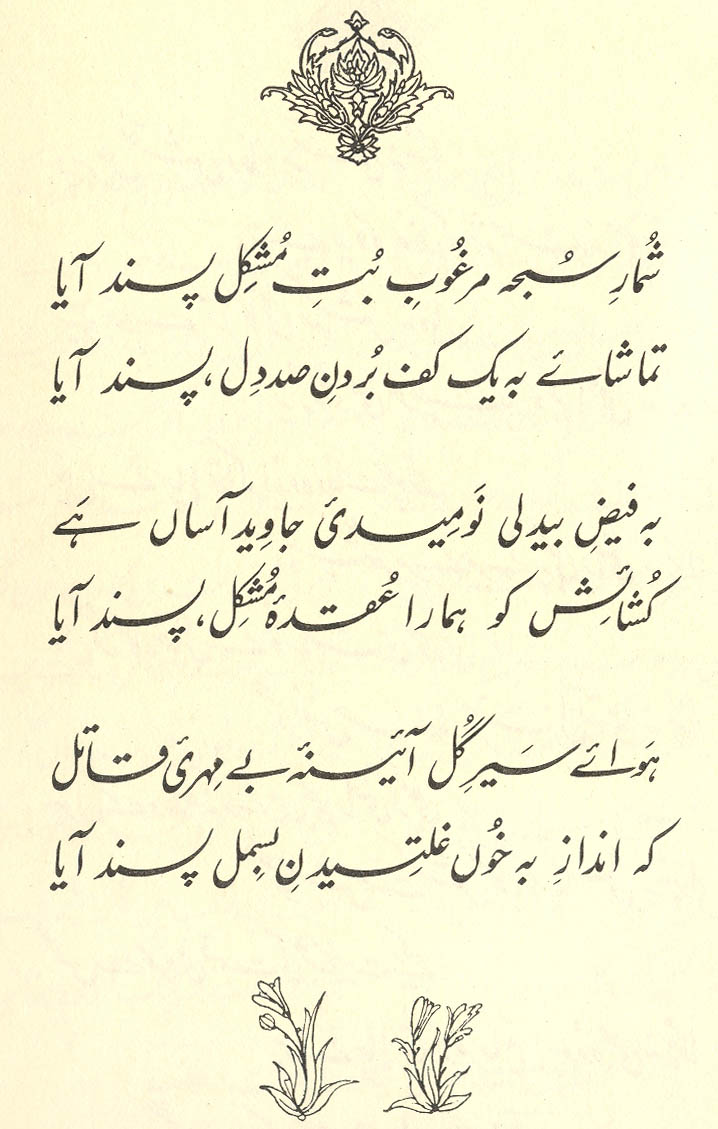
The one who became acquainted with the springtime of life-- that is, who understood how much stability there is in life-- finished off the enjoyments of the world in a state of preparation for travel. As does the tulip, who drinks up a glass of wine beside the camel-litter. For the tulip, he has given the simile of a glass of wine; and for the branch, the metaphor of a camel-litter. For the tulip to drink a glass of wine beside the camel-litter is an extremely rare/supreme theme and idea.
== Asi, p. 50
He says that the one who has formed an estimate of the brief interval of the duration of life-- even if he enjoys the delights and luxuries of life, then he does it with one foot in the stirrup, like the tulip. For the tulip sits in the camel-litter (branch) prepared to travel, with a glass of wine in hand. The meaning is that in delight and luxury it never at all becomes dull/inattentive, but rather always keeps in mind what is to come.
== Zamin, p. 27
The traveler is on the point of leaving; thus he eats and drinks while in the camel-litter itself. The tulip flower has an extremely short life. For a tulip the similes are a glass, and also a camel-litter. It is, so to speak, drinking a glass while in the midst of a journey.
== Gyan Chand, p. 64
For background see S. R. Faruqi's choices . This verse is NOT one of Faruqi's choices, but I'm now adding it anyway because I find it interesting. For more on Ghalib's unpublished verses, see the discussion in 4,8x .
Textually, I basically always follow Arshi, and also rely on Raza who himself usually follows Arshi. Both Arshi and Raza have, in the second line, , which yields a really unsatisfactory reading. The manuscript evidence is divided between and . All three commentators go with , which is much more satisfactory. In this one case, I am going with them.
On the nature of a , with illustrations, see 147,7x .
Gyan Chand makes the crucial connection: that the tulip has the shape-- and therefore the likeness, and the simile (which here is also a kind of metaphor )-- of both a wine-glass and one kind of camel-litter. This is a piquant and unusual situation: two separate similes/metaphors/images for the same object in the same line, both elegantly integrated into a vision of the brevity of life.
The person who has understood the briefness of life contents himself with downing a (tulip-shaped) glass of (tulip-colored) wine beside, or even in, his (perhaps roughly tulip-shaped, see 147,7x ) camel-litter. Like the tulip itself, he understands how soon he'll be moving on. And more to the point, he accepts his fate-- the hasty glass of wine even 'pleased him'; perhaps he felt fortunate to have time for the glass of wine at all. Does this attitude represent defiant courage in the face of death, or Sufistic transcendence? Ghalib has, as usual, left us to decide for ourselves.
graphics/camelrider.jpg