Verse 11816ilpasand aayaa
G2
1
the counting of the prayer-beads was agreeable to the difficulty-loving idol
2
the spectacle of the holding of a hundred hearts in one hand pleased her
'Desired; —desirable; agreeable; amiable; lovely, beautiful; estimable, excellent'.
'Walking abroad for recreation; entertainment, exhibition, show, sight, spectacle; sport, amusement, pleasure, fun, jest, joke; anything strange or curious'.
| References | |
|---|---|
| Arshi, Imtiyaz Ali | Ghazal# 3 |
| Raza, Kalidas Gupta | 141 |
| Nuskhah-e-Hamidiyah | 28 |
| Asi, Abdul Bari | 50-51 |
| Gyan Chand | 63-64 |
| Hamid Ali Khan | Open Image |
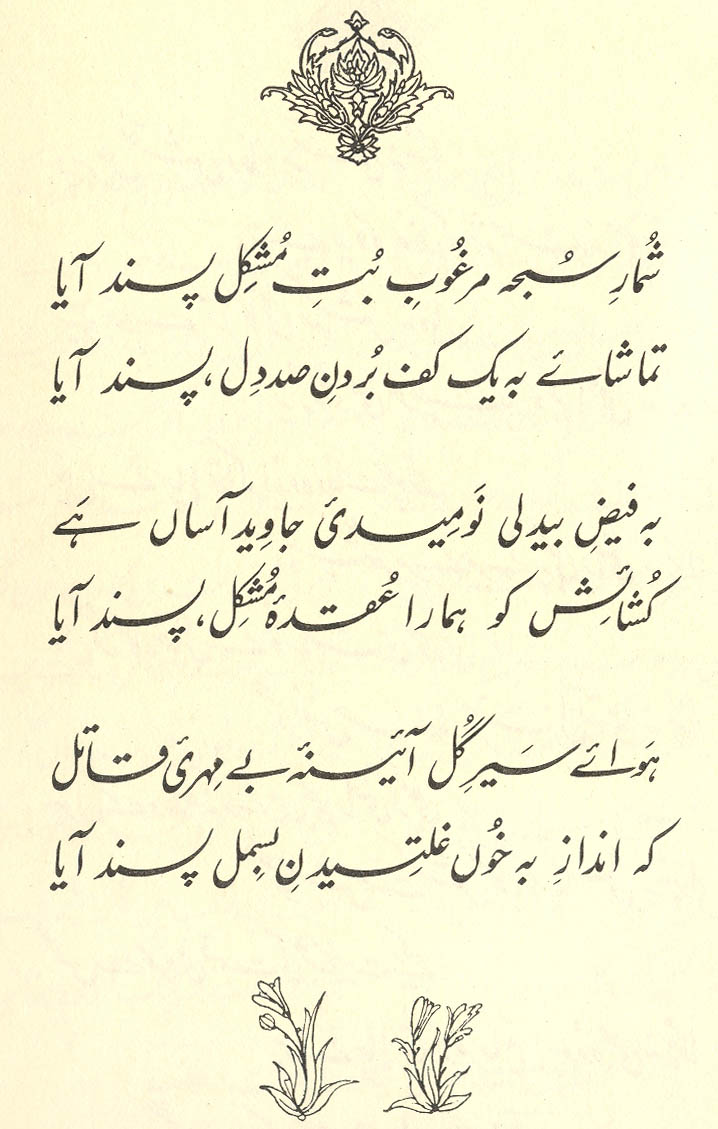
Her taking a hundred lovers' hearts in one hand at one time pleases her. Then, the poet has also made of those hundred hearts a set of prayer-beads, and he says it's as if she finds the counting of the prayer beads very pleasing. (8)
== Nazm page 8 ; Nazm page 9


Urdu text: Vajid 1902 {8}
This entire ghazal is from that period when the color of Persianness [] was prevailing [] over Mirza Sahib. Except for the refrain , whole lines are in Persian. So much so that the first line of the opening-verse too contains a Persian aspect in the refrain. That is, among the people of Iran is idiomatic []. But with regard to the meaning, this is such an untouched theme that up to today no poet's thought has touched it. (19-20)
Because in prayer-beads there are one hundred beads, in the act of reciting prayers with them, the act of holding a hundred hearts in one hand occurs. Because a difficult feat has taken place, the activity pleases the difficulty-loving beloved. (15)
Compare 136,4 . (255)
ABOUT : This word is one of Ghalib's real favorites. As Faruqi points out in 51,4 , it has both a this-worldly meaning (the spectacle of the world's beauty, variety, change, inexhaustibility) and a mystical meaning ('a scene of mystical knowledge that is visible only to the eye of the heart, and that can be seen only by closing or rejecting the eye of the senses'). In Persian, it's also a normal way of saying 'to see'; because of Ghalib's very Persianized vocabulary (as also in the non-colloquial usage ), it's hard to know in some cases how much weight should be put on the word.
Compare the prayer-beads in 10,2 , which gives another slant on them; they are cleverly evoked in 60,8 as well.
Here's an excellent example of an 'A,B' verse. The two lines are, grammatically and semantically, entirely independent. Do they both refer to the same situation? Do they refer to two different situations-- and if so, are these being likened to each other, or contrasted? And if one line is taken as primary, and the other as a mere commentary on it, which one is primary? Are the prayer-beads that the beloved holds in her hand metaphorically equated with lovers' hearts (as her mind wanders during her prayers), or are the lovers' hearts that she holds in her hand metaphorically equated with prayer-beads (as they are lined up and reminiscently fingered)? Of course, there's no way to tell, and we're left to make our own choices.
Here the first, worldly sense of is dominant, but the second can't be ruled out either, since after all it's 'prayer-beads' that the demanding, intransigent 'idol' is counting.
Note for grammar fans: As Bekhud Dihlavi observes, is a direct translation from Persian; it doesn't sound idiomatic in Urdu. Compare the use of in 10,3 .
Note for meter fans: Does the first line represent a case of ' contrived rhyme '? Not exactly, but still, since is treated as a single adjective, there's an unusual relationship that blurs the normal barrier between rhyme and refrain .
graphics/hearts.jpg