Verse 6after 1826aakyaa
G7
1
the breath is a wave of a sea of self-lessness
2 a
what complaint is there of the negligences of the Cupbearer ?
2 b
as if there's a complaint of the negligences of the Cupbearer !
2 c
what a complaint there is of the negligences of the Cupbearer !
t>> : 'Surrounding, encompassing, enclosing, encircling, circumambient; containing, embracing, comprehending; knowing, well acquainted (with); --that which (or he who) surrounds, or contains, &c.; periphery, circumference (of a circle); the ocean; --one who comprehends or knows'.
'The being beside one's self, alienation of mind, ecstasy, transport, rapture; senselessness, insensibility, stupefaction, delirium'.
is spelled to harmonize with the rhyme .
| References | |
|---|---|
| Arshi, Imtiyaz Ali | Ghazal# 38 |
| Raza, Kalidas Gupta | 369-370 |
| Hamid Ali Khan | Open Image |
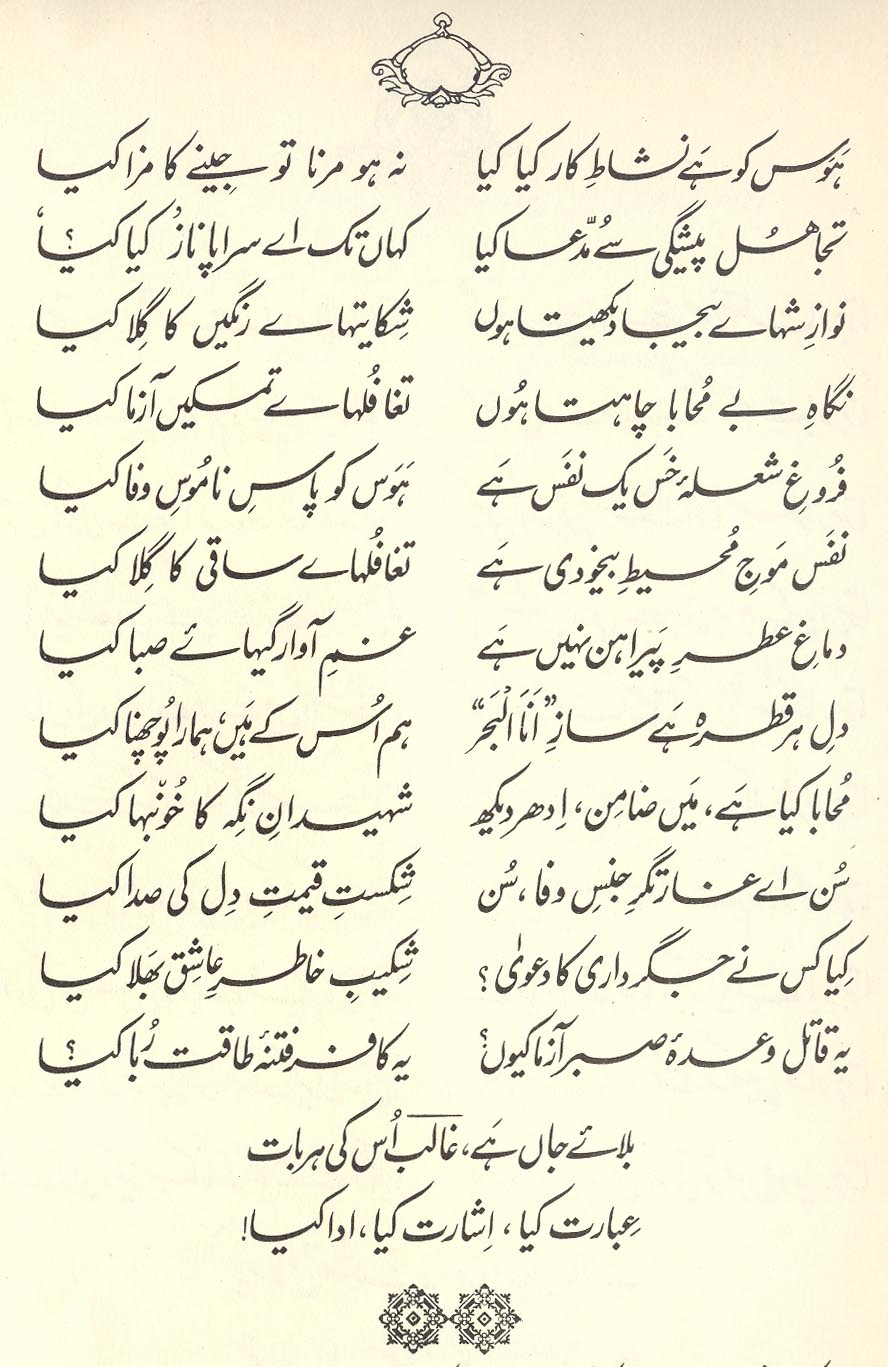
The one who sees his [=the Cupbearer's] face and enters a state of self-lessness-- if the Cupbearer doesn't give him wine, then why should there be any complaint? (22)
== Nazm page 22

Another meaning of this verse also arises, that we are intoxicated in a [mystical] state. Why should we fret over worldly existence or nonexistence? (45)
Our heart is in such a state that a self-lessness constantly affects us. Now who would complain of the beloved's negligence? We are not there within ourself....
We are intoxicated with ardor for, or with the mere thought of, the Cupbearer. What need do we have of wine? (53)
ABOUT : I have hyphenated 'self-lessness' to try to break the grip of 'selflessness' in the usual English sense of 'extreme unselfishness'. Rather, in the ghazal world means a state of being outside or beyond oneself: self-transcendence, transport, entrancedness, etc. (see the definition above). 'Bekhud' was a popular pen-name , as witness the two 'Bekhuds' whose comments appear above. A similar situation exists with , which is not 'heartlessness' in the English sense; on this see 8,2 .
This is another verse on the lines of 21,3 , with the same grammar in the second line and even the same rhyme -word. The various interpretive possibilities of are used to form a kind of penumbra around the plain (?) statement in the first line; see 21,1 for more on this.
What complaint is there against the Cupbearer for 'negligences'? asks (2a). No complaint at all! -- (2b) indignantly asserts. Why not?
=Perhaps because it's not necessary for the Cupbearer to do his job, since the lover is already utterly intoxicated with mystical awareness and is far beyond the point of caring about wine.
=Perhaps because the Cupbearer has already done his job, as Nazm says: the sight of his beauty, or even the thought of it (as Bekhud Mohani suggests), has already intoxicated the lover more than sufficiently.
=Perhaps because the 'breath' is not available for speech at all, since it's absorbed in the sea of self-lessness, so no complaint can be uttered in any case.
Or, alternatively-- yes there is a complaint, as (2c) maintains. Perhaps the Cupbearer's negligences have caused the drinker to lapse into mystical indifference, and have thus dampened the liveliness of the party. Or perhaps the drinker is in such a state that a bit more wine would beautifully finish him off-- another sip would push him into supreme intoxication, such that he could become the 'sea of self-lessness' itself and not just a wave; and/or another sip would kill him entirely, so that he would never need to return to the second-rate 'wine-house' of this world at all. (Remember 21,4 .)
Another pleasure of the verse is in the extraordinary image of the first line-- the breath as a wave in a sea of self-lessness. It sounds both soothing and revelatory, almost like mystical death in the high Sufi mode. It also evokes 11,1 .
graphics/oceanwave.jpg