Verse 8after 1826aadnahii;N
G5
In this meter the first long syllable may be replaced by a short; and the next-to-last long syllable may be replaced by two shorts.
1
from negation, affirmation exudes, speaking /'so to speak'
2
{[He] has given her / she has been given} in the place of a mouth, at the moment of creation, 'No'
'Forbidding, prohibiting; prohibition; —denying, disowning, disavowing; denial; —negation'.
'Establishing, confirming; confirmation, corroboration, verification, proof, demonstration; ascertainment; certain knowledge'.
'Dripping, sprinkling, sprinkle; trickle; oozing; distillation, exudation'.
| References | |
|---|---|
| Arshi, Imtiyaz Ali | Ghazal# 104 |
| Raza, Kalidas Gupta | 371-72 |
| Hamid Ali Khan | Open Image |
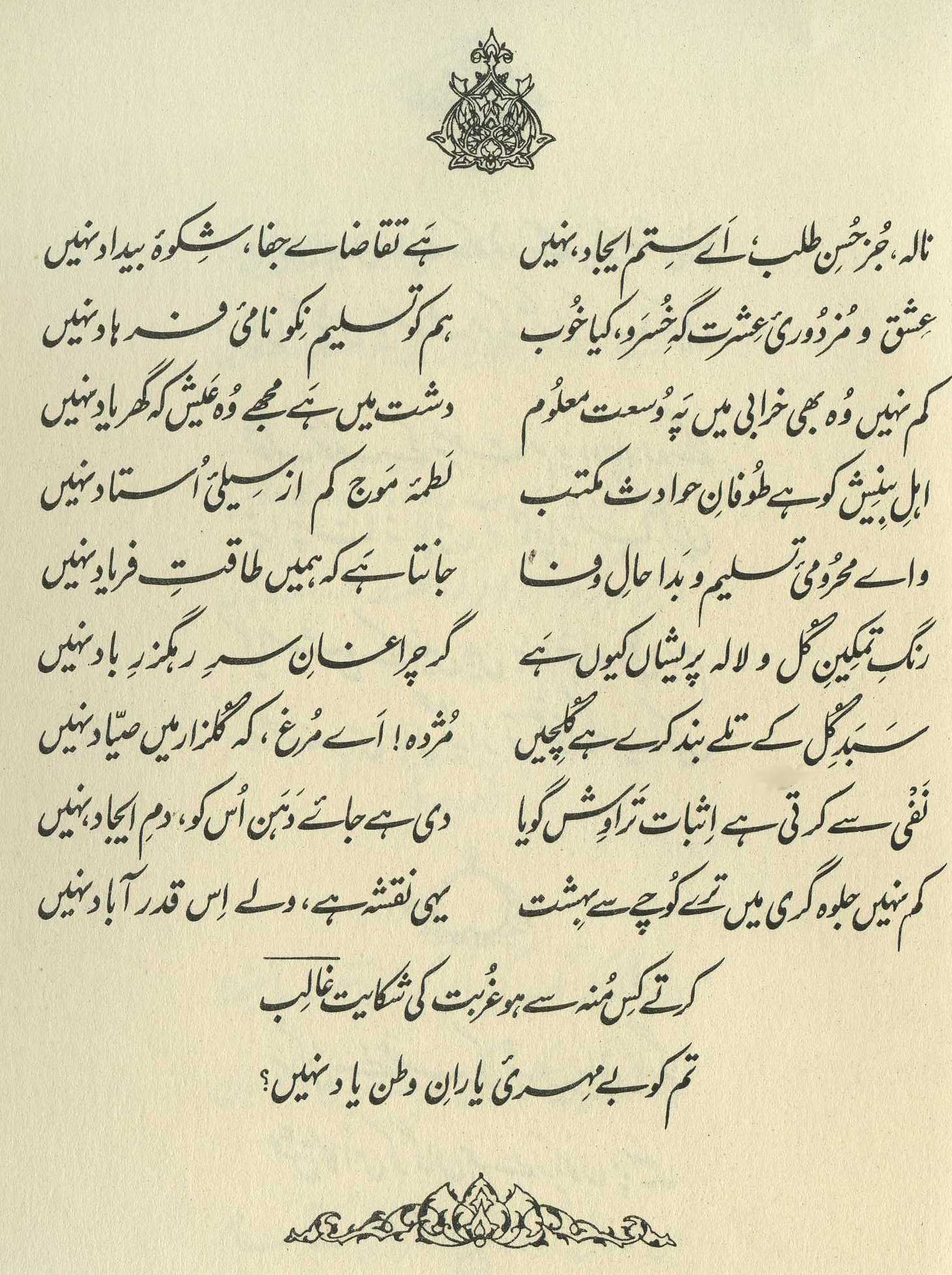
That is, if her mouth is present, it's only out of necessity, it's only in the imagination. Otherwise, externally, she has been given, in place of a mouth, 'No'. The word the author has here used as feminine [contrary to the usage of Mir]. The author himself used it as masculine in 131,6 . Here the nearness of [the feminine noun] has deceived him. Those people who like must find much pleasure from the word . But this word has become trite. (107)
== Nazm page 107

He says, it's as if [] from 'no' there drips 'yes' (that is, here the intent of the word 'negation' is 'no' and by 'affirmation' is meant 'yes'). 'Yes' [] is feminine, thus Mirza Sahib used 'affirmation' too as feminine. Here, the meaning of is 'to be manifest'.... Poets always treat the beloved's mouth as nonexistent. And on the day of creation instead of [] a mouth, the word 'no' was bestowed on the beloved. That is, to everything the beloved says 'no', and from saying 'no' there is proof of her having a mouth. (159)
To everything the beloved replies 'no'. From this it can be known that she has a mouth. If she didn't say 'no', nobody would know at all that she had a mouth. So to speak [], from 'no' emerges 'yes'. That is, it's learned that it has been present since creation. The Lord has given her 'no' in place of [] a mouth. (209)
Among other things, the word order may be a bit confusing in this one, so here's the prose order: .
We know that the beloved has no mouth; for further discussion of this fascinating piece of ghazal physiology, see 91,4 . This verse plays on that basic truth with exceptional complexity. Consider the paradoxical thrust of the first line: from negation, affirmation exudes. The line's wild abstractness is energized by the weird idea of affirmation/proof as something that can 'drip' or 'ooze' (see the definition above). It's impossible to figure this out until we know the second line (which of course, under mushairah performance conditions, would be only after a tantalizing delay). Even when we do hear the second line, it's not easy to put the whole thing together. Here are two wonderfully contradictory possibilities:
=She denies/negates everything; that affirms/proves that she has 'No' instead of a mouth.
=She says 'No' to everything; that affirms/proves that she has (some kind of) a mouth.
Moreover, there's lovely wordplay. Despite Nazm's snide remark, the classic double meaning of -- both 'speaking' and 'so to speak, as if'-- has surely never been used to better advantage; for more on this, see 5,1 . The word is also amusing: we can well imagine that something can drip, exude, etc. from a mouth. And if that something is as abstract as 'affirmation/proof', the effect is still more piquant. (Compare the even more extreme 17,2 , in which 'desertness' is what drips.)
There's also the small clever pleasure of -- literally, 'in the place of'-- where we would expect the usual , 'instead of'. The beloved doesn't just have 'no' instead of a mouth in some abstract sense, she literally has a 'no' on her face in the place where a mouth would be. And the 'no' issues itself forth as a (constantly repeated) word, so doesn't that mean the 'no' acts as a kind of mouth? There's an extra degree of realness here-- our imaginations are pushed closer to somehow envisioning her ravishing little face, with its rosy cheeks and that blank space of the nonexistent mouth between them, which of course isn't really empty because it contains 'no' where the mouth would be.
Abstractness, multivalence, wordplay, humor-- all in very high degrees, all mixed into a creative, spicy stew (and not blended into a vague porridge). What more can two small lines of poetry offer?
Note for grammar fans: the second line can be read as having either a perfect participle, 'is in a state of having been given' [], as Bekhud Dihlavi reads it; or a construction with subject omitted '[the Lord has given' [], as Bekhud Mohani reads it; in this verse it doesn't seem to make much difference.
graphics/no2.jpg