Verse 10after 1826aadnahii;N
G5
In this meter the first long syllable may be replaced by a short; and the next-to-last long syllable may be replaced by two shorts.
1
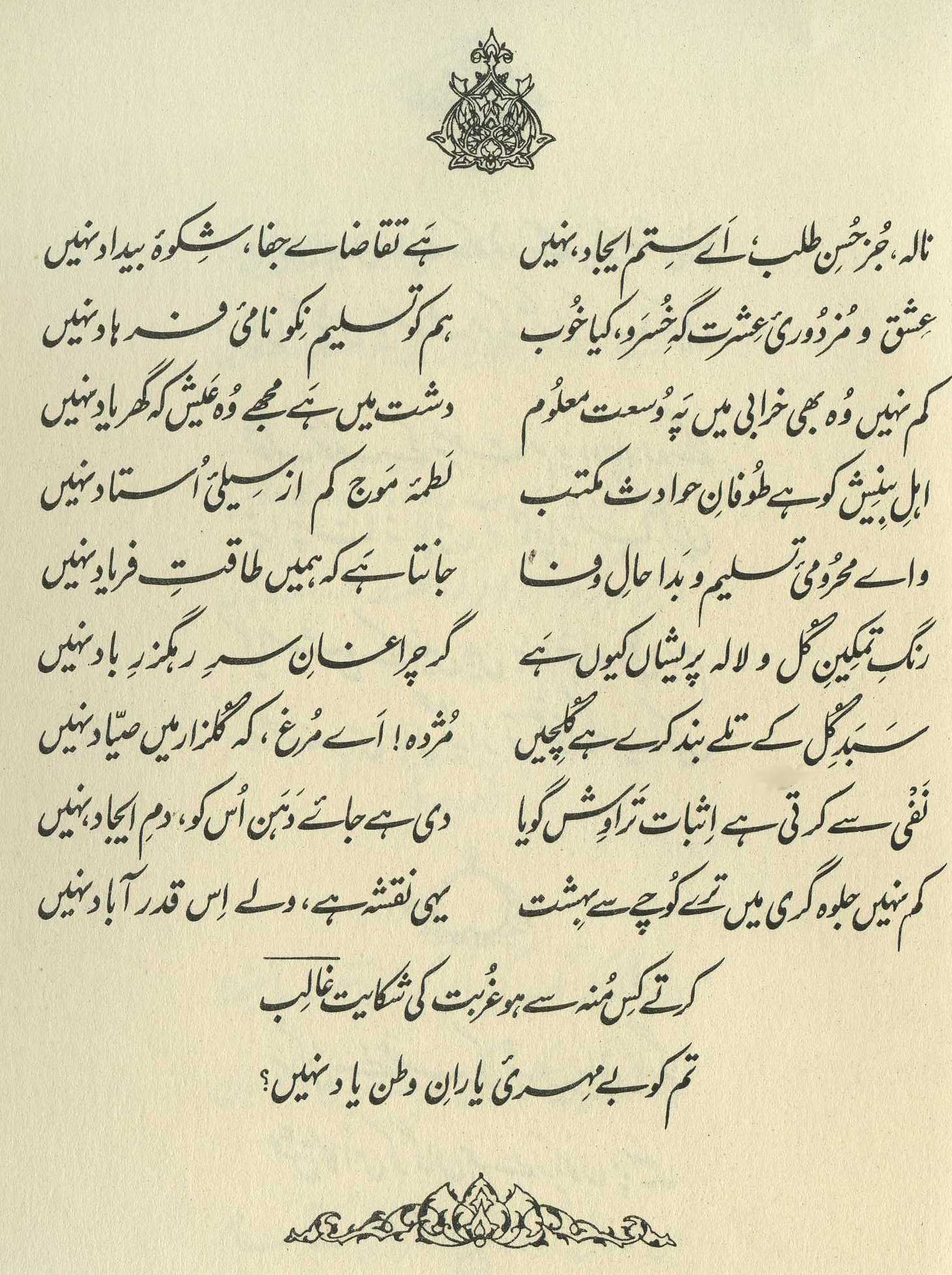
how do you have the nerve/'face' to complain of foreignness/exile, Ghalib?
2
you don't remember the unkindness of friends at home?!
'Travelling (to foreign countries), going abroad; emigration; —being far from (one's) home or native country; the state or condition of a stranger, or foreigner, or exile; wretchedness, misery; humility, lowliness'.
tan>> : 'Native country, country, home, abode, residence, dwelling'.
| References | |
|---|---|
| Arshi, Imtiyaz Ali | Ghazal# 104 |
| Raza, Kalidas Gupta | 371-72 |
| Hamid Ali Khan | Open Image |
Among the difficulties of Urdu grammar one problem is [the grammar of and its relationship with direct and indirect objects]. [This problem is discussed at length, with examples.] (108-09)
== Nazm page 108 ; Nazm page 109


He says, 'Oh Ghalib, with what 'face' to you complain of being in a foreign country? Don't you remember the unkindness of friends in the homeland?' That is, if while traveling nobody inquires about your welfare, then in the homeland who cared about you? (159)
In this verse so many words are full of meaning. (1) 'With what face?'. (2) The complaint of living abroad, from which it is learned that he experienced trouble when abroad. (3) He said 'friends of the homeland'; he didn't say 'people of the homeland'. That is, while there friends were faithless, here everyone is a stranger-- if they don't show kindness, then how is it strange? In this verse it necessarily emerges that no matter how much trouble may have occurred in the homeland, still a person certainly remembers the homeland. (210)
In addition to the home/abroad dichotomy, this verse plays on the friends/strangers one too. It's not just Ghalib's compatriots in general who were unkind, but specifically his close friends or companions. As Bekhud Mohani points out, it's not surprising if strangers are not kind, but for one's own close friends at home to be unkind cuts much deeper. Yet as Bekhud Mohani also observes, the memory of home-- even if it's a wistful or false one-- never seems to be entirely given up, as a yardstick for judging everything else.
It's a good resonant closing-verse . A strong note of bitterness and alienation is a fine one on which to end. As an even stronger instance consider 111,16 , in which the poet doesn't just express resentment, but threatens to wipe out the world if it keeps on maltreating him. Then there's the more complex case of 149,1 , another verse that imagines the lover as receiving contempt from the homeland.
graphics/vatan.jpg