Verse 11816aamujhe
G3
1
in rest/repose/ease, reproach/scorn is appropriate to me
2
the dawn of the homeland is a teeth-baring smile to me
'Spurning, rejecting, despising; chiding; reproach, blame; scorn, contempt; rejection'.
| References | |
|---|---|
| Arshi, Imtiyaz Ali | Ghazal# 141 |
| Raza, Kalidas Gupta | 227-28 |
| Nuskhah-e-Hamidiyah | 194-195 |
| Asi, Abdul Bari | 221-222 |
| Gyan Chand | 336-339 |
| Hamid Ali Khan | Open Image |
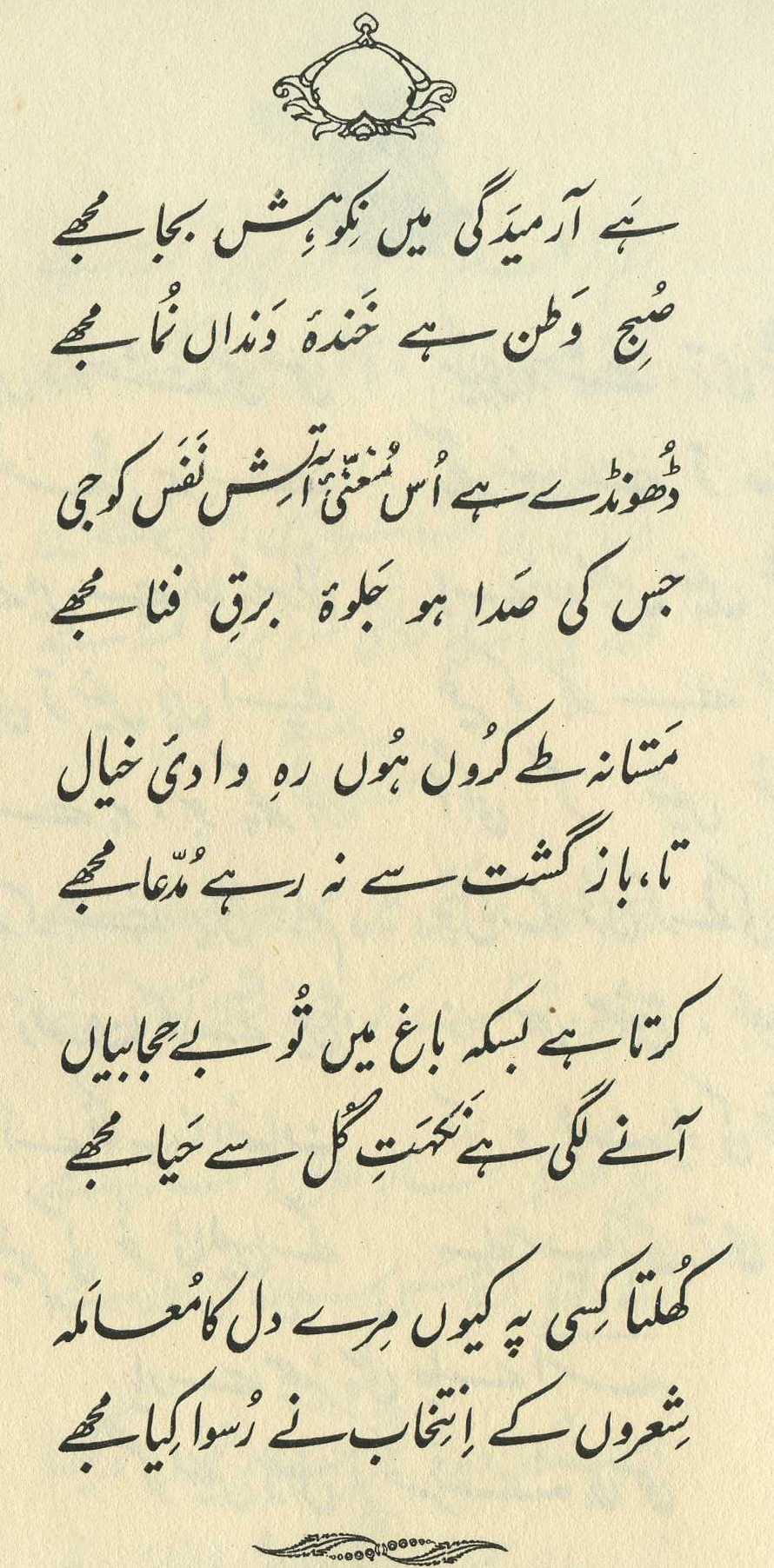
That is, in repose and abandonment of wandering, reproach and scorn are a proper punishment to me, so that in my homeland it's not a dawn to me, but rather it's a teeth-baring smile at my condition. The smile of the dawn is a famous metaphor . (157)
== Nazm page 157

The dawn in the homeland laughs at me, and it ought indeed to laugh. Because I'm seated here comfortably. It doesn't look proper for a madman and desert-wanderer to remain in the homeland.
We can also understand this verse like this: some individual who loves the homeland is seeing it in the clutches of Other s. And because of his lack of courage, or ardor for pleasure, or love of near and dear ones, doesn't try to cut the chains on the feet of the homeland, but his sensibility constantly reproaches him: 'Oh you cruel one, what are you doing?' In such a state his gaze falls on the whiteness of dawn, and the thought occurs to him that this is not the whiteness of dawn; rather, the dawn of the homeland is laughing at my love of ease. (288)
This reading can also emerge: that I'm comfortable in a foreign country; seeing my comfort, people taunt me. This taunting can be because I'm outside the homeland and still am happy; or because people say that the homeland hasn't esteemed you, and only after coming here have you been comfortable. People's teeth-baring smile (that is, their sarcastic laughter) reminds me of the dawn in my homeland, or it seems to me to be the dawn in my homeland, because that dawn too taunts me. That is, the people of my homeland weren't pleased with me either. In this connection this verse seems to be of the same kind as 101,10 . This meaning is far-fetched, but not impossible, because the image of 'the dawn of the homeland' is present; the speaker either is in the homeland, or is not in the homeland but rather in a foreign country. 'Repose' can also signify death, for 'death in a foreign country' is a common theme .
== (1989: 271) 2006: 295
Dawn is a 'teeth-baring smile' because the first light of dawn-- the 'crack' of dawn-- shows itself as a narrow horizontal strip of brightness, or even whiteness, on the horizon; for more on this, see 67,1 .
Bekhud Mohani's nationalistic interpretation has two problems. One problem is the early date of this ghazal (1816); at that time, the English had only held Delhi (with a farman from the Mughal emperor, of course) for thirteen years, and their presence was not as yet very obtrusive, so that nationalist sentiment had hardly even begun to develop as it would in the later part of the century. The other problem is the fact that even in Ghalib's later life, evidence that he opposed the British presence in India is hard to come by. He was certainly wretched during the events of 1857, and described his and Delhi's sufferings vividly; but it's clear that he blamed both sides, and from his extant writings it seems that he blamed the rebels more than the British. (He thought of himself as an aristocrat, and in Dastanbu he generally depicted the rebels as brutal, low-class ruffians.)
Of course it can be argued that in taking such an attitude he was simply being politically prudent or expedient; but to make such an argument persuasive, there should also be private letters to his friends that confidentially expressed his 'real' nationalistic or anti-British sentiments. As far as I'm aware, there aren't any; nor is there any other significant evidence. 'Absence of evidence is not evidence of absence', of course; but it certainly isn't evidence of presence. Nevertheless, the 'nationalist Ghalib' of Bollywood's imagining is very much alive. A gathering in Pune (Sept. 27, 2019) to commemorate Ghalib's death anniversary was recently told that Ghalib foresaw the independence movement, and 'guided Indians to join hands and fight intruders to regain their land'.
Why does the dawn of the speaker's homeland give him a 'teeth-baring smile'? Because he's reposing peacefully-- and thus contemptibly-- at home; he's not doing his duty as a lover, which would involve wandering from pillar to post, retiring to the desert, and so on. And of course, the dawn of the homeland doesn't necessarily give him such a smile in reality: the verse says clearly that it only seems so to him [], because he's castigating himself and is full of self-reproach.
Faruqi's comparison with 101,10 seems exactly as he describes it: far-fetched but not impossible. The verse itself gives us no reason to assume that the speaker is in a foreign country. But since we know he often experiences hostility and contempt in his homeland, the reading certainly isn't so implausible either.
For other teeth-baring smiles, see 166,1 ; 346x,3 ; [ 400x,4 ]. On teeth and the cosmetic : 417x,2 . On the erotic use of teeth: 378x,4 .
graphics/dawn.jpg