Verse 31816aamujhe
G3
1
intoxicated(ly), I traverse the road of the valley of thought
2
so that no intention/meaning like turning back would remain to me
'Drunken, drunk... ; --Like a drunkard, drunkenly, &c.'
is an archaic form of ( GRAMMAR )
'A valley, vale; low-lying ground; an oasis (in a desert); a desert; --channel (of a river); a river'.
'Turning back, returning; return, retreat'.
'What is claimed, or alleged, or pretended, or meant; desire, wish; suit; meaning, object, view; scope, tenor, drift; --object of search'.
| References | |
|---|---|
| Arshi, Imtiyaz Ali | Ghazal# 141 |
| Raza, Kalidas Gupta | 227-28 |
| Nuskhah-e-Hamidiyah | 194-195 |
| Asi, Abdul Bari | 221-222 |
| Gyan Chand | 336-339 |
| Hamid Ali Khan | Open Image |
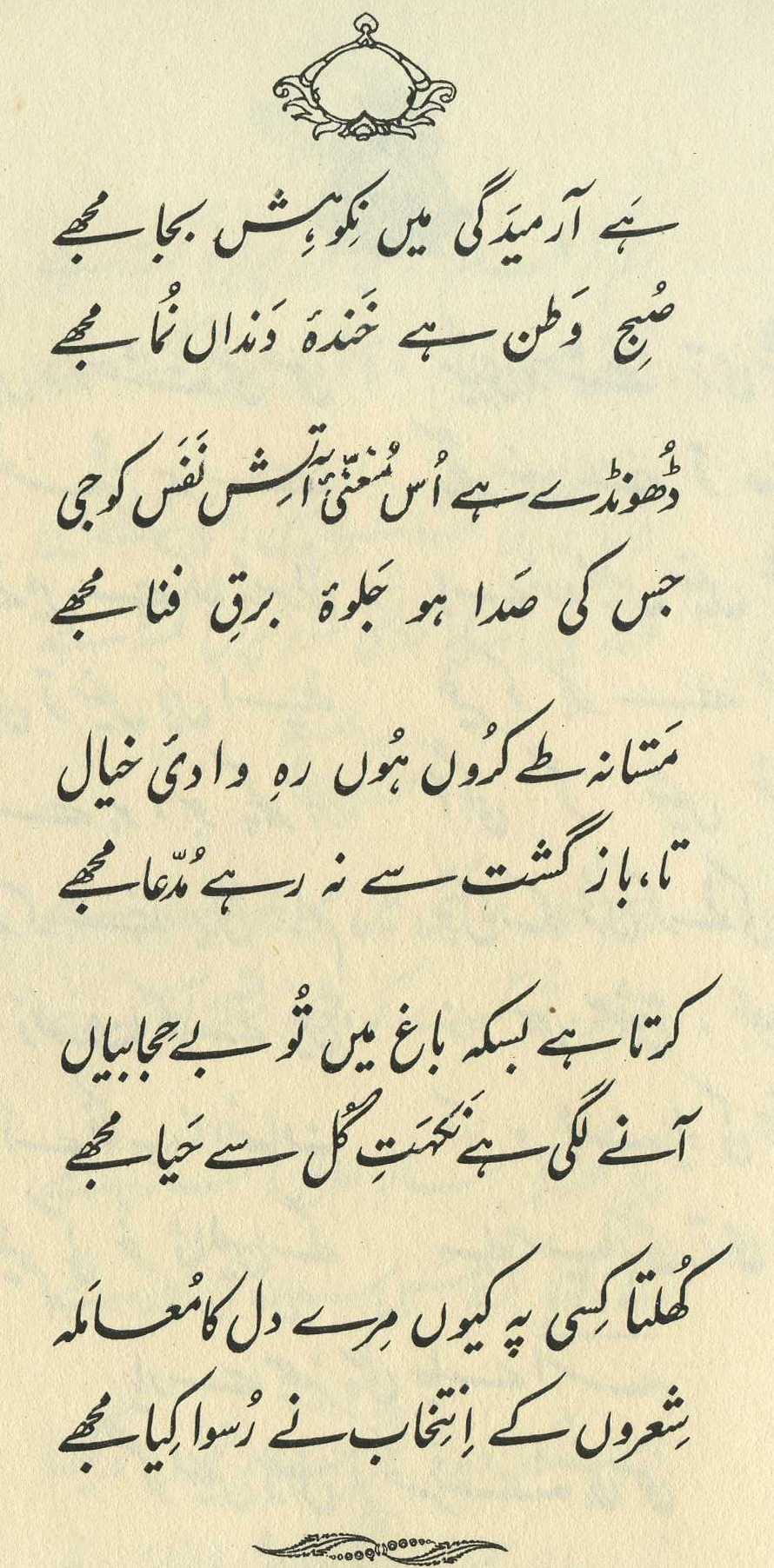
That is, I want to be so immersed in my thought that I would never be able to emerge again. From Mir Muhammad Husain Sahib Azad we learn that and have for some time been considered contrary to eloquence even in Delhi. [There follows an extremely long discussion of Delhi and Lucknow usages and archaisms.] (158)
== Nazm page 158 ; Nazm page 159 ; Nazm page 160 ; Nazm page 161


He says, in the field of thought I am traversing the road in an intoxicated manner, so that I would have absolutely no intention of turning and going back. That is, I would lose myself in such a way that I would never afterwards be able to return to awareness. (216)
Now, instead of they say . I traverse the field of thought as intoxicated ones do, so that no purpose of turning and going back would remain to me. (289)
This apparently prosy little verse invites speculation:
=Is the speaker doing the traversing in a state of intoxication, or merely in a manner that evokes or imitates that of intoxication? (Is he drunk, or just imitating drunkenness?)
=Since a 'road' and a 'valley' or 'channel' [] are linear, would walking along them 'intoxicated(ly)' really cause one to lose one's way so irrevocably? Or is the speaker deluding himself?
=Since his goal is that no thought of returning 'would remain' [], is he actually still struggling with a desire to return?
=Is he walking intoxicated(ly) not along a real road, but only along the metaphorical road of the valley of thought, so that his thought will be impaired, and he won't be able even to form a coherent claim or intention or meaning [] about returning?
It's not surprising that the subtleties accumulate, when a wild card like 'thought' is invoked. Don't forget the ominous shufflings of the 'card-player of Thought' in 81,2 .
In addition, we can admire the unobtrusively clever affinity and sound effects between in the first line, and in the second. Though the former is about traveling, and the latter about remaining, the two are only very subtly distinguishable in pronunciation.
graphics/twistingroad.jpg