Verse 21816aamujhe
G3
1
the inner-self searches for that fire-{breath/spirit}-possessing singer
2
whose echo/voice/call would be the glory/appearance of the lightning of oblivion to me
is an archaic form of ( GRAMMAR )
'A singer; a musician; -- part. adj. Making free from want; rendering in a state of competence, or rich, or independent'.
'Breath (of life), animal life; --soul; spirit, self, person; substance, essence, individual thing itself'.
'Echo; sound, noise; voice, tone, cry, call;.... [among Khatris] an invitation (to a marriage ceremony, or a feast)'.
| References | |
|---|---|
| Arshi, Imtiyaz Ali | Ghazal# 141 |
| Raza, Kalidas Gupta | 227-28 |
| Nuskhah-e-Hamidiyah | 194-195 |
| Asi, Abdul Bari | 221-222 |
| Gyan Chand | 336-339 |
| Hamid Ali Khan | Open Image |
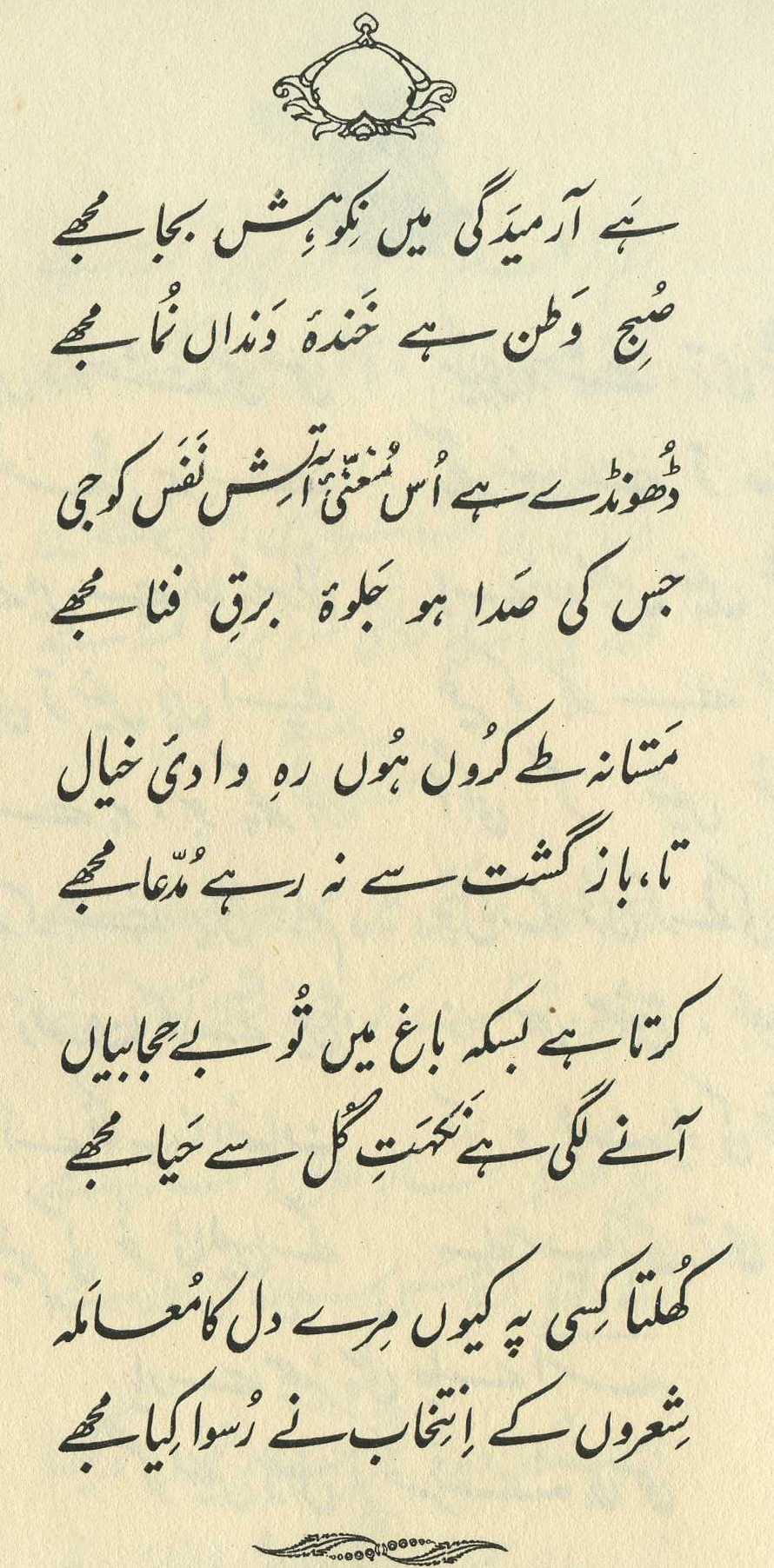
That is, the self wants an experience of hearing such that a state of 'oblivion to the self' [] would occur.... But to say in a verse 'let this be so, let that be so' makes the verse loose. If, on the contrary, he had brought this theme into the expression, and said, 'your voice is to me the glory/appearance of the lightning of oblivion', then it would give more pleasure. (157)
== Nazm page 157

He says, my heart is searching for that singer, the lightning of whose voice would fall on me and obliterate me, and I would forget my very self along with my existence. (216)
I long for a mystical guide [] who will express the secrets of Reality in such a way that the world and the pleasure of the world will become vile in my eyes....
[As for Nazm's criticism:] Now 'a reversed Ganges has begun to flow!' []. The correction that he has devised-- the Lord knows what kind of literary creation it is! (289)
[See his discussion of Mir's M 472,6 .]
In the first line we learn that the speaker's inner self is searching for a , a singer (and/or, conceivably, an 'independence-maker'-- see the definition above), who will have a breath, or spirit, or essence, of fire. This is a tall order! We look forward to clarification in the second line. And do we get it? Not exactly; but we get some fascinating abstraction-play instead.
We're offered the vision of a singer whose 'breath' or essence is fire, such that his/her voice would 'strike' the hearer like a bolt of lightning, and bring oblivion. Don't we have here an echo of Moses seeking to experience God's presence on Mount Tur ? In Qur'an 28:29, after all, Moses's experience begins with the sight of a 'fire'; he approaches it, and then hears the Voice from a tree nearby. And in 36,5 , the speaker complains that a single lightning-flash before the eyes was unsatisfactory-- he wanted from the beloved 'speech', a conversation, a voice, as well.
In the present verse, the speaker wants a voice that will resemble, or act as, or actually be, the 'lightning of oblivion'. A voice that slays its hearer with its first sound? A voice that is to the ears, through a sort of synesthesia, what lightning is to the eyes (and to the whole body, if it strikes directly)? A divine Voice that gives the long-desired command of oblivion, and thus releases one from the wretchedness of mortal life? As so often, we're left to decide for ourselves.
There's also the wonderful multivalence of the final 'to me'. It can be read as meaning that all this lightning-striking would be done 'to me' (as opposed to being done to someone else). But it can also be read as rendering the whole verse radically subjective: the speaker may long for someone who would be the most desirable beloved in the world 'to him'-- meaning, not necessarily to anyone else. If he longs for someone whose call would be a lightning-strike 'to him', the implication can quite well be that this is a private matter, and perhaps no one else would experience it in the same way. In fact it might not even be a voice or call; it could be merely an 'echo' that would affect him so strongly.
Of course, the subjunctive verb grammar itself makes it clear that no such person or entity has (yet?) turned up.
graphics/lightning.jpg