Verse 9x1816aamujhe
G3
1
to what extent the low-naturedness of the temperament of longing/desire?!
2
oh Lord , may I acquire the loftiness of the hand of blessing/prayer!
'How many? how long? by how much?'.
trat>> : 'Of inferior understanding; of a mean disposition; low-natured; base, vile'.
tab((>> : 'Stamping, printing; print, impression, edition (of a book, &c.); — nature, innate or natural disposition; genius; natural temper, temperament; idiosyncrasy; quality'.
'Wish, desire, longing, eagerness; hope; trust; expectation; intention, purpose, object, design; inclination, affection, love'.
'Height, elevation, loftiness, eminence, exaltation; pride'.
'Prayer, supplication (to God); an invocation of good, a blessing, benediction; wish; congratulation, salutation'.
| References | |
|---|---|
| Arshi, Imtiyaz Ali | Ghazal# 141 |
| Raza, Kalidas Gupta | 227-28 |
| Nuskhah-e-Hamidiyah | 194-195 |
| Asi, Abdul Bari | 221-222 |
| Gyan Chand | 336-339 |
| Hamid Ali Khan | Open Image |
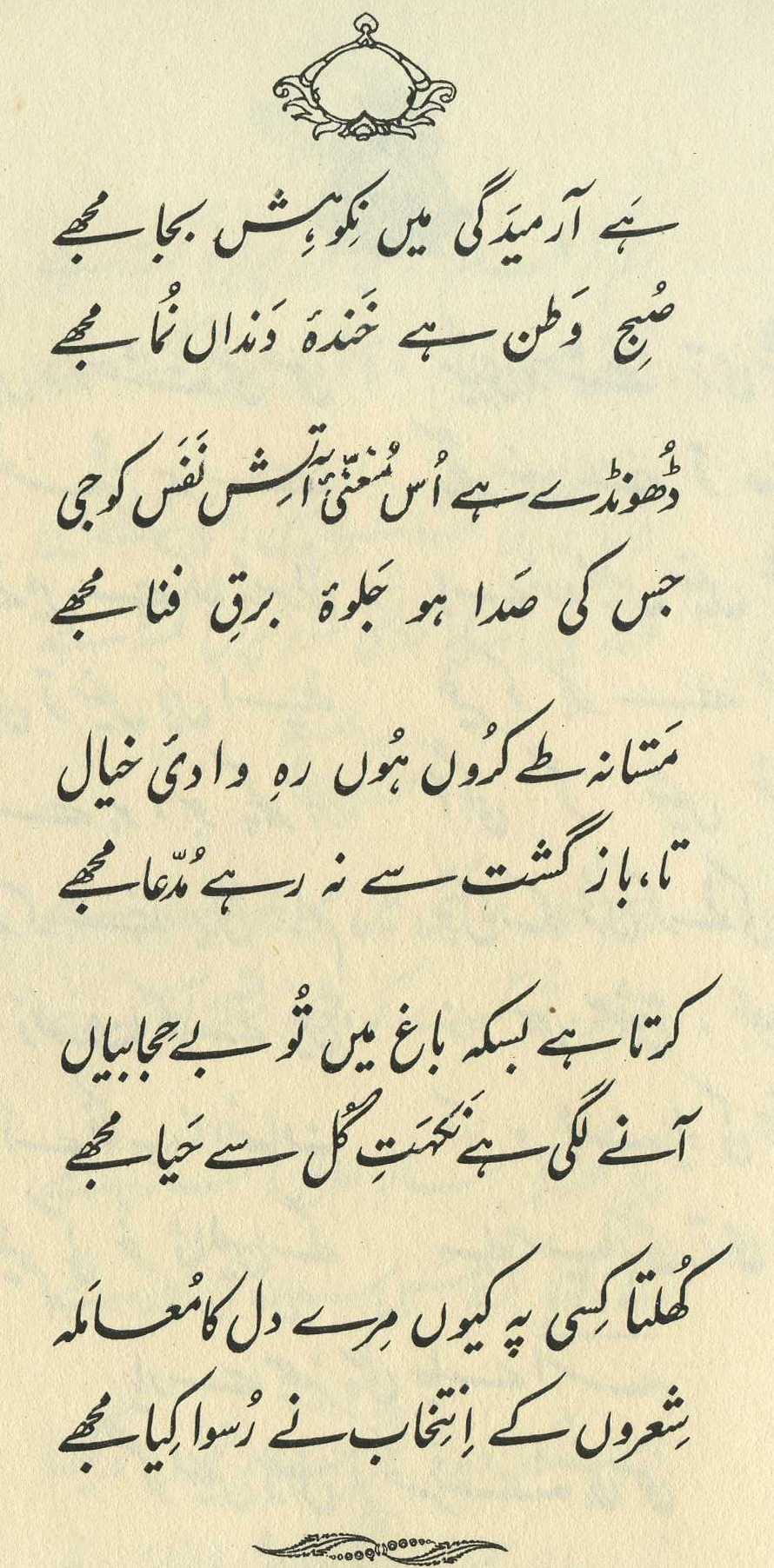
Oh Lord, how long and how far am I to bear the low-naturedness of the temperament of longing? Now bestow on my thoughts such loftiness as you have bestowed on the hand of blessing/prayer. Longing is itself low-natured, or the creation of longing is low-naturedness. For this reason I do not want it-- now may I remain superior to it!
== Asi, p. 221
That is, the things for which I pray are very low and commonplace-- from which the low-naturedness of the longing is evident. When I ask only for a blessing, then may God give me the guts to ask only for lofty purposes.
== Zamin, p. 330
From forming any longing/desire, a man is lowered from his level, because into his life there comes the feeling of a deficiency and a lack. For this reason, the temperament that forms a longing/desire is usually low/inferior. On the other hand, a prayer can be made to the Lord for the fulfillment of some longing. In prayer, the hands are raised up. In prayer there's also an elevation to some extent, because included in it is faith in the Lord himself. In this way, to pray is loftiness. Instead of remaining fallen in mere longing/desire, the loftiness of offering a prayer is more pleasing. A longing/desire and a prayer are the same thing, but there's a difference in the nature of each one. When religious faith is merged into a longing/desire, it becomes a prayer.
== Gyan Chand, p. 338
For background see S. R. Faruqi's choices . For more on Ghalib's unpublished verses, see the discussion in 4,8x .
The first line uses a variant form of the multivalent 'kya effect', but creates it through the Persianized . The line can thus be read either as a genuine question, or as an indignant negative rhetorical question.
Gyan Chand points out the obvious sense in which the apparent humility of prayer is actually a form of elevation-- physically one's hands may be lifted, and spiritually one shows faith in a Higher Power. Thus supplication is, paradoxically, an elevating activity; while mere longing or desire is a manifestation of lowness, weakness, incompleteness. But as Gyan Chand also observes, a prayer that one makes on behalf of oneself [] is really the same as a longing, but with a bit of religious faith thrown in. Thus it too may well be thought of as unworthy, vulgar, low; along these lines, consider the complexities of 79,1 .
There's also another possibility of the word , however: it can refer to the speaker's 'blessing' offered to somebody else. (This sense resonates with Ghalib's 'independence' verses-- for discussion see 9,1 -- in which one shouldn't solicit, or even accept, benefits from outside oneself.) This is the sense of -- 'to give a blessing (to), to bless, to pray for' (Platts p.518). This use too can involve extreme humility: the beggar can 'bless' or 'pray for' the kind person who gives him a coin. In 110,8 Ghalib urges himself to give such a blessing to the King, in gratitude for his pension; in 120,10 the victim of highway robbery gives such a blessing to the highway robber.
But there's also a well-established usage that has a sense of a senior person's power extended protectively over a junior person: elders in the family commonly 'bless' young people. Even more commonly, venerable spiritual leaders give such blessings or benedictions to their followers. Such blessings often involve the lifting of the right hand, which is then placed on the bowed head of the recipient (who, ideally, is simultaneously bending to touch the feet of the venerable person). When young people report their well-being to an elder, they often begin with 'Through your blessing...' [].
Of course, in principle there's nothing heretical about this, since all parties would emphatically agree that any such 'blessing' operates only through God's will and pleasure, and only because the senior party prays to God on the junior party's behalf. But there's still a notably hierarchical relationship between the giver and the receiver of such a blessing. In Christian religious terminology 'benediction' has that same kind of formal, hierarchical sense-- bishops give 'benedictions' to their flock, pastors to their parishioners, often in fact with an upraised right hand.
If we look at all Ghalib's uses of in his ghazals, none leaps out as clearly reflecting this latter, hierarchical sense. But he could hardly have been unaware of the complexities of the term. The range of all three possibilities-- praying on behalf of oneself, praying humbly for a blessing to be given to someone else, and/or giving someone a benediction that suggests some spiritual power of one's own-- enriches and deepens the verse.
graphics/hands.jpg