Verse 11816arkii
G2
1
rejection/contempt is the punishment of the complainer/plaintiff of the injustice of the heart-stealer
2 a
may it not be that a teeth-baring smile would be the dawn of Doomsday!
2 b
may it not be that the dawn of Doomsday would be a teeth-baring smile!
'Spurning, rejecting, despising; chiding; reproach, blame; scorn, contempt; rejection'.
'Let it not be, by no means, away! God forbid! lest'. (Steingass p.1148)
| References | |
|---|---|
| Arshi, Imtiyaz Ali | Ghazal# 143 |
| Raza, Kalidas Gupta | 230-231 |
| Nuskhah-e-Hamidiyah | 205-206 |
| Asi, Abdul Bari | 224-225 |
| Gyan Chand | 342-343,549 |
| Hamid Ali Khan | Open Image |
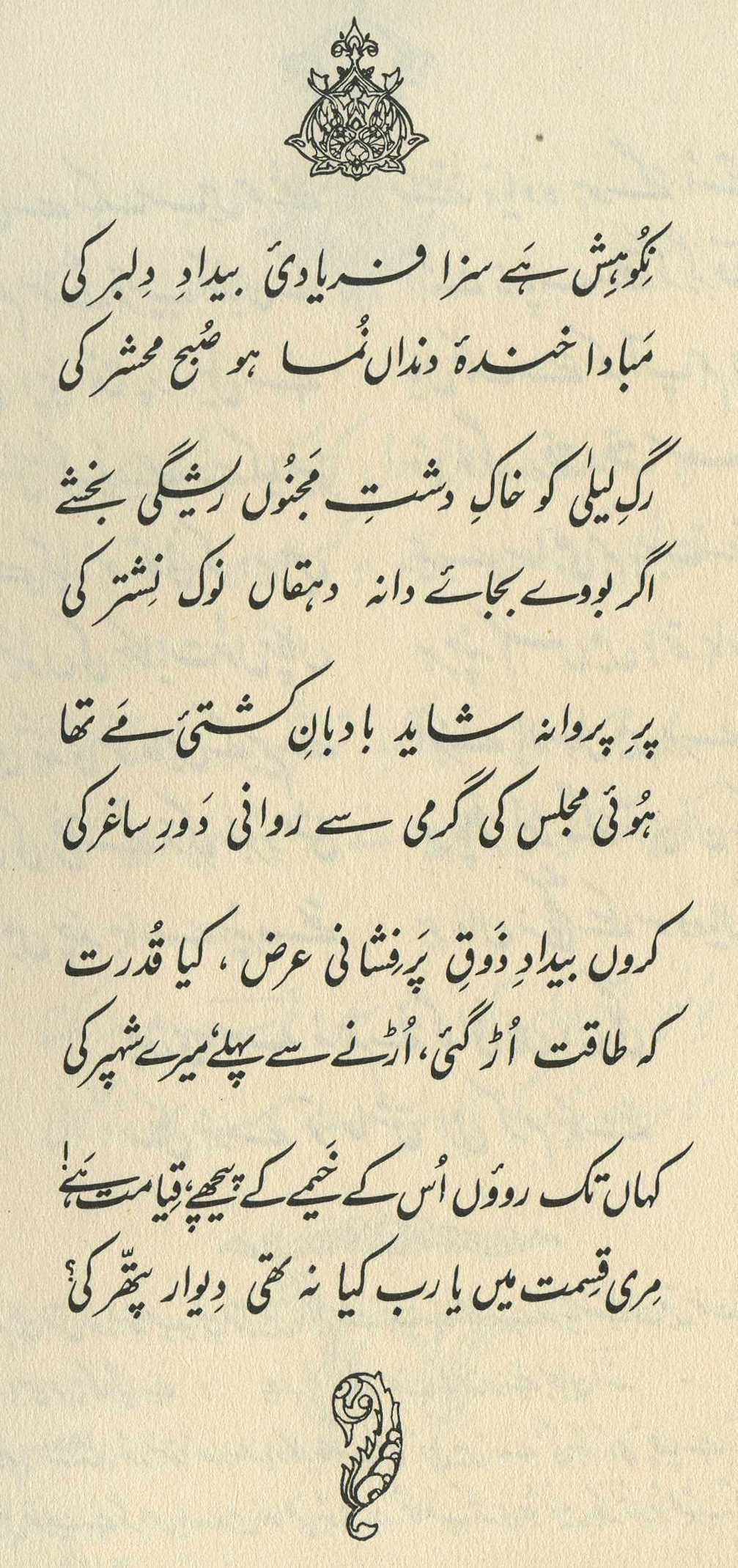
That is, the one who would complain about the unjust beloved-- he is punishable with rejection/contempt and blame. May it not be that the morning of Doomsday too would show a teeth-baring smile toward him! (179)
== Nazm page 179

He says, the punishment of the culprit who makes a complaint about the beloved's tyranny is contempt and blame. I fear-- may it not be that the morning of Doomsday too would, toward that wretch, assume the form of a teeth-showing smile! (240)
They always give for the dawn/morning the simile of a teeth-showing smile. The lover who would rise up with a complaint against the tyranny of the beloved, his punishment is blame/reproach. And it wouldn't be surprising if what people call the dawn/morning of Doomsday would be not a dawn, but rather, for the complainants against the cruelty of the heart-stealers, a teeth-showing smile.... In the eyes of the lover, the cruelty of the beloved has such grandeur that he considers it a crime to complain of the injustice of the beloved, and such a major crime that it alone is the cause of the coming of Judgment Day: it will come for the punishment of such people. (323)
is usually used in two ways. One usage is prayerful ('may the Lord not make it be so!'); in the other usage is suspicion and anxiety ('may it not be that')....
In the verse are a number of excellences of meaning. (1) To make a complaint about the beloved's cruelty is, in a legal sense, a crime. On Judgment Day it will be punished. (2) It is a well-known problem in legal interpretation whether the difficulties that befall a man in the world are in truth the fruit of his sins. That is, if in the world he endured trouble, then the intensity of his punishment will be reduced. Accordingly, if the requital of the impatient lover's sin (complaining against the beloved) takes place here, then it's better. (3) So that on Judgment Day he can receive a reward for enduring the difficulties of passion. (4) On Doomsday there will be justice, but that doesn't mean that God the Most High won't be sarcastic toward his foolish servants.
Now let's consider the verbal excellences.... The repetition of has created in the verse a kind of harmony that isn't found in the common run of verses. From its repetition a kind of roughness develops, and to use it in a pleasing way is not within just anyone's power. In the verse there are fifteen words altogether, out of which six words... contain eight uses of .
This is not one of Ghalib's finest verses, but it's certainly an example of meaning-creation . By meaning-creation is meant the using in the verse of words such that their meanings, whatever they might seem apparently to be, upon reflection would emerge as greater, or various, meanings. Through meaning-creation, a verse comes have depths [].
== (1989 288-90) 2006: 312-14
The first line reports, in legal language, an extreme state of unfairness and lawlessness. The complainer or plaintiff-- the term goes right back to 1,1 -- who appeals against the 'injustice' [] of the 'heart-ravisher' or 'heart-carrier-away' [] would seem to be making a charge of theft, and he should be entitled to a hearing, through which the accused would be, if convicted, in danger of punishment. But instead, the line reports that the plaintiff himself is the one in danger of punishment-- and not only in danger of it, but apparently guaranteed to receive it, for the punishment for simply making such a complaint 'is' rejection or contempt. Not only will his case not be heard and judged, but he will be scorned and rejected for even having raised the issue.
The abstractness of the grammar-- A 'is' the punishment for B-- makes it impossible to say whether any particular case, past, present, or future, is being described, or whether the law is simply being stated as a general rule. We're obliged to wait, under mushairah performance conditions, for further information in the next line.
In the next line, however, instead of information we get, in the mode, an exclamation. As Bekhud Mohani observes, the comparison of the white line of light that is the first appearance of dawn, to the line of dazzlingly white teeth shown in a smile, is a staple of ghazal imagery; for more on 'crack of dawn' imagery, see 67,1 . In the present verse it's not a friendly, lips-upcurved smile, but a horizontal line-- an ominously 'teeth-baring' (literally 'teeth-showing') smile, a sinister and threatening gesture.
The exclamation itself is conspicuously multivalent: may it not be that 'A would be B', or-- thanks to the 'symmetry' of Urdu grammar-- that 'B would be A'. The first reading fears that the beloved's teeth-baring smile might signal the unleashing of such almighty wrath that it would be (literally or metaphorically) the dawn of Doomsday (2a). The second reading fears that the dawn of Doomsday itself would appear as a teeth-baring smile, echoing or reinforcing the judgment described in the first line (2b).
We still can't tell whether any particular such 'crime' is being described here, or whether a general statement is being offered. In either case, the lover's fearful reaction shows, unsurprisingly, that he imagines his own fate to be at issue. He either has committed, or will commit, or thinks of committing, such a dire offense; or else he so fears to (accidentally?) commit it, that even the thought brings an immediate panic reaction that's wildly cosmic in its scope. Cosmic-- and also perhaps a bit comic? That depends on how we read it, and as so often, the tone of the exclamation is left for us to decide for ourselves.
For more on such 'teeth-baring smiles', see 67,1 .
And here's an example from Mir [M 512,2 ]:
[if she/he/it would show a teeth-baring smile, then I too will weep
lightning flashes forcefully, certainly, today there's rain]
graphics/crackofdawn.jpg