Verse 21816arkii
G2
2
if the farmer would sow, in place of seeds, lancet-points
'Wound; sore; scar'.
'Fibre; filament; nerve; vein (of a leaf); stringiness (of a mango, &c.)'.
'A lancet, fleam; a trocar; a canine tooth'. (Steingass p.1403)
'A lancet, fleam: — , or (- , or - ), To apply the lancet (to), to lance; to bleed, phlebotomize'.
| References | |
|---|---|
| Arshi, Imtiyaz Ali | Ghazal# 143 |
| Raza, Kalidas Gupta | 230-231 |
| Nuskhah-e-Hamidiyah | 205-206 |
| Asi, Abdul Bari | 224-225 |
| Gyan Chand | 342-343,549 |
| Hamid Ali Khan | Open Image |
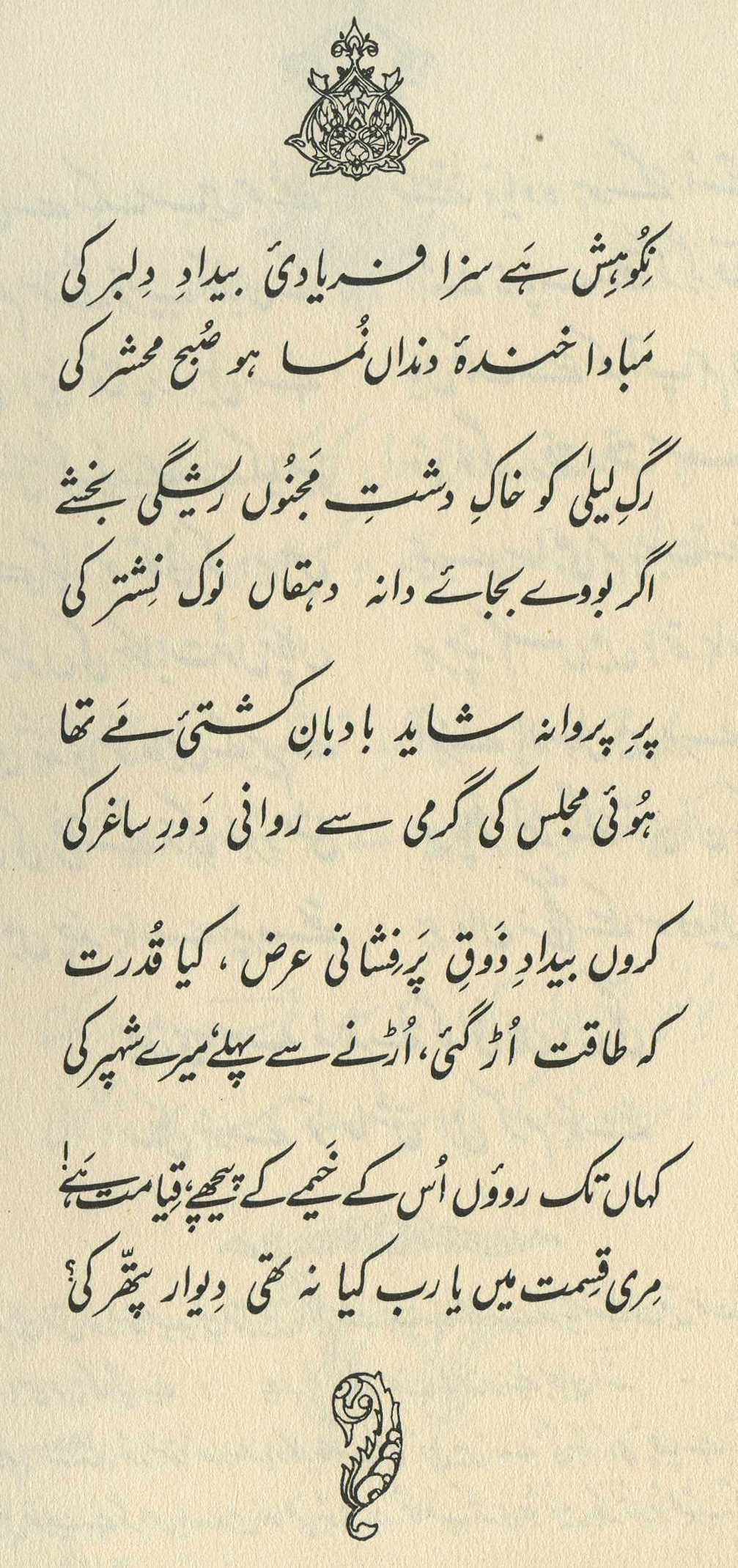
In this verse is a reference to the famous story of Laila's being bled, and Majnun's veins pouring out blood. And the probability is that the author had said and the calligrapher and the calligrapher had put in the extra dots to make it . In any case, the gist is that if they would sow in the desert of Majnun the points of lancets instead of seeds, then from there the veins of Laila would sprout-- to this extent passion had created unity between lover and beloved, and lancet and vein. (180)
== Nazm page 180

= to sprout, to increase, to be wounded....
If the farmer would sow, instead of seeds, lancet-points, then from the pricking of every thorn, or lancet-point, of the desert of Najd, blood would flow from the veins of Laila. That is, now the unity of lover and beloved has reached such a limit that from Majnun's pain, Laila feels pain. This verse gestures toward the story that when Laila was bled, Majnun's vein spontaneously opened up. In this meaning I agree with Janab Hasrat.
Janab Shaukat: 'Now if in the dust of the desert of Majnun lancets are sown, then from them the veins of Laila will grow, because Majnun loves the veins of Laila'.... What a fine reason he has given for the veins of Laila sprouting! If this reason had not been given, it would have been better.
[Disagreeing with Nazm:] The Lord knows what meaning this 'sowing of lancets in the hand' would have! To sow lancets in the dust has a meaning-- that is, that in order to torment him, thorns or lancets would be spread in the road. Apart from this, the word 'dust' would become useless. (323)
In the light of all the aforementioned analysis [by the commentators, and Faruqi's own criticisms of their views], it seems necessary to say that the verse is meaningless/absurd. But the truth is just the opposite. The basic point is that this verse is sarcastic []. In the first line is a sarcastic claim, and in the second line is a sarcastic condition for it. That is, the verse's meaning is just what the commentators have written, but its intent is different. The intent is that indeed, from Majnun's hand the blood flowed, at the time when Laila was bled. But to the extent that it's a question of Laila herself being affected by Majnun's hardships, that's impossible.
If some such impossible thing would happen as that someone would sow lancet-points in the dust of the desert of Majnun, then Laila's veins too would be wounded. That is, to cause Laila to be affected by Majnun's pain is just as absurd an idea as that someone would take up farming in the remote desert where Majnun is, and in addition would sow there, instead of seeds, lancet-points. In the verse is irony ['irony'] of a high order. The perfection of irony is that is just this: that on a literal level, or apparently, it would seem absurd. If you don't consider this verse sarcastic, then in truth it's meaningless/absurd. On the level of irony, it recalls some of Swift's sarcastic essays.
== (1989: 293) 2006: 315-18
The first line is awesomely, Ghalibianly, in-your-face opaque. It's so impossible to make anything out of it, that we can't even tell whether the abstract noun has been made from , which seems appropriate to the shape of the veins, or , which might be appropriate to someone walking painfully (barefoot?) in the harsh desert. (See the definitions above.) We're forced to wait desperately-- and, under mushairah performance conditions, as long as conveniently possible-- for the second line to clarify the situation.
And does it? Of course it doesn't. When I read Faruqi's commentary, I found myself not as satisfied as he is. He interprets the verse as a sarcastic sneer at Laila's lack of loyalty and devotion to Majnun: her veins would never open for him, the way his (in the story cited by Bekhud Mohani) opened for her. That's certainly more satisfactory than what most of the commentators say, but it hardly feels definitive. For after all, the ambiguous situation depicted in the first line is so thoroughly different from the clear-cut story (her vein is opened, he bleeds) on which the verse is purportedly based. Why would we think of Laila as wandering (barefoot, so her feet are vulnerable) in the 'dust of the desert of Majnun' anyway, if she's not a true lover? The main thrust of the traditional story shows us that she in fact is a true lover; along these lines, consider 104,1 . If the verse is going to taunt her for inadequacy, it needs a strong and clear reason-- which is exactly what it fails to provide.
Here's another possibility: perhaps Majnun is so identified with his desert that by an extension of his own passion, even the dust of his desert 'loves' Laila. Deserts are damaging environments, but not a single speck of dust in his desert would ever wound Laila! Not unless other impossible things would also happen-- and here we get Faruqi's sarcastic reading of the second line. Not, in effect, till 'all the seas run dry' and 'the rocks melt with the sun', as Burns would put it. And then we notice one more dimension: the source of the impossible, paradoxical, deadly danger, hypothetical as it is, is even then not the desert, but the 'farmer', practicing some kind of inhuman but 'human' cruelty quite alien to the behavior of the desert. Surely we are to think of the contrast between the devotion of Majnun's desert to Laila, and the (rhetorical, hyperbolic) cruelty of the human intruder into it.
Still, the verse is so difficult and obscure that it's well below his usual level. For an all-time-great one about Laila and Majnun and Majnun's desert, see 138,1 .
ABOUT : To open a vein in the forearm with a thin, sharp-bladed instrument called a lancet or fleam []), and then to let out fairly large quantities of blood into a basin before binding up the incision, used to be a common medical treatment that was thought to be beneficial for a number of illnesses. The illnesses so treated included madness, which was thought to result from an excessive pressure on the brain that blood-letting might relieve. For an example of the medical use of the lancet to treat madness, see 14,3 ; for other lancet verses, see 47,3x ; 103,3x ; 125,9 ; 209,3 // 242x,5 ; 256x,2 ; 271x,2 ; 366x,4 . An example from Mir : M 54,9 . For a thorough, and illustrated, overview of the history of the treatment, see * Bloodletting Instruments in the National Museum of History and Technology *.
graphics/lancet.jpg