Verse 9after 1826aadnahii;N
G5
In this meter the first long syllable may be replaced by a short; and the next-to-last long syllable may be replaced by two shorts.
1
it's not less in splendor-possession than your street, Paradise--
2
there is only/emphatically this same design/layout, but it's not populous/flourishing to this extent
>> 'Manifestation, publicity, conspicuousness; splendour, lustre, effulgence'.... : 'Clearness, conspicuousness; splendour; affectation, blandishments'.
'A delineation; a portrait; a picture; --a design; a plan; a model, pattern, an exemplar; --a map, chart'.
'Inhabited, populated, peopled; full of buildings and inhabitants, populous; settled (as a colony or town); cultivated; stored; full; occupied;... --flourishing, prosperous; pleasant; happy'.
| References | |
|---|---|
| Arshi, Imtiyaz Ali | Ghazal# 104 |
| Raza, Kalidas Gupta | 371-72 |
| Hamid Ali Khan | Open Image |
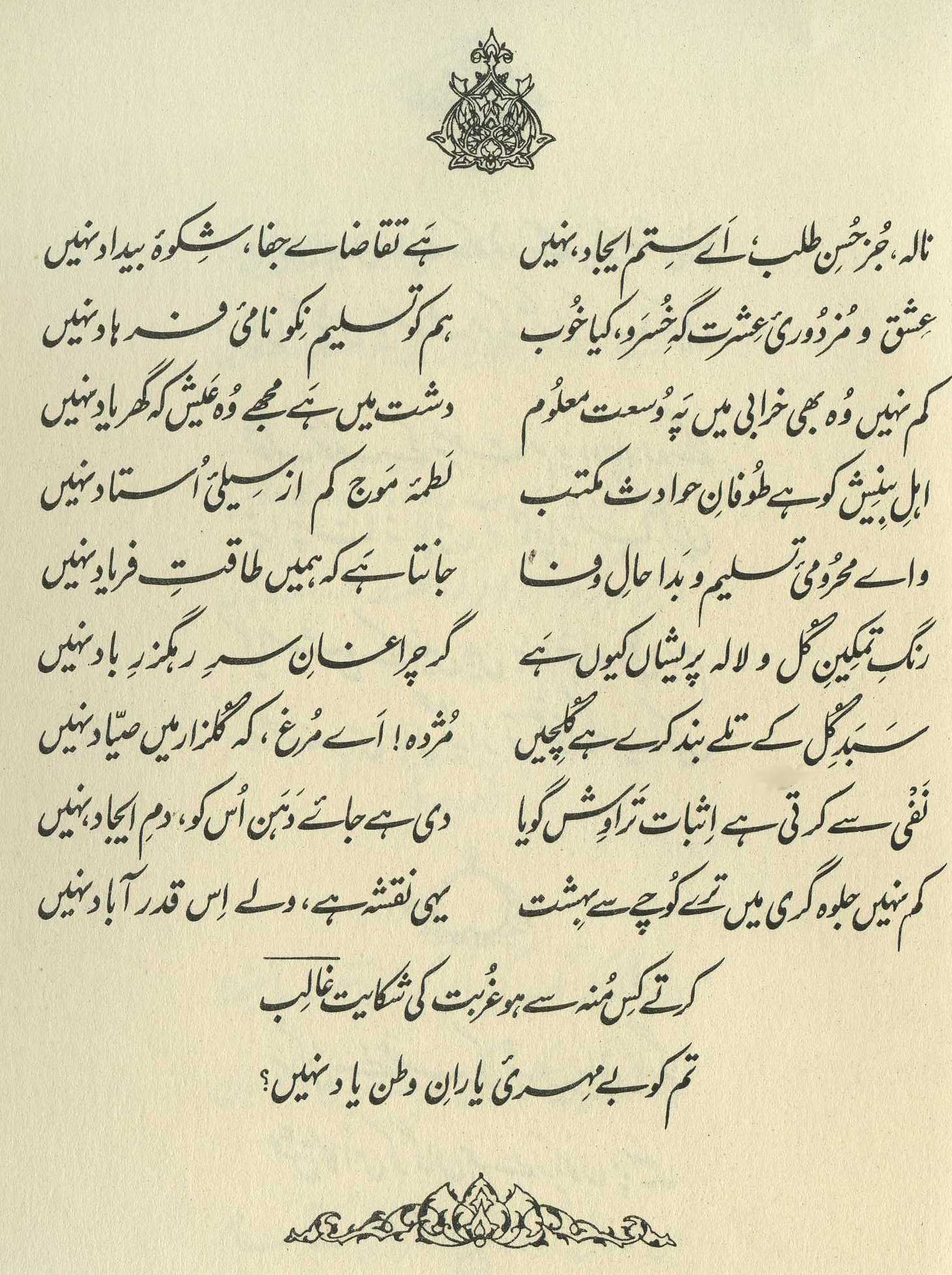
That is, here there's always a crowd of lovers. (108)
== Nazm page 108

In Paradise too, there's a flourishing/springtime like that of your street. The difference is only that here there's a great population because of lovers. (209)
Compare 35,9 . (176, 231)
(1) People can have access to the beloved's street only while alive. In order to arrive in Paradise, it's necessary to die.... Finding the beloved's street easier of access than Paradise, people keep gathering in the beloved's street....
(2) Paradise seems comparatively desolate because it's a big place, and those who go there are few.
(3) Those who long for Paradise, and those who enter it-- the poor things are dried-out Ascetic s. Little do they know that Paradise is present in the world itself. Only a handful of fools follow them on the road to Paradise. The rendezvous of the people is the beloved's street.
(4) Among the dwellers in Paradise there's not such a pain and burning as would make them cry out or lament. They lie there quietly. How would there be turmoil or commotion there? The dwellers in your street are full of pain and burning and intoxication. Here, there's constantly a commotion going on.
== (1989: 147) 2006: 168-69
[See also his comments in M 371,1 .]
Earlier in this ghazal we had 101,3 , and now this one. The same judiciously comparative tone, mentioning virtues and defects in different living situations. That one compared the desert favorably with the lover's house, for its breadth; this one compares the beloved's street favorably with Paradise, for its quality of being more populous/flourishing []. The rhetorical possibilities of this comparison are well presented by Faruqi. But it's the tone that's delightful-- the ruthlessly pragmatic, firmly focused, house-hunting tone. The speaker almost sounds as if he has a floor plan at hand, to compare the layouts. (Do we want to live in a crowded, lively urban area, or in the ritzy but boring suburbs?)
This verse is also part of a line of thought that makes invidious comparisons between things earthly and things heavenly, to the disadvantage of the latter. For more examples of such 'snide remarks about Paradise' verses, see 35,9 .
It's clear that the speaker has been to Paradise, since he knows it well enough for close and judicious comparison. It's also clear that he judges Paradise with reference to the beloved's street, since he takes the beloved's street as the norm and refers to Paradise as having 'this very same design' []. But it's not as crowded, not as lively-- because, apparently, fewer people seek (or at least attain) the company of God, than that of the beloved.
And even more strikingly, it's clear that the speaker has come back from Paradise and has taken up residence (again?) in the beloved's street. In fact he, the returnee from Paradise, is standing on the beloved's street even as he speaks, as 'to this extent' [] shows. This whole wonderful extra layer of 'mischievousness' [] is added to the verse simply by a and an . Economy of means can't get much more perfect.
graphics/street.jpg