Verse 4after 1826aadnahii;N
G5
In this meter the first long syllable may be replaced by a short; and the next-to-last long syllable may be replaced by two shorts.
1
to people of insight, the typhoon of events/calamities is a school
2
the buffet of the wave is not less than the slap of an Ustad
'Accidents, occurrences; misfortunes, calamities'.
'A blow with the edge of the open hand on the back of the neck; a slap, cuff'.
| References | |
|---|---|
| Arshi, Imtiyaz Ali | Ghazal# 104 |
| Raza, Kalidas Gupta | 371-72 |
| Hamid Ali Khan | Open Image |
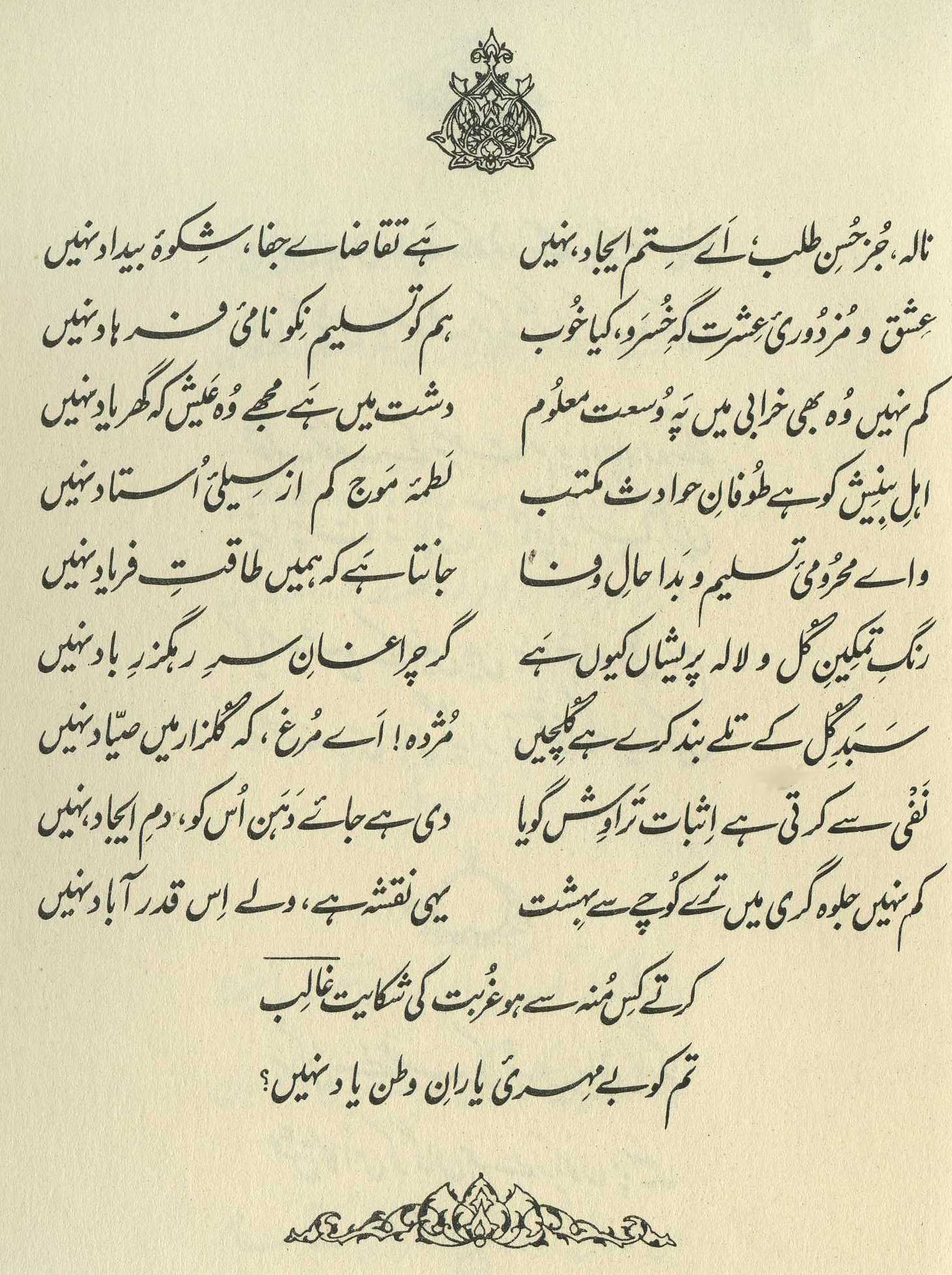
By 'wave', the wave of the typhoon of events is meant. The meaning is that instruction in good counsel comes from events. (107)
== Nazm page 107

He says that for people of insight, the typhoon of events has the authority of a school. The blow of the wave is not less than the slap of an Ustad, for the obtaining of the lesson of good counsel. (158)
In the eyes of the wise, the typhoon of events is a school. They consider the slaps of the waves to be not less than the slaps of an Ustad. That is, unlike fools, they don't fear difficulties, nor do they sit stupefied and helpless. Rather, they take a lesson in good counsel. (208)
This one is a classic mushairah verse-- we can't see where the first line is going until (after a suitably tantalizing interval) we get to hear the second. Even in the second, we don't get to the punch-word until the last possible moment: out of all this impersonal typhooning and waving and buffeting suddenly emerges the slap of the Ustad. (Traditionally, for an Ustad to slap or beat a lazy or misbehaving pupil was no more than his duty.) And then, also in true 'mushairah verse' style, the verse is effective, powerful, and complete all at once, even as it's over.
The mention of the Ustad introduces a human note into all that impersonal wildness. But of course, your human Ustad slaps you because he cares about you: he wants to get your attention, he wants to impress something on your memory, he wants to chastise your laziness, he wants to prepare you for the future as best he can. Are we meant to see God's hand behind the typhoon of events? If so, we'll have to do it on our own authority, because the verse itself presents as the Ustad-figure only the 'wave of events/calamities'.
Thus in the guise of cheerful, straightforward moral instruction, it's a grim and somewhat terrifying verse. It reminds me of 208,12 , in which the speaker not only confronts 'an ocean of blood', but fears that something even worse might be looming in the future. For after all, a 'typhoon' [] is a deadly storm: it can wreck everything you have, it can carry away your loved ones, it can kill you in an instant. Its 'waves' can be dozens of feet high.
So if the 'typhoon of events/calamities' is a school, and its huge 'wave' buffets us like an Ustad's slap, it would seem to be a kind of Dickensian nightmare-school. What lessons are being imparted? Well, what do we learn from being hit by a typhoon? Both to take every precaution, and to realize that sometimes no amount of precaution will suffice. We are to learn how to live in an ominous, insecure world, in which suffering is sure to come often, with little or no warning, and from unexpected directions. 'Insight' into such a world is bought at the price of sorrow.
graphics/school.jpg