Verse 6after 1826aadnahii;N
G5
In this meter the first long syllable may be replaced by a short; and the next-to-last long syllable may be replaced by two shorts.
1
why is the style/color of the dignity/establishedness of the rose and tulip disturbed/scattered
2
if they are not lamps at the edge of the wind's road?
'Colour, colouring matter, pigment, paint, dye; colour, tint, hue, complexion; beauty, bloom; expression, countenance, appearance, aspect; fashion, style; character, nature; mood, mode, manner, method; kind, sort; state, condition'.
'Establishing, confirming; investing with authority, giving power, enabling, affording opportunity; majesty, dignity, authority, power; sedateness'. (Steingass p.325)
'Dispersed, scattered; disordered, confused; dishevelled, tossed (as hair); amazed, distracted, perplexed, bewildered, deranged; troubled, distressed, wretched; ruined'.
| References | |
|---|---|
| Arshi, Imtiyaz Ali | Ghazal# 104 |
| Raza, Kalidas Gupta | 371-72 |
| Hamid Ali Khan | Open Image |
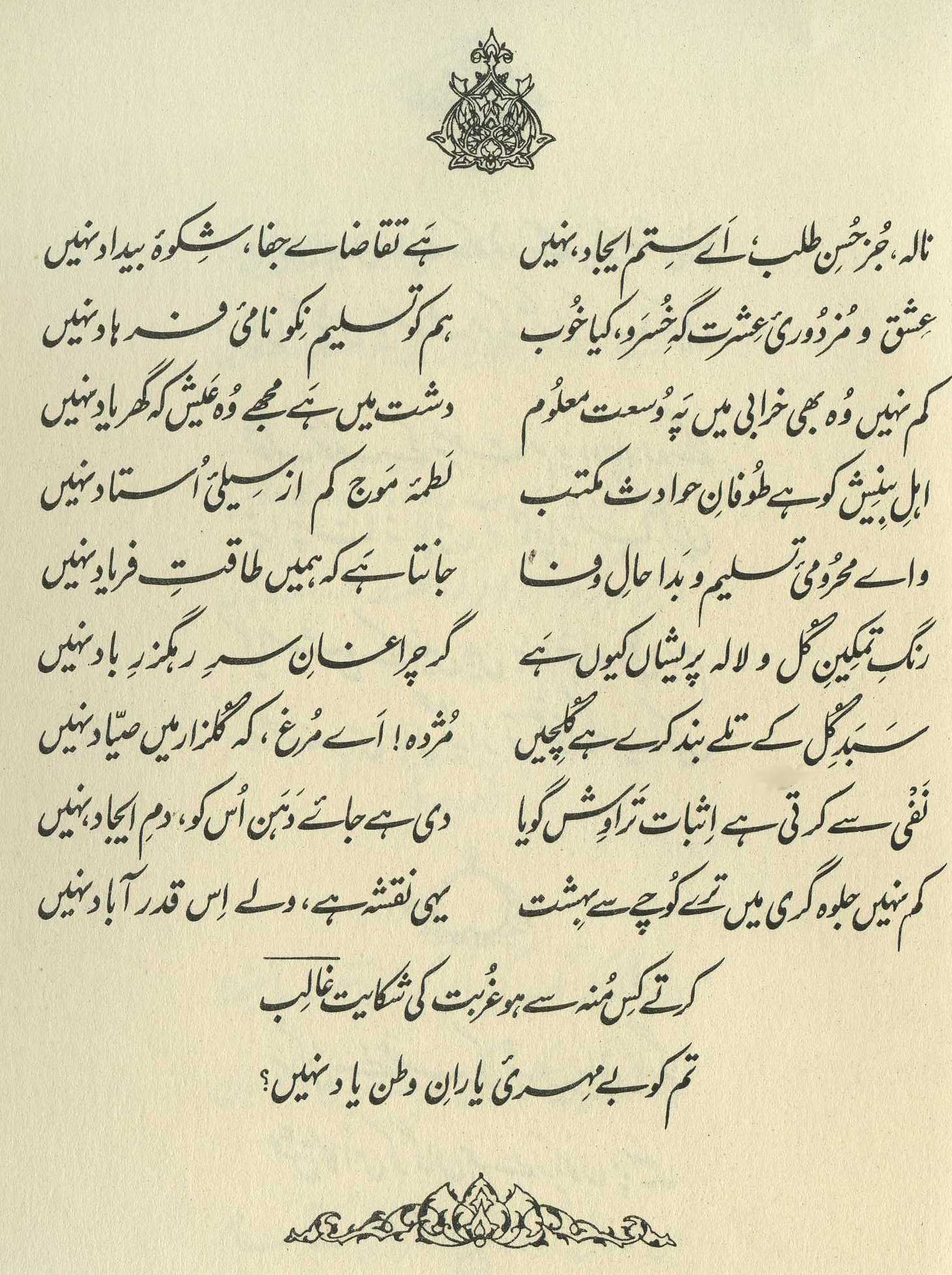
That is, if the glory/appearance of the rose and tulip is not a lamp of the wind's road, then why is it so unstable/transient? (107)
== Nazm page 107

The meaning is that if a lamp is lit and put in a windy place, then it is quickly extinguished; and the rose and tulip too are unstable/transient. That is, flowers don't last longer than one or two days. (158)
That is, the way the flames of lamps flutter in the face of the wind, and are quickly extinguished, in the same way the tulip and rose, too, quickly wither and vanish. For opened tulips and roses he has given the simile of flickering lamps. (208)
Roses and tulips in full bloom are lamp-like. They have the rounded bowl shape of an oil lamp. They are dazzlingly radiant in their redness, like a flame. They have a limited lifespan at best, and will soon lose their brilliance. They sway back and forth in the wind, the way a lamp-flame flutters in the wind. And of course, once they are 'blown' (this is actually the term used for roses that have shed their petals) they and their radiance are destroyed, the way a lamp-flame is blown out by the wind.
There's an obvious wordplay with , which means literally 'color', and by extension 'style, aspect, mood' and so much else (see the definition above). Then there's the elegantly multivalent opposition between , which has a basic meaning of 'establishedness' or 'dignity' (such as the aristocratic rose and tulip, rulers and beloveds of the garden, ought to have), and , which literally means 'disordered, scattered' (as by the wind), and by metaphorical extention means 'distracted, anxious' (as at the approach of death).
The classic, melancholy ghazal meditation on the transience of the rose's beauty is well presented here. It has a lyrical appeal. It also has ominous overtones: when our short-lived summer rose-lamps go out, what can we look forward to except to be left in darkness, with only the cold autumn wind blowing?
In 105,2 , the sun itself becomes a lamp in the wind's road.
graphics/windflowers.jpg