Verse 61821aatchaahiye
G3
1
growth and increase is from the root/origin, Ghalib, for the branches/derivatives
2
from only/emphatically silence emerges the speech/idea/matter that is needed
'Intoxication, drunkenness; exhilaration (from wine, &c.), hilarity'.
'Growing; increasing; rising; growth; increase; rise'.
'Showing, exhibiting, pointing out; —showing itself, appearing'.
'Growth and increase'. (Steingass p.1404)
'Growing up'. (Steingass p.1405)
'Bottom, root, origin, base, foundation; original, source; an essential, a fundamental principle; essence; element, principle; chief thing, main point, original or old state or condition'.
'Tops, summits, heads; branches; subdivisions; ramifications; derivatives'.
is an archaic form of, here, ( GRAMMAR )
'Speech, language, word, saying, conversation, talk, gossip, report, discourse, news, tale, story, account; thing, affair, matter, business, concern, fact, case, circumstance, occurrence, object, particular, article, proposal, aim, cause, question, subject'.
'Is necessary, is needful or requisite, is proper or right'.
| References | |
|---|---|
| Arshi, Imtiyaz Ali | Ghazal# 180 |
| Raza, Kalidas Gupta | 361 |
| Nuskhah-e-Hamidiyah | 242 |
| Gyan Chand | 493 |
| Hamid Ali Khan | Open Image |
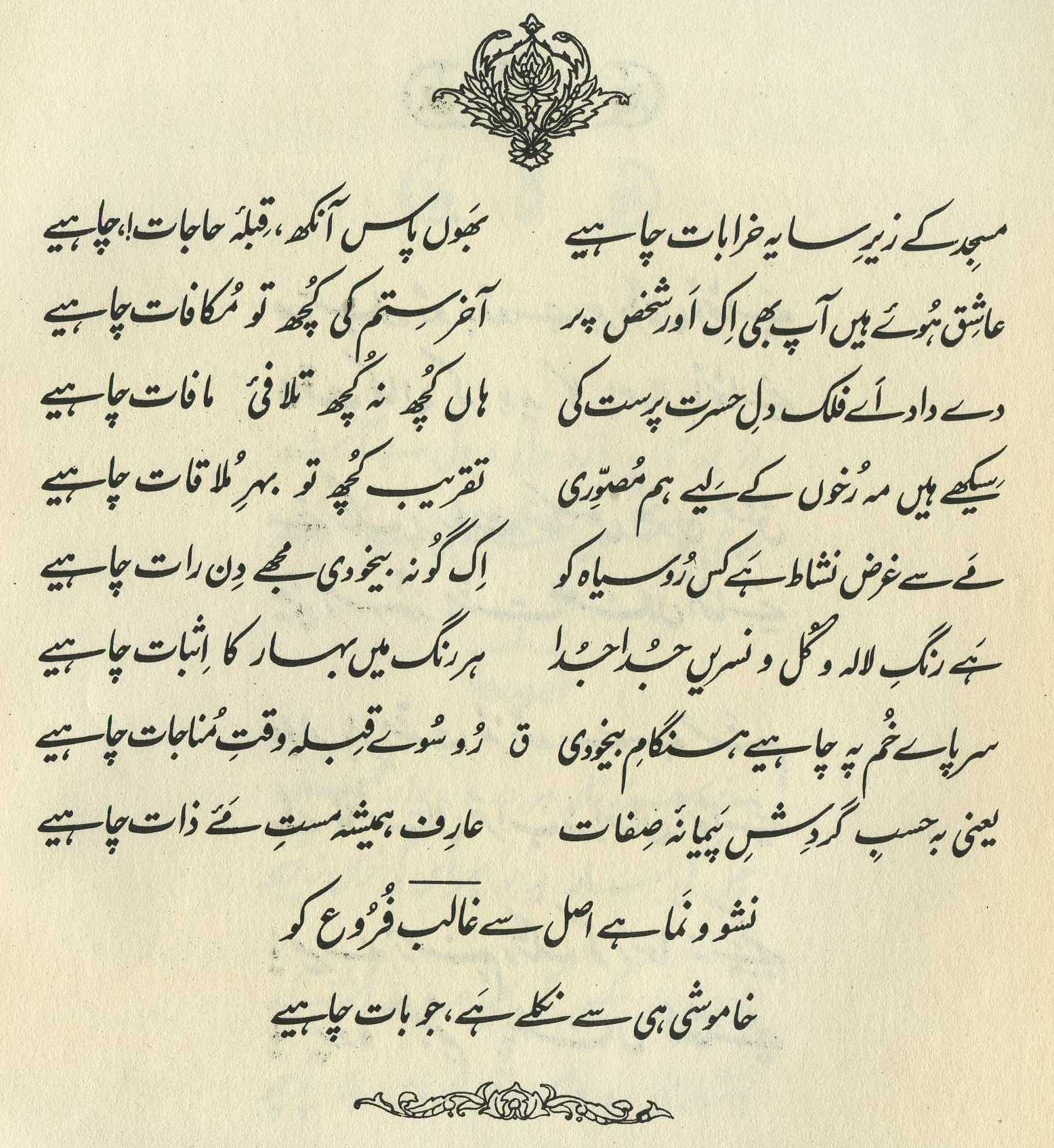
The meaning of this verse-set is that the beginning of the whole world of bodies is free from the body and bodily things, and is outside this world, the way the branches of a tree all emerge from the root, but the root is hidden. The second illustration [] is whatever speech there is, it has emerged from silence; that is, first meaning came into his head, after that speech arose from it, and meaning itself is hidden.
The third illustration [in 131,7 ] is that there are flowers of different colors in the garden, and in every color the proof of spring is present, and spring itself is hidden from the eyes. After this he says that from the many-colored flowers we ought to take the lesson that in every color/aspect man ought to prove/establish his origins. Sometimes he is flushed with intoxication, sometimes he is the Ascetic who stays awake all night; that is, all these colors/moods are among the qualities of Being []. And every single quality manifests itself in its own time, and bears witness to the presence of Being. [The commentary abruptly turns to a long technical discussion about the scansion of the final in .] (140-41)
== Nazm page 140 ; Nazm page 141 ; Nazm page 142


He says, from the origin-- that is, from the root-- is the flowering and fruiting of the branches. Oh Ghalib, the speech that emerges from a man's lips-- first the man inwardly understands its meaning, when some speech emerges from his lips. In this whole verse-set he has included these same ideas of mysticism, and in these verses has expressed these three things. [He copies almost verbatim the three points made by Nazm.] (197)
The meaning of this verse-set is exactly what Janab [Nazm] Tabataba'i has written. That is, the origin of the whole world (the world of bodies) is free from the body and bodily things, and is outside this world. The way the branches of a tree emerge and grow from the root, but the root is hidden. (263)
The first line, to avoid convolutedness, can be like this: . (326)
This verse marks the beginning of a verse-set that includes the remaining four verses of the ghazal. The ordering is unusual, because the present verse is, formally speaking, a closing-verse , but it doesn't appear as the last verse of the ghazal. This state of affairs is rare, but not unheard-of; it's more common in Mir and other earlier poets . Nowadays the urge to have the closing-verse actually be the last verse is so strong that some commentators and editors have moved this one to the final position; among them are Hasrat Mohani (108); Bekhud Dihlavi; Baqir (337); and Josh (243-44); Hamid too has done so. But as always, I follow Arshi; and the more scholarly editors and commentators are with him. To me, this officially-marked verse-set doesn't feel half as unified as some of those not officially so marked (for discussion, see ' verse-set '); but we're aiming for fidelity to the best authorial tradition, not personal choice by any modern editor. So this closing-verse is the beginning of a verse-set.
And what a simple, seemingly plain, but actually subtle verse it is! The second line states a truth about human life, and the first line has already 'proved' it with a powerful and elegant 'objective correlative'. Silence is to speech, as the root is to the branches. This beautiful relationship has various suggestive corollaries:
=The root provides not anything the branches happen to fancy, but only, and exactly, what they need for proper growth; similarly, silence gives rise to the speech that is 'needed', that is necessary. There may well be other kinds of speech that are desirable, or desired, but are not necessary; these do not (necessarily) arise from silence.
=The growth and nurture of the branches by the root proceeds slowly, over many years, and not always at the same pace, and the branches have no control over it. Human beings must learn to be still, and patient, and enduring.
=Everyone sees the branches, but no one sees the root. Human beings are mysteries to each other, and perhaps to themselves as well.
The verse also lends itself to a mystical reading. When things come 'out of silence', it may mean that their origin is not silence itself (as we've been assuming so far), but something that works through silence, or some divine actor who moves behind a veil of silence. On this latter reading, the 'necessary speech' might be the voice of an angel (compare 169,13 ), or even the direct words of God.
graphics/banyan.jpg