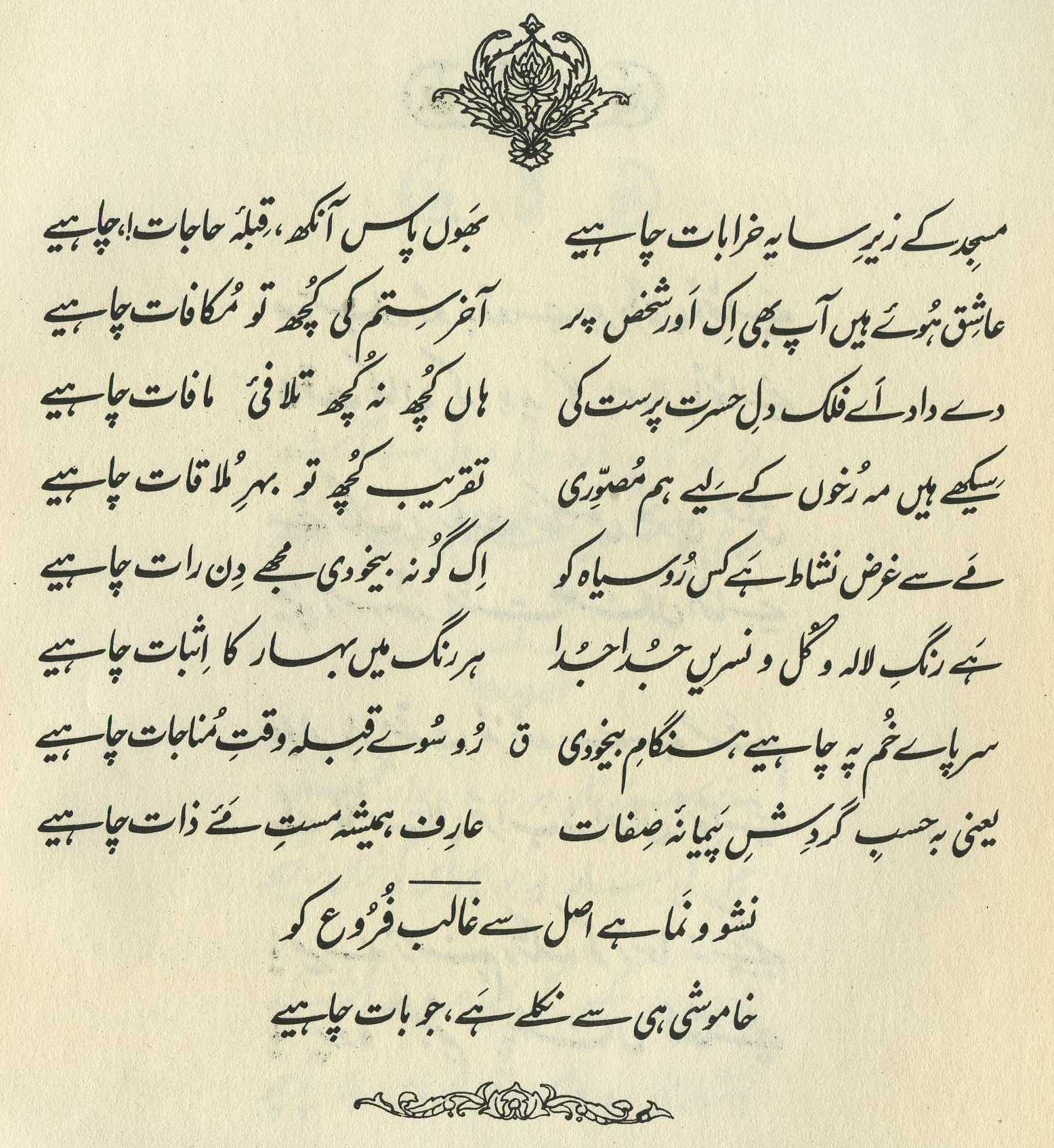
Verse 11821aatchaahiye
G3
1
under the shade/shelter/protection of the mosque, a wine-house is needed
2
near the brow an eye, supplier/ Qiblah of necessities, is needed
'Shadow, shade; shelter, protection'.
'Ruins, desolate place;... A tavern; --a brothel (such being usually kept in ruins).'
'That part to which Muslims turn their faces when at prayer; the temple of the Ka'ba in Mecca; Mecca; --an altar, a temple, an object of veneration or reverence;... (by way of respectful address) Father! Worship! Sire!'.
'What is looked to for the attainment of (one's) necessities or desires; one who supplies (another's) needs'.
'Is necessary, is needful or requisite, is proper or right'.
| References | |
|---|---|
| Arshi, Imtiyaz Ali | Ghazal# 180 |
| Raza, Kalidas Gupta | 361 |
| Nuskhah-e-Hamidiyah | 242 |
| Gyan Chand | 493 |
| Hamid Ali Khan | Open Image |
The simile s of the eye as a wine-house, and the eyebrow as the [arched] prayer-niche [] of a mosque, are well-known. The author has here created an innovation by taking the reflection [] of this simile. The term is a of a mosque, but it is a very idiomatic word. And the thing is that when an idiom is used only for the sake of creating a , then the is displeasing. And when the idiom would be wholly engaged [], then using the very same is attractive; and this is the situation with every verbal device []. (139-40)
== Nazm page 139 ; Nazm page 140


Poets always give the simile of a wine-house for the eye, and the prayer-niche of a mosque for the eyebrow. He says, oh Supplier of Necessities (this is directed toward the Preacher , or the Shaikh , or the Ascetic ), a wine-house certainly ought to be built adjacent to the mosque-- the way God the Most High has created an eye near the eyebrow. (195)
He has composed a joke on the Preacher: 'Oh Supplier of Necessities, there definitely ought to be a wine-house next door to the mosque, the way near the eyebrow there's an eye'. In this verse the meaning also emerges that between the mosque and the wine-house is the relationship of eyebrow and eye-- and the eye is of a higher rank than the eyebrow. (260)
What an irreverent and mischievous [] verse! Two conventional similes are abruptly combined, for a slightly shocking, amusingly witty effect. Why is the emblematic Qiblah -pointing niche [] of a mosque like an eyebrow? Because they both have an arched shape, and they both shelter and protect what is beneath them. (For a verse linking the eyebrow and a , see 347x,2 .) Why is the eye like a wine-house? Because it regularly provides, and pours into the mind, the intoxicating, ravishingly beautiful colors and forms of the world. (For a classic meditation on this theme, see 169,5 .)
All very well known and well established. But when the verse suddenly juxtaposes them (which, in order to maximize the effect, it cleverly doesn't do until the second line)-- the whole thing explodes. The verse 'proves' with the most perfect poetic logic that every mosque should have next to it-- and in its shelter and protection-- that most officially un-Islamic place, a wine-house (described in its crudest and rawest form, in which it is linked to ruins and prostitution as well; see the definition above).
And not only that, but as Bekhud Mohani points out, the verse also proves that the wine-house is of higher rank than the mosque, just as the eye is of higher rank than the eyebrow. Since it could well be said that the eyebrow exists only in order to protect the eye, it could also follow that the mosque exists only to protect the wine-house (which justifies the 'under the shade/shelter/protection' in the first line).
And what about ? Obviously, it's a double source of wordplay. The is the direction (toward Mecca) that Muslims should face in prayer, and every mosque features a small arched opening [] that marks it, so there's a perfect affinity with the reference to the mosque in the first line. And since means 'necessities, needs', it resonates elegantly with the refrain , .
The commentators read as a vocative-- a teasing, mock-respectful address to one of the conventionally pious figures of the ghazal world, in a verse that is meant to shock his religious sensibilities. But the expression can also refer to a thing (see the definition above), and in this case the closest (and thus most obvious) thing is the eye, so that the reading would be 'an eye, [which is] a supplier of necessities, is needed'. This reading offers a further touch of enjoyment: the formal, respectful expression, so seemingly appropriate to a mosque, is applied instead to the wine-house-- the 'eye' that supplies our need for color and beauty (and intoxication, and escapism) in this world, the 'eye' for which the mosque is nothing but a protective eyebrow, the eye that itself is, with elegant word- and meaning-play, a Qiblah . Remember, after all, the lovely 48,9 .
For another verse that begins with , see 362x,1 .
Mir offers a vision of the Ka'bah as being very possibly outranked, and certainly outlasted, by the wine-house; the use of (with its associations of ) to describe the Ka'bah is the real linchpin of the verse [M 270,7 ]:
[up to the Ka'bah, we hear, is desolate and wrecked
if anything is well-peopled, it's the wine-house, these days]
And he also relishes the beloved's two arched -like eyebrows [M 1220,8 ]:
[don't ask about the devices of passion! -- the way beneath the brows, the eyes of idols
where they saw arches, decorated two wine-houses]
But the way Ghalib brings all the imagery together so irresistibly is entirely his own.
graphics/mihrab.jpg