Verse 71821aatchaahiye
G3
1
the color of tulip and rose and eglantine is each one separate
2
in every mode/manner/'color', a demonstration/proof of springtime is needed
'The Dog-rose, or Eglantine'.
'Colour, tint, hue, complexion;...appearance, aspect; fashion, style; character, nature; mood, mode, manner, method'.
'Establishing, confirming; confirmation, corroboration, verification, proof, demonstration; ascertainment; certain knowledge'.
'Is necessary, is needful or requisite, is proper or right'.
| References | |
|---|---|
| Arshi, Imtiyaz Ali | Ghazal# 180 |
| Raza, Kalidas Gupta | 361 |
| Nuskhah-e-Hamidiyah | 242 |
| Gyan Chand | 493 |
| Hamid Ali Khan | Open Image |
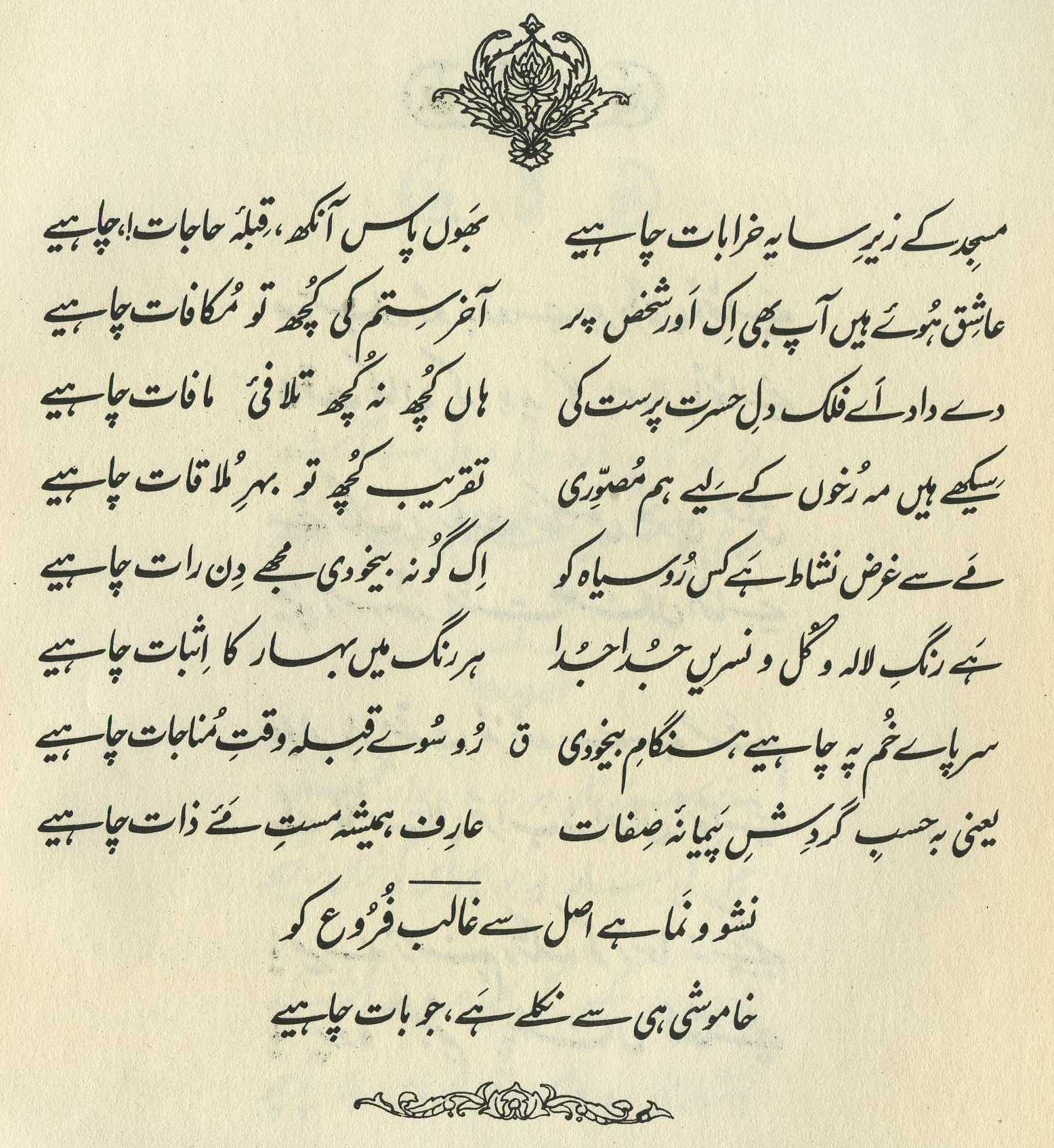
[See his comments for the whole verse-set : 131,6 .]
== Nazm page 140 ; Nazm page 141 ; Nazm page 142


He says, the colors of tulip and rose and eglantine are separate. That is, the tulip can be of many colors, but in each of its variously colored flowers is a wound/scar [on this see 33,1 ]. The rose too is of many colors. The eglantine is most often white. The gist is that the variation in colors and shapes is not the point. In every color it's necessary for a proof of springtime to exist. By 'springtime' is here meant the thought of an expression of the essence of the Court of the Most High. The verse is mystical, and is a fine one. (196)
This is the second verse of a four-verse verse-set ; for discussion see 131,6 .
The crucial word here is obviously , and how cleverly it's been deployed! The first line opens with , and then occupies itself with comparing flower-colors and emphasizing the individuality and differentness of each. The second line opens with the similar-seeming , and we expect to continue our discussion of colors and flowers. Maybe 'in every color' is a different kind of beauty, or a necessary part of the visual symphony of the garden, or a fresh pang to the heart of the desolate lover?
But then the second line develops the abstract possibilities of , to the exclusion of its 'color' meaning. The abstract meanings of (see the definition above for a sampling of the word's very wide range) are invoked both by the word , drawn from the domain of logic and reasoning, and by the verb , which suggests that something 'is needed', and thus might or might not be present. Once the verse starts arguing that a 'proof' of something is 'needed', it's outside the domain of color and into that of the philosophical discussion of 'aspect, character, nature, mood, mode', etc. How effortlessly the protean makes the transition! But only in retrospect, of course, after we've heard (or read) the whole second line, and then gone back and mentally reinterpreted the verse. (The first time through, we're bound to be fooled, because Ghalib has set it up for us that way, beyond our power to avoid.)
If we decide to read the two lines as describing the same situation-- since here, as so often, we have to make our own decision about their relationship-- we will go back and reread the first line, turning each flower into a complex moral agent with not just its own color but its own 'aspect, character, nature, mood, mode', etc.-- and therefore its own obligation to provide a 'proof' of spring. Alternatively, we can decide that the two lines are separate, with the first one a mere illustration of the second: just as each flower has a color of its own, so every mood and mode and form of activity needs to provide its own 'proof' of spring.
An obligation is thus being placed by the speaker on almost everything in the world. By what authority does he speak? By whom are all these proofs of spring 'needed'? Is he demanding them with confident power and authority, speaking perhaps on behalf of God? Or is he simply expressing a personal hope or desire, or even a wistful longing? And what would it take to constitute a 'proof' of springtime, anyway? Just a vivid (if short-lived) burst of color, like that of a flower? Or would it require something else more imbued with conscious activity and choice, or even with mystical insight? Needless to say, Ghalib induces us to raise these questions, and then leaves us with no answers at all.
graphics/flowers.jpg