Verse 51821aatchaahiye
G3
1
from wine, joy/pleasure is the object/intention of which disgraced/'black-faced' one?!
2
I need a single/particular/unique/excellent style/'color' of selfless-ness, night and day
'An object of aim or pursuit, or of desire, or of want; aim, end, object, design, view, purpose, intention; business; meaning; a want, need, necessity, occasion; interest, concern; interestedness, interested motive'.
t>> : 'Liveliness, sprightliness, cheerfulness, gladness, glee, joy, pleasure, exultation, triumph'.
'Colour; kind, sort, species; form, figure, fashion; mode, manner'.
'Is necessary, is needful or requisite, is proper or right'.
| References | |
|---|---|
| Arshi, Imtiyaz Ali | Ghazal# 180 |
| Raza, Kalidas Gupta | 361 |
| Nuskhah-e-Hamidiyah | 242 |
| Gyan Chand | 493 |
| Hamid Ali Khan | Open Image |
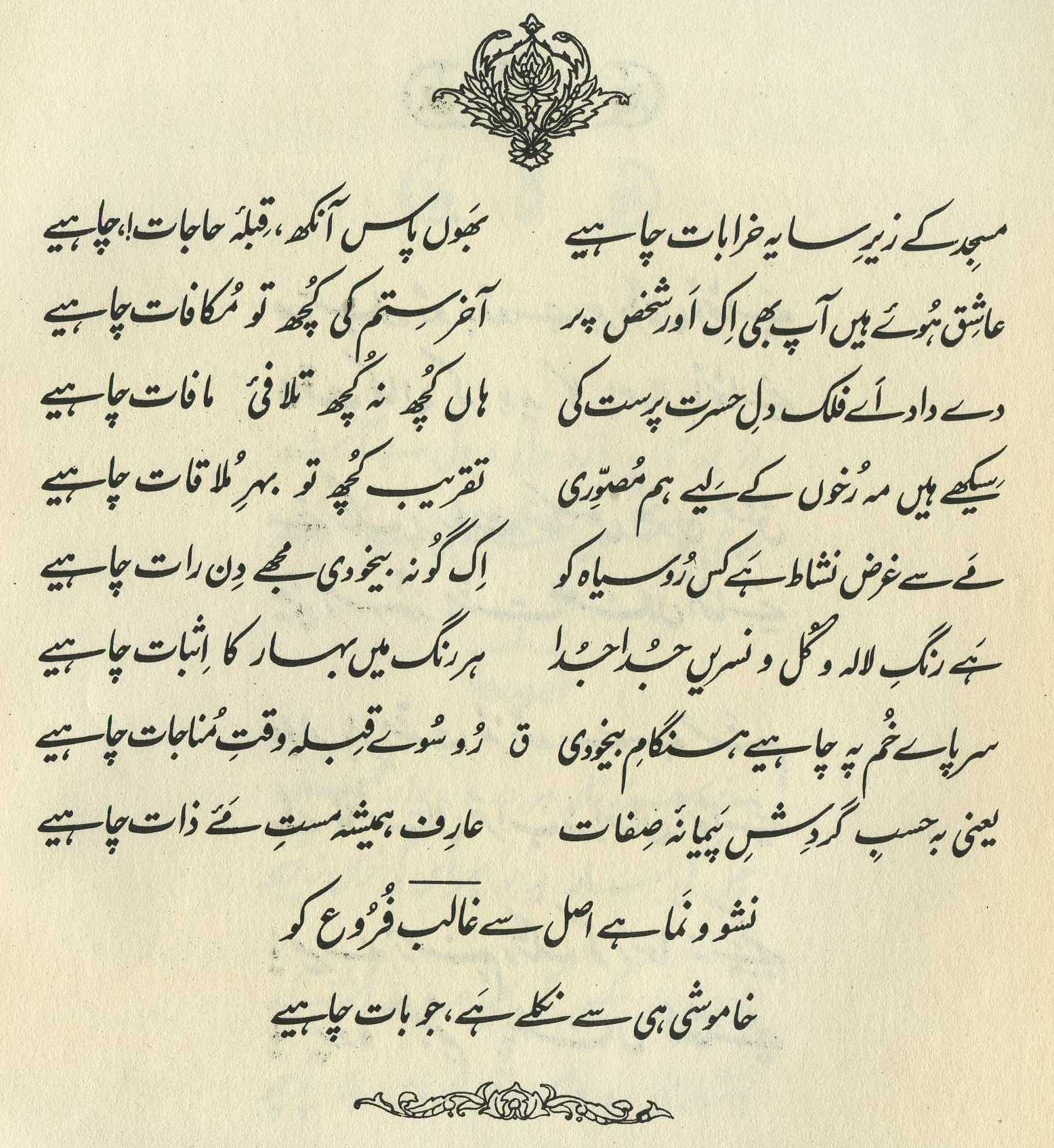
That is, he keeps causing forgetfulness of grief through unconsciousness and selfless-ness. (140)
== Nazm page 140

By drinking wine, my intention is not that I would obtain joy and delight, but rather I drink wine so that I would forget grief and sorrow. Night and day, I need some small selfless-ness. (196)
This is a verse of such broad meaning that it's not easy to comment on it. Besides joy, all the other things that necessitate drinking wine may be there-- all are present in it. Because the author has left the burden of understanding them on the mind of the hearer. Many different aspects can be seen in this verse.... The meaning of emerges as, I need one kind of selfless-ness. That is, there's nothing special about wine. I need selfless-ness, however it might be obtained....
The phrase is a doomsday/wonder! That is, the whole day my heart is full of troubling thoughts, and if at night I sleep, then frightful scenes occur in dreams. In short, asleep or awake, I find no peace. From a doomsday/wonder of power has been created in the verse. That is, it's not that I have an ardor for selfless-ness-- rather, it's become my new necessity. Or say, rather, that it's a type of medicine. (262-63)
Compare 33,2 . (128)
The color imagery offers some elegant wordplay: means literally 'color', and means 'black-faced'. And of course, there are the two highly color-coded words, (black) 'night' and (white) 'day'. There are also the overtones of the ruby (or blood) color of wine, and we can hardly avoid thinking of the idiomatic expression , 'black-drunk', for someone who's very drunk indeed-- drunk enough to become 'self-less', perhaps. (For examples of , used with imagery of (dark) shadows, see 49,2 and 80,4 .) As always, I use 'selfless-ness' to remind the reader that this is not the English word 'selflessness', meaning 'extreme unselfishness'; rather, it's about serious (Sufistic) loss of self, or obliviousness to self.
The speaker's rhetorical question sounds contemptuous, fierce, almost desperate-- people who naively (and culpably) seek joy through wine are, by implication , 'disgraced ones' or 'wretches'. Why such harshness? The speaker implies that he himself would never be so vulgar as to use wine to seek mere joy or pleasure-- where he is, joy doesn't even exist, and relief from pain is the overriding necessity. Or perhaps he thinks that such pleasure-seekers are frivolously misusing a great and serious medicine, and turning it into a mere toy; such cheap behavior is a 'disgrace'.
Whatever our view of the speaker himself, his words are chillingly bleak. Bekhud Mohani has pointed out some of their possible implications. A milder, more compassionate version of this theme can be seen in 86,3 -- where those who seek joy in wine are not 'disgraced', but are simply naive remnants of an earlier, more hopeful generation.
graphics/wine.jpg