Verse 31847aakahte hai;N
G5
In this meter the first long syllable may be replaced by a short; and the next-to-last long syllable may be replaced by two shorts.
1
they are of bygone/former times, these people-- don't rebuke them!
2
{they who / when they} call wine and music 'sadness-dispelling'
| References | |
|---|---|
| Arshi, Imtiyaz Ali | Ghazal# 107 |
| Raza, Kalidas Gupta | 390 |
| Hamid Ali Khan | Open Image |
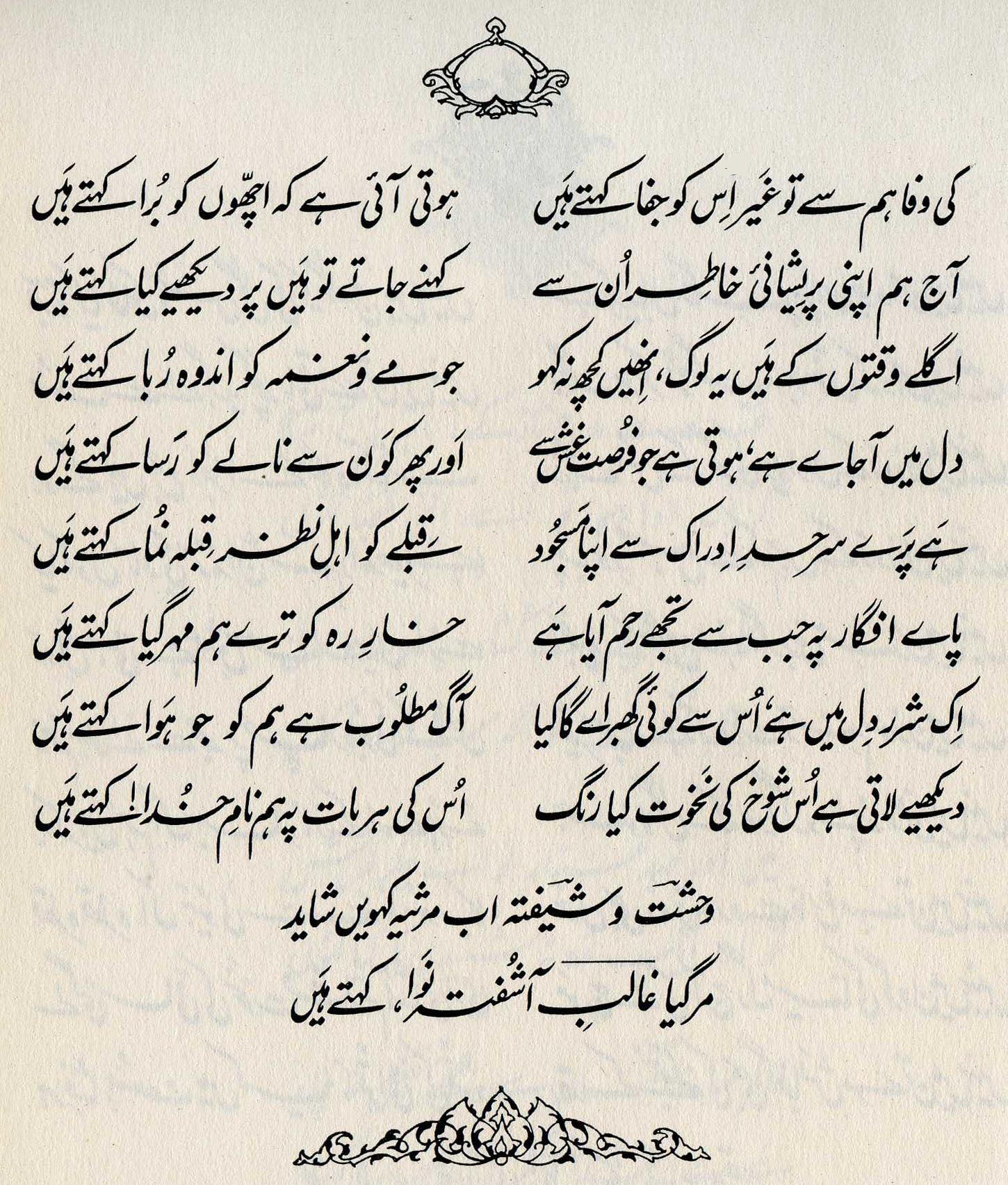
His intention is to deny that it is sadness-dispelling, or establish that it is sadness-creating. Or the point is that sadness is the kind of thing that 'when cajoled, doesn't get cajoled' []. (84)
== Nazm page 84

He says, those people who count wine and song among grief-removing things are simple, straightforward men of the old days. Wine and song are not sadness-dispelling-- rather, they are sadness-creating. Because when some item of pleasure comes before the eyes, then the memory of the beloved is refreshed. (135)
People of the old times consider that from wine and music the sorrow of the heart is erased. Don't tangle [] with them. These people are of the old times-- that is, they are simple and straightforward. Or, they aren't capable of understanding the situation and pace of this era. The meaning is either that from wine and song sorrow increases, or that sorrow is not a thing to be erased. (174)
In the first line, the speaker seems to be soothing somebody-- himself?-- and helping him control his temper. 'These people' may have offended him, but they are merely leftovers from the old days, and one should not rebuke them, quarrel with them, abuse them. The phrase literally means 'to call somebody something'. And by convention, what you 'call' somebody when using this phrase about a person is something negative, so it comes to mean abuse, scolding, quarreling. Bekhud Mohani interprets it as 'Don't tangle with them', and Baqir interprets it as 'Don't shake a finger at them [in reproach]' (221). The phrase also, of course, has a fine affinity with the next line.
So what do these old fossils do that's so irritating that one can barely refrain from quarreling with them? In good mushairah style, the first line gives us no clue at all, and we are forced to wait for the second line. What they do, we finally learn, is to call wine and music 'sadness-dispelling'. Why exactly is this so offensive? As usual, we're left to deduce the reasons for ourselves. Here are several obvious possibilities:
=Wine and music are not sadness-dispelling, but in fact are useless for this purpose, and one shouldn't fraudulently promote quack remedies.
=Wine and music are not sadness-dispelling, but in fact are all too clearly sadness-enhancing. (According to some commentators, this is because they bring back memories of happier times.)
=Nothing whatsoever is sadness-dispelling, since sadness is coterminous with life, and one shouldn't deal in illusions and false hopes.
Wherever we place the emphasis among these options, the question remains: why do people of 'old times' hold these erroneous views? Are they simply romanticizing their own youth, as they think back to the good old days when the world was young, and thus see things falsely in the golden glow of memory? Or are they hypocrites who keep up a kind of pretense that all is well-- a kind of pretense that used to be considered appropriate, but has now been abandoned? Or has the human world indeed evolved over time, as it is wont to do, so that people actually do (or at least think they do) have more complex and grievous sorrows now than they used to in the past-- sorrows beyond the reach of wine and song?
And what is the speaker's relationship to these time changes? Is he himself a burnt-out former lover, such that the 'old times' spoken of in the verse represent his own early days of intense passion? Or is he a member of the younger generation, with a furious need to correct the irritating follies of his elders?
All these interlocking questions hover in a kind of cloud of implication around this lovely, simple verse. Lovely, simple-- and ominous. This verse chills the heart. Compare it with the more overtly desperate, almost furious 131,5 .
Note for grammar fans: The postposition in the first line is crucial: means 'to call somebody something'-- in practice, something bad, like a bad name or a term of abuse. It should never be confused with , 'to say something to somebody', which is neutral and just describes an utterance.
graphics/musicians.jpg