Verse 51847aakahte hai;N
G5
In this meter the first long syllable may be replaced by a short; and the next-to-last long syllable may be replaced by two shorts.
1
beyond the limit of the senses is their/our prostration-object
'Perception, apprehension, understanding, comprehension'.
'Anything opposite; --that part to which Muslims turn their faces when at prayer; the temple of the Ka'ba in Mecca; Mecca; --an altar, a temple; an object of veneration or reverence'.
'Showing, exhibiting, pointing out'.
' 'Showing the '; an instrument by which Muhammadans at a distance from Mecca ascertain the direction of the ; —a mariner's compass'.
| References | |
|---|---|
| Arshi, Imtiyaz Ali | Ghazal# 107 |
| Raza, Kalidas Gupta | 390 |
| Hamid Ali Khan | Open Image |
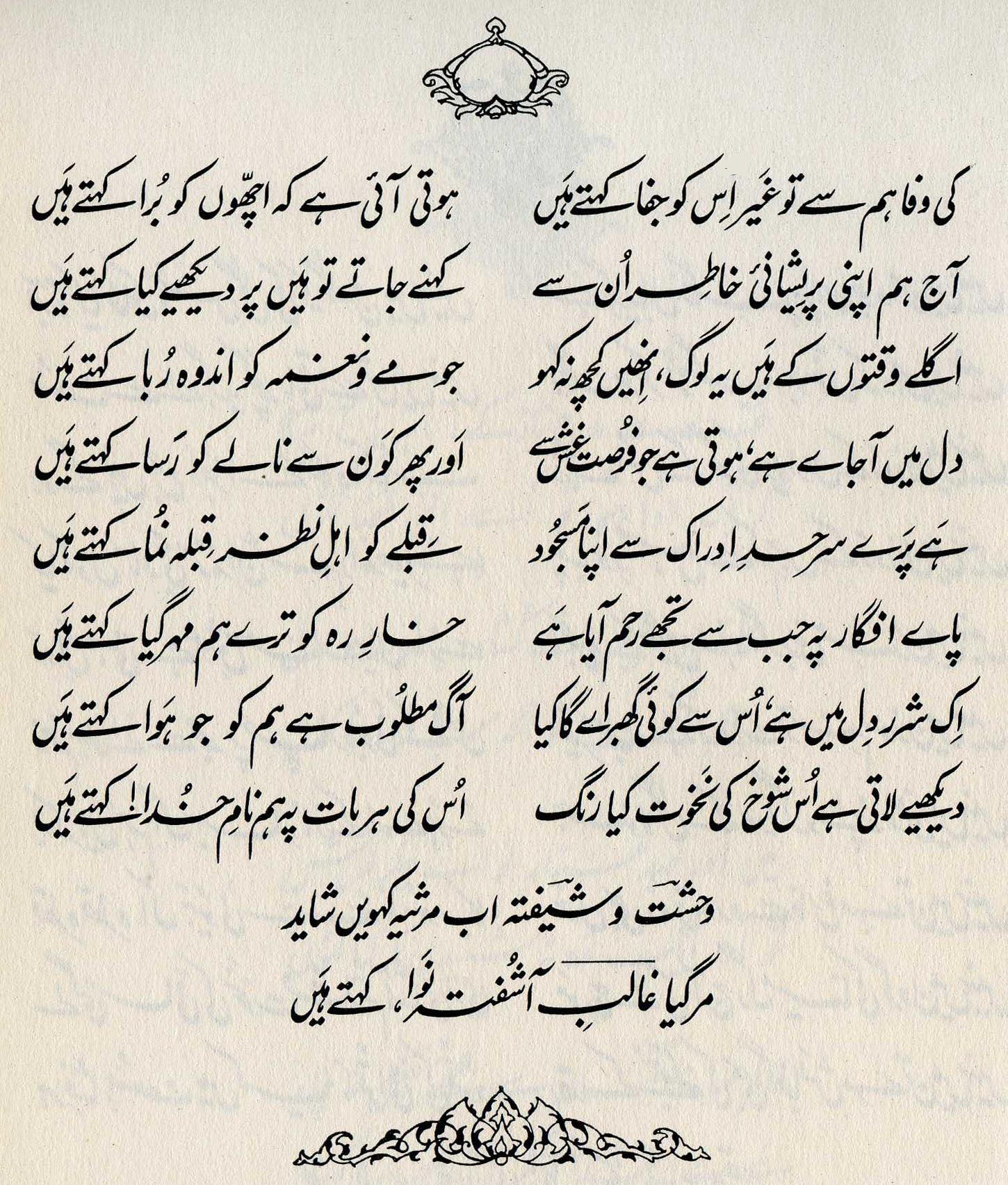
Calling the Qiblah a 'Qiblah-pointer' is something that clearly no one other than Mirza has done.
==Urdu text: Yadgar-e Ghalib , p. 147
The author has versified this problem: that by doing prostrations toward the Ka'bah , the goal is not to do prostrations to the Ka'bah. Rather, the one to Whom we do prostrations is beyond the directions, and a prostration must have a direction. For this reason, He has decreed the direction of the Ka'bah. (85)
== Nazm page 85

To separate the Qiblah from the 'Qiblah-pointer' is a theme that could fall to Mirza Sahib's lot alone. Before Mirza Sahib, nobody said it. This verse is an answer to the objection of those people who say that the Muslims too prostrate themselves before the stones of the door of the Ka'bah. He says, our worship-object is absolutely very far beyond the limit of the senses. That is, whether we have seen the Ka'bah or not, we prostrate ourselves in the direction of the Ka'bah. (135)
Except for its much greater depth and memorableness, this would be a classic mushairah verse, with all the elements in place. The first line is theologically irreproachable, since every Muslim knows that God is not a material object that human senses can detect. We effortlessly read in its normal sense of something that is 'adored, worshipped' (Platts p.1033). But the line is also quite obscure as to its intention-- what is the point of such a vague, broad abstraction? And in particular, the use of , literally 'own', denies us any information about the identity of the worshiper(s) in question.
In a mushairah setting, we of course are compelled to wait through the traditional tantalizing interval of repetition and audience response, before we are allowed to hear the second line. And then we learn not only who the worshipers are ('people of vision'), but also where the first line was going. We realize that is to be read, unusually, in its absolutely literal, grammatically precise sense of 'a receiver of [prostration]'. But the full sense of the verse is withheld until the very last moment-- is the final word in the second line, right before the refrain . Thus it comes with a shock of surprise, delight, and fulfillment.
As the commentators admiringly observe, nobody but Ghalib would think to call the Qiblah a 'Qiblah-pointer', a kind of compass (see the definition above)-- and a conspicuously ' fresh word '. This verse offers the intellectual shock of radical originality. Yet this originality is of a focused, limited, lucid-seeming kind. Far from being difficult to understand, the verse is straightforward. And as in the case of most mushairah verses, once we get it we've got it. This is a verse that in a sense yields up all its intellectual content at once, like a crushed grape. There aren't even two ways to read it, much less ten.
But then of course once we've got it, what exactly have we got? Since the Qiblah itself is basically a pointer (to the Ka'bah) already, what does it mean to call this pointer, in effect, a 'pointer-pointer'? Does it mean that the Ka'bah itself, to which the Qiblah points, is merely a proximate goal, and a pointer in its own right? If so, it must point to something 'beyond the limit of the senses'. But how can anything beyond all sensory perception be 'pointed to'?
Perhaps that's why it's the 'people of vision'-- and is the ordinary word for sight, gaze, etc.-- who don't just 'see' the physical or literal Qiblah as one might expect, but who 'see through' it and consider it merely a pointer toward the real, immaterial . There's thus a nice play on 'sight' and 'insight', something like the double (physical and mental) sense of 'vision'.
Compare the treatment of Ka'bah versus in 413x,5 .
On this unspecific use of , see 15,12 .
graphics/mihrabthatta.jpg