Verse 71847aakahte hai;N
G5
In this meter the first long syllable may be replaced by a short; and the next-to-last long syllable may be replaced by two shorts.
1
a single/particular/excellent/unique spark is in the heart-- will anyone be perturbed/alarmed by this?
2
'fire' is sought/meant by us, when we say 'wind'/desire
'To be confused, confounded, flurried, or flustered (by, or in consequence of, - ); to be perplexed, bewildered, or embarrassed (by); to be perturbed, disturbed in mind, agitated, disquieted, distracted; to be alarmed, scared, dismayed'.
'Fire; flame; heat, excessive heat; (met.) anger, passion; love; lust'.
tluub>>: 'Sought, required, demanded, desired, longed for; wanted, needed, necessary; --s.m. A quest; a desire; an object, a purpose'.
'Air, wind, gentle gale; ... —affection, favour, love, mind, desire, passionate fondness; lust, carnal desire, concupiscence'.
| References | |
|---|---|
| Arshi, Imtiyaz Ali | Ghazal# 107 |
| Raza, Kalidas Gupta | 390 |
| Hamid Ali Khan | Open Image |
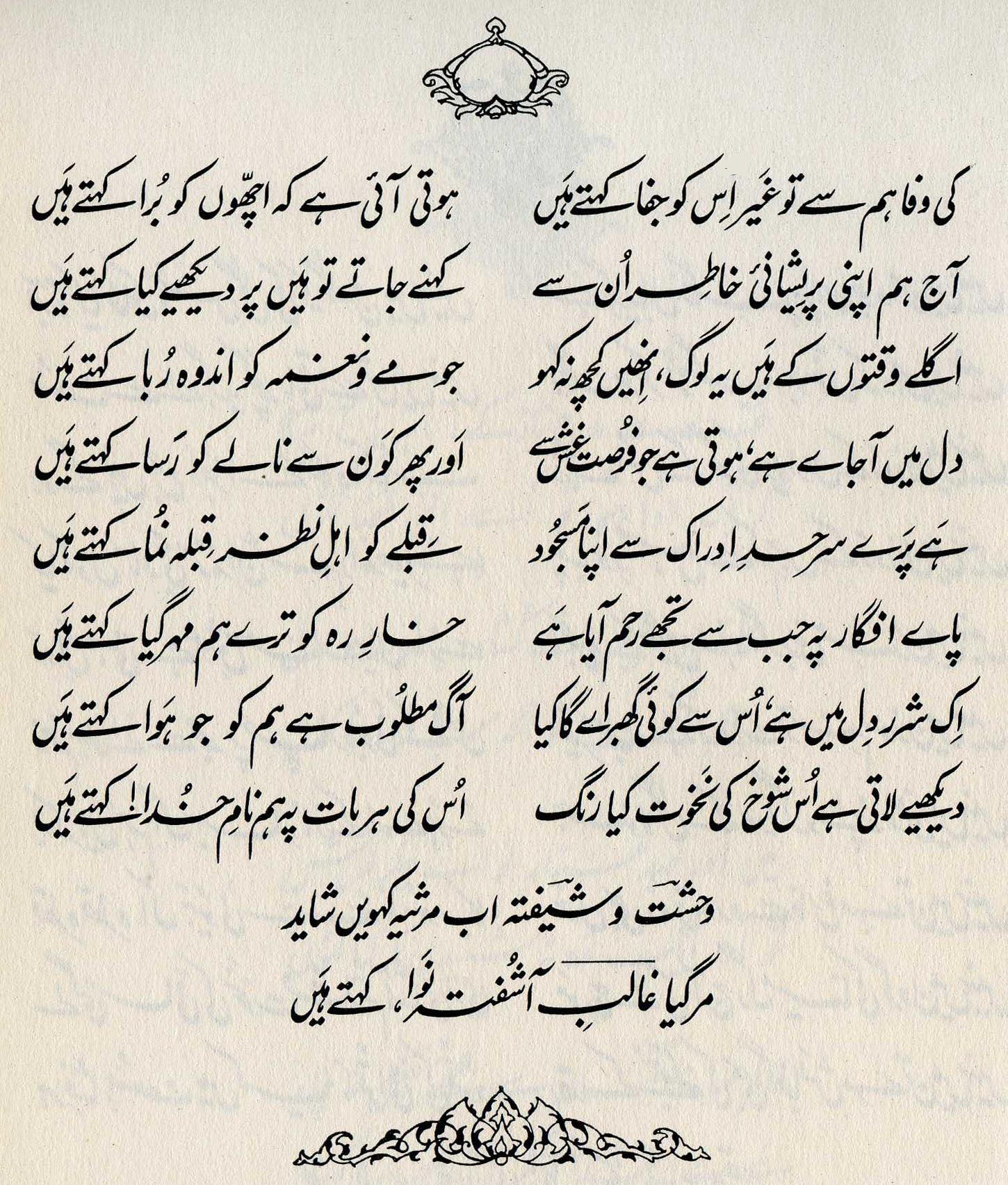
That is, it ought not to be thought that humans are made to take a breath through being perturbed by the heat of the animal spirit [] that is in the heart. Rather, it is the vital spirit [], and merging into it is desired.... The author has versified this theme in the manner of a poetic account. But since the question of the circulation of blood has been proved, it is actually thus.... From this verse the author's philosophical temperament can be estimated. (85)
== Nazm page 85

In accordance with modern philosophy (since the problem of the flow of blood has recently been proved) he has composed this verse, from which the philosophical capability of Hazrat the author can be learned. By the 'spark' is intended the animal spirit, which is present in human beings. He says, humans are not obliged to take a breath through the heat of the animal spirit; rather, through the wind/desire of every breath the mingling with the vital spirit is sought. (136)
The heat of love in the heart is not something that anyone would be perturbed about. Rather, when the word wind [] is constantly on our tongue, it's wrong to think that this means that we are perturbed about the heat of this fire. Rather, we need wind in order to make of this small ember a burning flame. (176)
It's a philosophical verse. By 'spark' is meant the vital spirit []. Because of this spirit perturbation is created. This perturbation seizes hold of wind. And the act of respiration is set in motion. Mirza says that the vital spirit is only a single spark. Why will anyone be perturbed by it? For its progress only wind is effective, and from respiration only wind increases its vitality. As if what they call 'wind' is in reality fire, which we constantly seek in order to establish life, so that more perturbation would be created and respiration would constantly continue. (172-73)
[A related verse of Mir 's might have been an influence; see that verse, M 847,11 , for extensive discussion of the theme. Bedil too has a thematically related verse, which is also discussed in M 847,11 .]
Ghalib's two lines seem to be entirely without connection . 'In my heart there's only a single spark-- and that too, is it something for anyone to fear?! When I say wind, then in truth my meaning is fire.' -- what does this mean? If the spark in the heart is no cause for fear, then why ask for wind? And even if we are asking for 'wind', then how can its meaning be 'fire'? This seems apparently to be devoid of logic.
In order to resolve this apparently illogical expression, consider the points below:
A single spark is in the heart-- a state of confinement, a demand for wind. Because the intermediate state is not expressed, there's a feeling of illogic. A single spark took birth in the heart. Now the hope was that this spark, steadily growing, would bring first the heart, then the whole body, within its range. But it's confined; the spark is not finding the opportunity to grow and flourish. I call out, 'Wind! Wind!'. People think that I have become fearful of my spark and am demanding wind so that it would extinguish it. Thus-- what the hell [], is a spark anything to be anxious about? I am seeking wind so that it would bestow on the spark more strength.
A second point is that the coming and going of breath within the body becomes a means of vitality. This same breath, within the heart, will bestow on the spark more force. As if this very breath that is the basis of life in reality also cuts off life, because if the spark in the heart flares up, then it will finish off the whole existence. In this way the eternity [] of the breath, which causes the prolonging of life, in reality conducts it to the stage of mystical knowledge and eternity [] where the whole existence turns to fire.
As Mir says: M 15,9 .
With regard to the mood of dramatic mysteriousness, Ghalib's verse is inferior to the verses of Bedil and Mir that I discussed above. But Mir's and Bedil's verses don't have the complexity of meaning that Ghalib's verse does.
Zafar Iqbal has adopted Ghalib's theme very excellently:
[so what if the fire would flare up! I have plenty of endurance for the spectacle--
opening my breast, I give wind to the ember].
== (1989: 106-08) 2006: 129-31
The first line sounds innocuous, soothing-- would, or should, anyone worry about a tiny spark, and that too one that's confined within the speaker's heart? Surely nobody would find in it a cause of anxiety?! The clear effect of the speaker's words is to reassure us that there's no danger-- this tiny confined spark hardly counts, it's nothing like a fire, everything is under control. Under mushairah performance conditions, we would of course be made to wait a bit before being allowed to hear the second line.
Then suddenly that brilliant, sinister second line turns everything around. Far from reassuring us, the speaker presents his passion as almost a threat: 'Our little inner spark is not enough-- we want more, we want fire! Bring on the wind!'. For even a tiny spark can become a conflagrationl, just as in 6,6 the tiny drop of a sigh that remains in the heart turns into a typhoon.
As we've seen in other verses, is a very convenient word: it has not only the meaning of 'wind', but also that of 'desire' (for more on this see 8,3 ), which here resonates with words like 'heart' and 'fire'. The word literally means 'sought' or 'desired' (see the definition above). Thus when the speaker says 'wind' (or 'desire'), what is sought or 'desired' by him is 'fire'-- which itself has a common metaphorical meaning of 'desire'.
Moreover, the structure of the second line offers us an additional reading as well. The second line could be taken to suggest that when we say 'wind', we actually mean 'fire'-- as though it were a question of clarifying a definition or reference, as for example in 59,6 (the poet means 'airs and graces', but finds it necessary to say 'knife and dagger' instead). Or it might be some kind of clever euphemism ('fire' might scare people, but 'wind' sounds more reassuring). Or it might be sheer obsession-- other people say 'wind' and mean the spring breeze, but the speaker's world is such that even when he says 'wind' he means 'fire'. (As in 15,7 , when from earth to sky the lover's world is a mass of burning.)
Really it's the second line that's the killer, isn't it? It almost glows in the dark. It's so punchy, so cryptic, so mysteriously ominous.
graphics/sparks.jpg