Verse 11847aakahte hai;N
G5
In this meter the first long syllable may be replaced by a short; and the next-to-last long syllable may be replaced by two shorts.
1
when/if she showed faith to us, then the Other s call it oppression/cruelty
2
it has kept happening over time-- that they vilify/'call bad' the good ones
'To speak ill (of), to pronounce or call (one) bad, evil, wicked, &c.; to vilify, abuse'.
| References | |
|---|---|
| Arshi, Imtiyaz Ali | Ghazal# 107 |
| Raza, Kalidas Gupta | 390 |
| Hamid Ali Khan | Open Image |
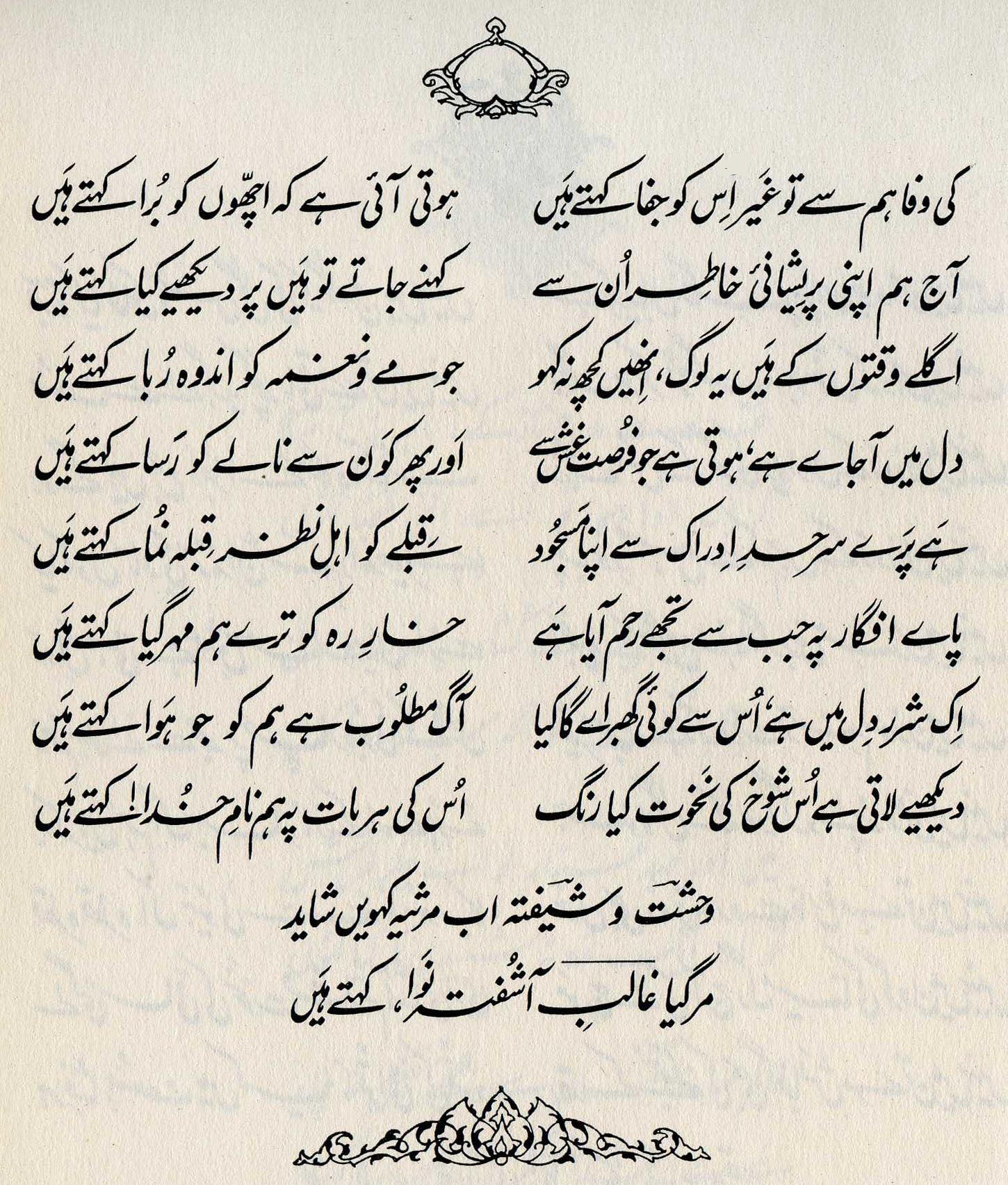
The subject of is the beloved. (84)
== Nazm page 84

He says, when the beloved treated us with faithfulness, then the Rival calls this oppression/cruelty. This ancient custom comes down to us, that enemies or jealous people always {vilify/ call 'bad'} good people. (134)
The first line is the complaint of the Rival s. In the second line he consoles his heart, that if they call faithfulness 'oppression/cruelty', then let them do it. It's nothing new. The people of the world always vilify the good ones. (174)
This verse is another example of play with words and idioms. The first line contains an amusing and attractive pair of nouns-- opposites that are separated by only a letter. Those who show are accused of . It's a very convenient slippage that involves replacing only one letter, so the Others can readily engage in saying that something is really its opposite.
The second line begins with the soothing truism-marker, something like 'it's been going on for ages' or 'it's come down to us' or 'by longstanding custom'. And indeed we learn that the longstanding custom is that 'they' vilify or abuse certain people. The idiomatic expression is a stylized one (see the definition above). But of course, the people who are vilified are 'good ones'. And this at once revitalizes the expression in its literal meaning, 'to say/call bad'.
Thus the second line plays on one set of opposites, just as the first line plays on another set. The first line can now be seen as a specific case; and the second line is revealed as the general principle illustrated or proved by it. And of course the verse is a lovely mushairah one, offering witty and quickly-grasped pleasures, and withholding the final, clinching idiom until the last minute.
graphics/goodbad.jpg