Verse 81847aakahte hai;N
G5
In this meter the first long syllable may be replaced by a short; and the next-to-last long syllable may be replaced by two shorts.
1
(please) look at what style/'color' that mischievous one’s pride/haughtiness displays/'brings'!
2
at her every utterance we say 'in the Lord ’s name!'
'Pride, haughtiness; consequential airs; pomp, magnificence'.
| References | |
|---|---|
| Arshi, Imtiyaz Ali | Ghazal# 107 |
| Raza, Kalidas Gupta | 390 |
| Hamid Ali Khan | Open Image |
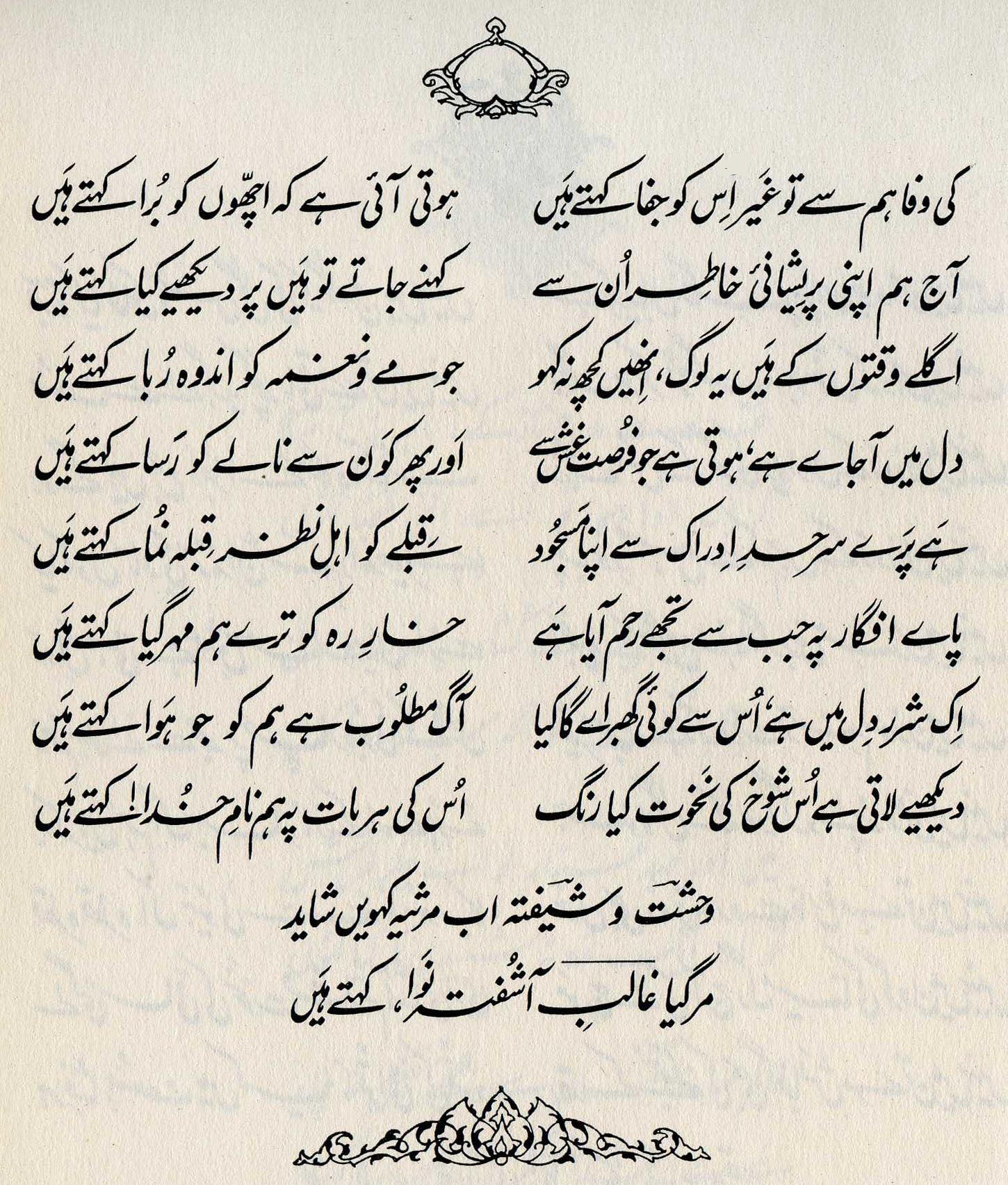
That is, from our doing that, she knows that her every word is good, and her pride/haughtiness keeps increasing. (85)
== Nazm page 85

He says, at her every word we always say, 'in the Lord's name!' or 'God has willed it so!' [], 'the evil eye be far away!' []. As if her pride/haughtiness keeps making progress, through such phrases of ours. As a result of these words, let's see what becomes of her pride/haughtiness-- that is, there's no telling in what herd this camel would settle down []. (136)
With , is fine. is an expression of praise. In just such circumstances they say [praise be to God!] etc., too. The meaning that at her every word we say, praise be to God! From this she's grown arrogant. Let's see what style/color her arrogance displays, and what effects her pride/haughtiness creates []. (173)
[See his discussion of in M 1700,3 .]
For this 'A,B' verse, the question is, in which order should the lines be read? The commentators tend to read (2) first, then (1). That is, it's the speaker's constant exclamations of awe and amazement that produce strange new (and deadly?) forms of behavior, since he is constantly reinforcing the beloved's arrogance. He invites the addressee to stick around and see what astonishing wonders come of it.
But it's also quite possible to read the lines in the order (1), then (2). In this case, the verse forms a kind of inexpressibility trope. The speaker begs the addressee (some friend?) to look at the beloved's behavior, at the mischievous, egregious, vivid forms her arrogance displays. The friend must look for himself, because the speaker can't possibly find words to describe it. Indeed, all he can do is marvel at her, and constantly, helplessly, exclaim 'in the Lord's name!'-- because her behavior is so wonderful, and/or because it's so awful.
Moreover, the two lines could also be taken as together describing the same situation. On this reading, the form that her mischievousness and haughtiness take is this: that every time she speaks she requires her lover to say 'in the Lord's name!'.
It's a verse as full of force as it's possible to get.
graphics/khuda.jpg