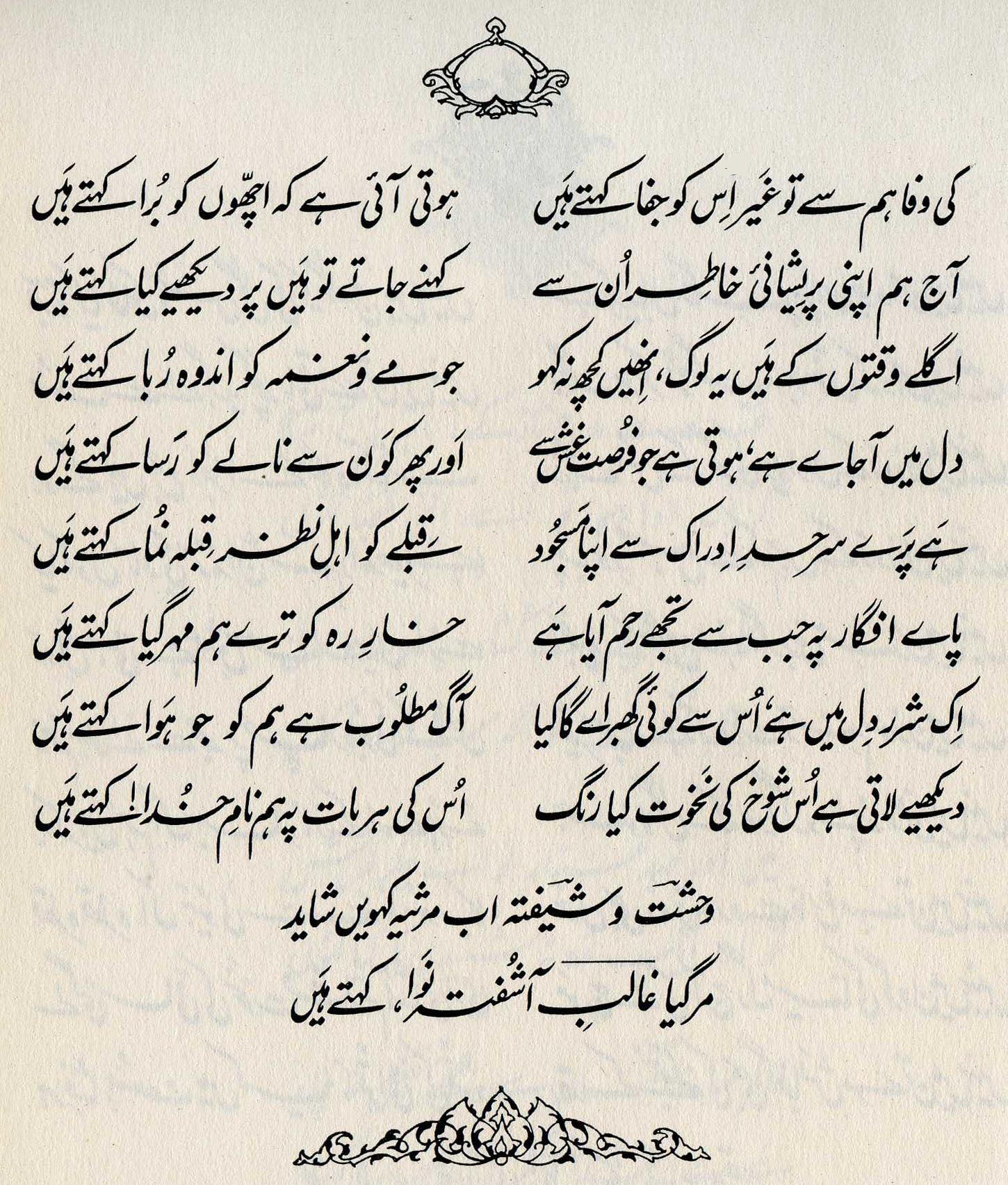
Verse 61847aakahte hai;N
G5
In this meter the first long syllable may be replaced by a short; and the next-to-last long syllable may be replaced by two shorts.
1
ever since you have had mercy on the wounded foot
2
we call the thorn of your road mandragora/'mihr-giya'
is a shortened form of , 'grass'.
'A mistress, the face of a sweetheart; the mandrake; the plant turnsole; a fresh fruit, from the root of which a delicious juice is extracted; chemists; those especially who search after the philosopher's stone, alchemists'. (Steingass p.1354)
| References | |
|---|---|
| Arshi, Imtiyaz Ali | Ghazal# 107 |
| Raza, Kalidas Gupta | 390 |
| Hamid Ali Khan | Open Image |
By 'your thorn of the road' is meant the thorn that has lodged in the lover's foot during his search for the beloved. The reason for calling it is that it became the cause of the beloved's affection and mercy. If it had not wounded the foot-soles, then she would not have felt mercy. And -- that is, [sun-grass]-- is a species of grass. (85)
== Nazm page 85

is a kind of plant of which the root is in the shape of a man. It's well known that people become kind [] toward the man who keeps it with him. Here, he has called the thorn of the road because the foot was wounded by the thorn, and the beloved felt mercy toward the wounded foot. (77)
He says, since our feet have become wounded by thorns of the road, you've felt mercy toward them. Thus we don't call the thorns of your road thorns, but rather, . [He then copies Hasrat's explanation for this, without acknowledgment.] (135)
[In English ] is 'root of mandrake' [English], a plant the root of which is two figures facing each other. They say that whoever has this root, the person before whom the root-bearer goes becomes kindly [] to him. (284)
is a species of grass. They say that whoever might have a sprig of this plant, everyone always remains kind [] to him. (172)
The proverbially magic plant with the human-shaped root is called in English ' mandrake ', and belongs to the 'mandragora' family; perhaps contains some cognate echo. Whether it does or not, clearly the affinity between its name, 'mihr-grass', and the that means kindness or graciousness, as in , is at the heart of the verse.
In fact there's not much else going on in the verse. It would surely be at its best in a mushairah , where it would be called on only for one quick, punchy, enjoyable effect. 'A fresh word is equal to a theme ', as Talib Amuli, Shah Jahan's poet laureate, famously said. (For further discussion, see 17,2 .) Presumably is such a fresh word that it can energize and carry the verse all by itself.
graphics/mandragora.jpg