Verse 21847aakahte hai;N
G5
In this meter the first long syllable may be replaced by a short; and the next-to-last long syllable may be replaced by two shorts.
1
our distraction/disorder of temperament-- today we, to her
2
indeed go to say it-- but let's see what {we say / she says}
'Dispersion, scattering, confusion, disorder, derangement, perplexity, bewilderment, perturbation, distraction; distress, embarrassment, trouble, misery'.
| References | |
|---|---|
| Arshi, Imtiyaz Ali | Ghazal# 107 |
| Raza, Kalidas Gupta | 390 |
| Hamid Ali Khan | Open Image |
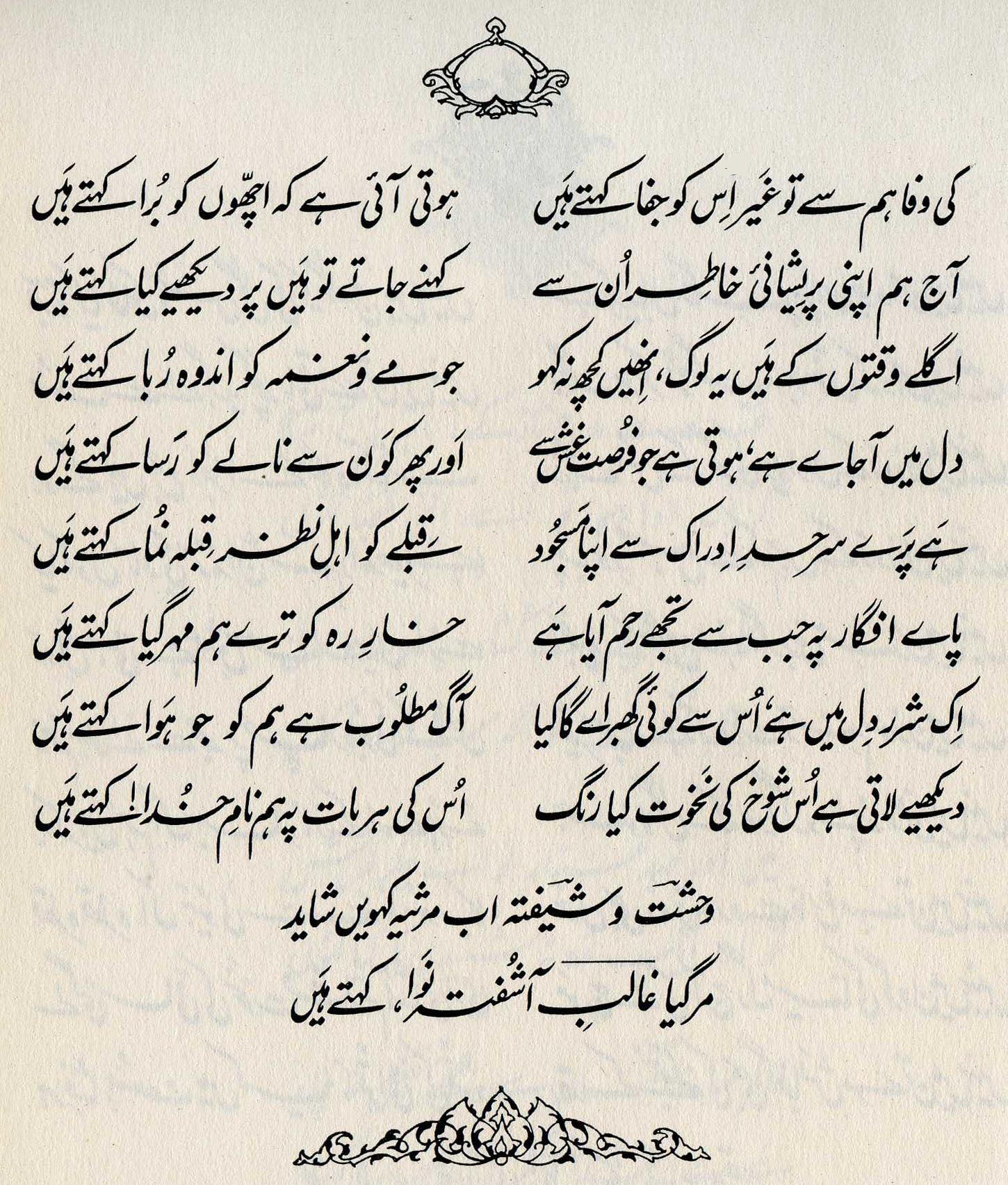
That is, having gone there, let's see what we say; or let's listen and see what she says. Of these two aspects, the first aspect is more meaningful. It expresses the additional meaning that having gone before the beloved, the absorption and self-transcendence that is created-- in it, will I say anything, and will anything come out of my mouth? (84)
== Nazm page 84

In this verse two meanings have been created. One is that having arrived before her, are we able to say anything, or not? That is, whether the awesomeness of beauty deprives us of the power of speech or not. The second meaning is that having heard our situation, let's see what answer she gives to it. But greater enjoyment is in the first meaning. (134)
Some Ustad has said,
/
You say, 'we'd say this, we'd say this if the beloved came'
these are all mere words; nothing {is/ can be} said/....
In this verse and are full of meaning. That is, at the hands of our heart we're now so anxious that we can't refrain from telling it. But along with that, it also emerges that hopelessness even now lowers the heart-- that speaking is useless, there prayers are not answered. (174)
Normally I translate line by line; this verse, however, is so classic a case of enjambment that it forced me into contortions to do so. (The point of doing so is of course to help readers get at the exact Urdu words in each line.) Otherwise, if we translate both lines together, the word order is very readable Urdu prose: Today we indeed go to tell her our distraction of temperament-- but let's see what {we/she} say(s).
This is a conspicuous example of Ghalib's trick of making grammar that can be read in two (or sometimes three, or more) ways. As all the commentators point out, the subject of can be either for the speaker, or (with the plural of respect) for the beloved.
Nazm makes the excellent point that the former reading is more interesting, because it offers two possibilities: the usual 'let's see what we say' (the lover doesn't know what words, if any, will actually fall from his lips when he gets there); and a negative rhetorical question or exclamation, 'let's see if we say anything!' (since he may be incapable of speech in that setting). This latter possibility is set up by the first line-- the lover's problem is -- scatteredness, distraction, confusion, anxiety. Just the sort of condition, in short, that may make it difficult or even impossible to find words.
And when we add the awesomeness of the beloved's beauty and bad temper, the effect may well be truly overpowering. Or, as Nazm maintains, the lover may be silent out of mystical absorption and self-lessness. Or, of course, out of exhaustion and weakness. Or out of sheer despair. Almost any other outcome is more probable, in short, than an effective, moving speech by the lover, that would be well received by the beloved. And we all know this already-- including the lover, who knows it best of all.
For the rhetorical situation seems to be that the lover is responding to the urging of some well-meaning friend. Go see her, the friend says, tell her how you feel. The lover agrees to try. But his dubiousness is set up in advance by 'indeed' (my best translation here of ). And it's made manifest by , 'but'-- a small word that, here as so often, says it all.
Bekhud Mohani quotes a verse by 'some Ustad'. It looks to be a slightly misremembered form of this clever one of Mir 's [M 729,5 ]:
[you say, 'we'd say thus, we'd say thus if she came'
these are mere words; nothing {is / can be} said].
graphics/pareshani.jpg