Verse 91847aakahte hai;N
G5
In this meter the first long syllable may be replaced by a short; and the next-to-last long syllable may be replaced by two shorts.
1
2
Ghalib of the distracted voice/song has died, they say
is a variant form of ( GRAMMAR )
| References | |
|---|---|
| Arshi, Imtiyaz Ali | Ghazal# 107 |
| Raza, Kalidas Gupta | 390 |
| Hamid Ali Khan | Open Image |
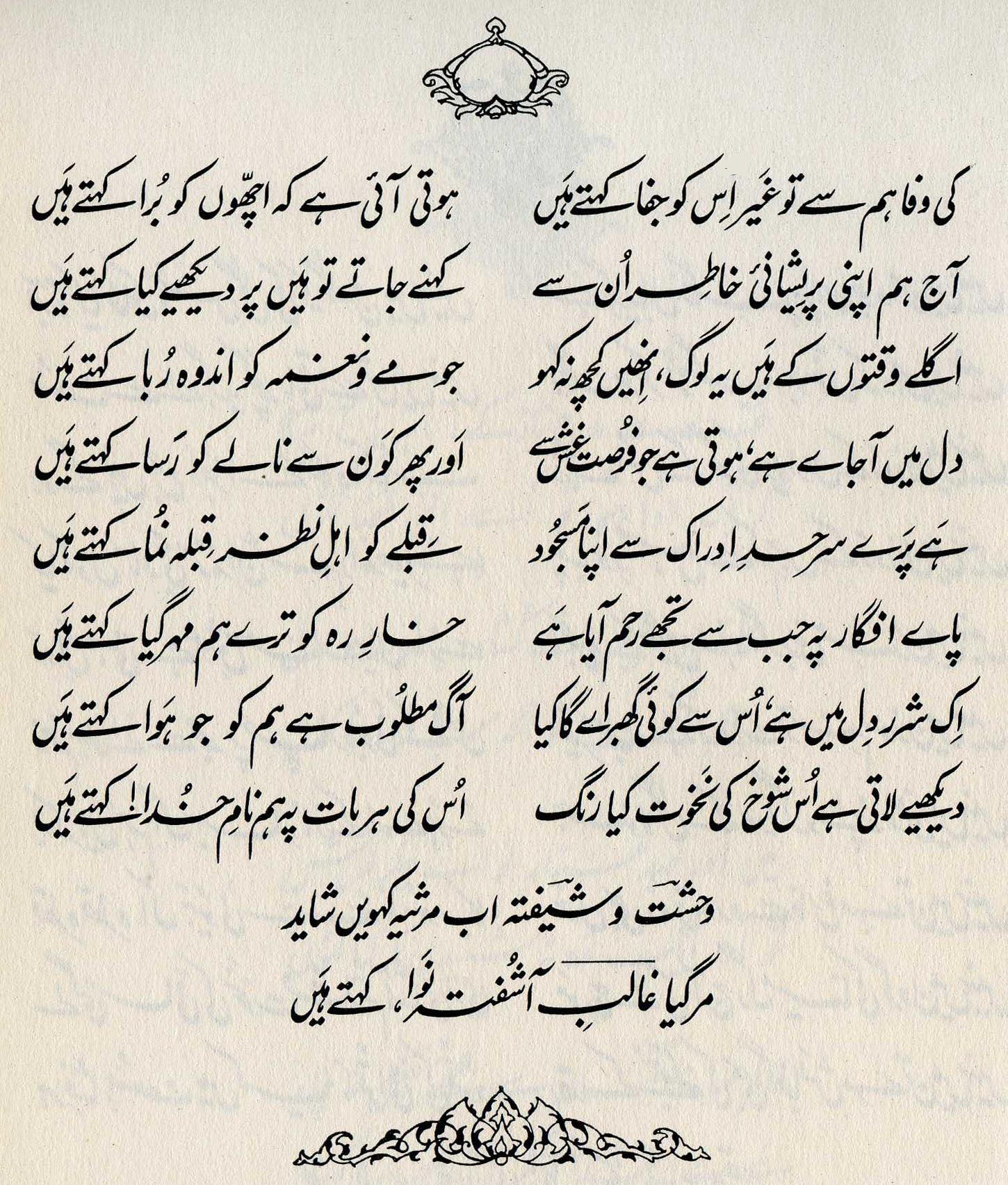
The theme of dying is extremely effective. For this reason the Preacher too colors his speech with this theme. And the poet too is pleased to do the same thing. Sheftah, author of the 'Anthology of Poets' [], is a famous connoisseur of poetry. (85-86)
== Nazm page 85 ; Nazm page 86


By 'Sheftah' is meant Navab Mustafa Khan Bahadur 'Sheftah', a noble of Jahangirabad. And by 'Vahshat' is probably meant Ghulam Ali Khan Sahib 'Vahshat'. They both were Mirza Sahib's shagird s, but more than shagirds, they were Mirza Sahib's loyal admirers. After the death of Momin Sahib, both those gentlemen used to obtain advice about poetry from Mirza Sahib alone. (136)
= sayer of confused things. The reason he has used these words for his style is that they have a relationship and association with and .... Vahshat and Sheftah were both poets, Mirza's contemporaries and his special friends and companions. (173)
What excellent use he makes of his friends' pen-name s! Not only do 'Vahshat' and 'Sheftah' have a common association with wildness, madness, and so on, but they also have an elegant affinity with in the second line; in fact and come from the same Persian root.
So now that they 'say' that Ghalib of the disordered voice/song is dead, perhaps Madness and the Distracted One will 'say' or compose an elegy for him-- what could be more appropriate? Perhaps Distraction itself will compose the most fitting elegy to such a disordered poet. (Just as 57 is full of equally abstract and extravagant reactions to the lover's death.)
Or, of course, perhaps two of Ghalib's close friends and shagird s will compose an elegy after his death. It is even possible to read the second line as being spoken by Vahshat and Sheftah, rather than by the usual generalized 'they'. Perhaps the two poets are beginning to plan out their elegy, and is one of the phrases they are thinking about including.
graphics/ghalib_tomb.jpg