Verse 4after 1821aa-egul
G3
1
happy the state of that black-drunk comrade/ Rival -- who
2
would [habitually] put, like the shadow of the rose, his head on the foot of the rose
'A fellow worker (in one's craft or ordinary occupation), an associate, a partner, a mate; -- a rival, opponent, adversary, antagonist; an enemy'.
| References | |
|---|---|
| Arshi, Imtiyaz Ali | Ghazal# 80 |
| Raza, Kalidas Gupta | 358 |
| Nuskhah-e-Hamidiyah | 132-133 |
| Asi, Abdul Bari | 148-149 |
| Gyan Chand | 250 |
| Hamid Ali Khan | Open Image |
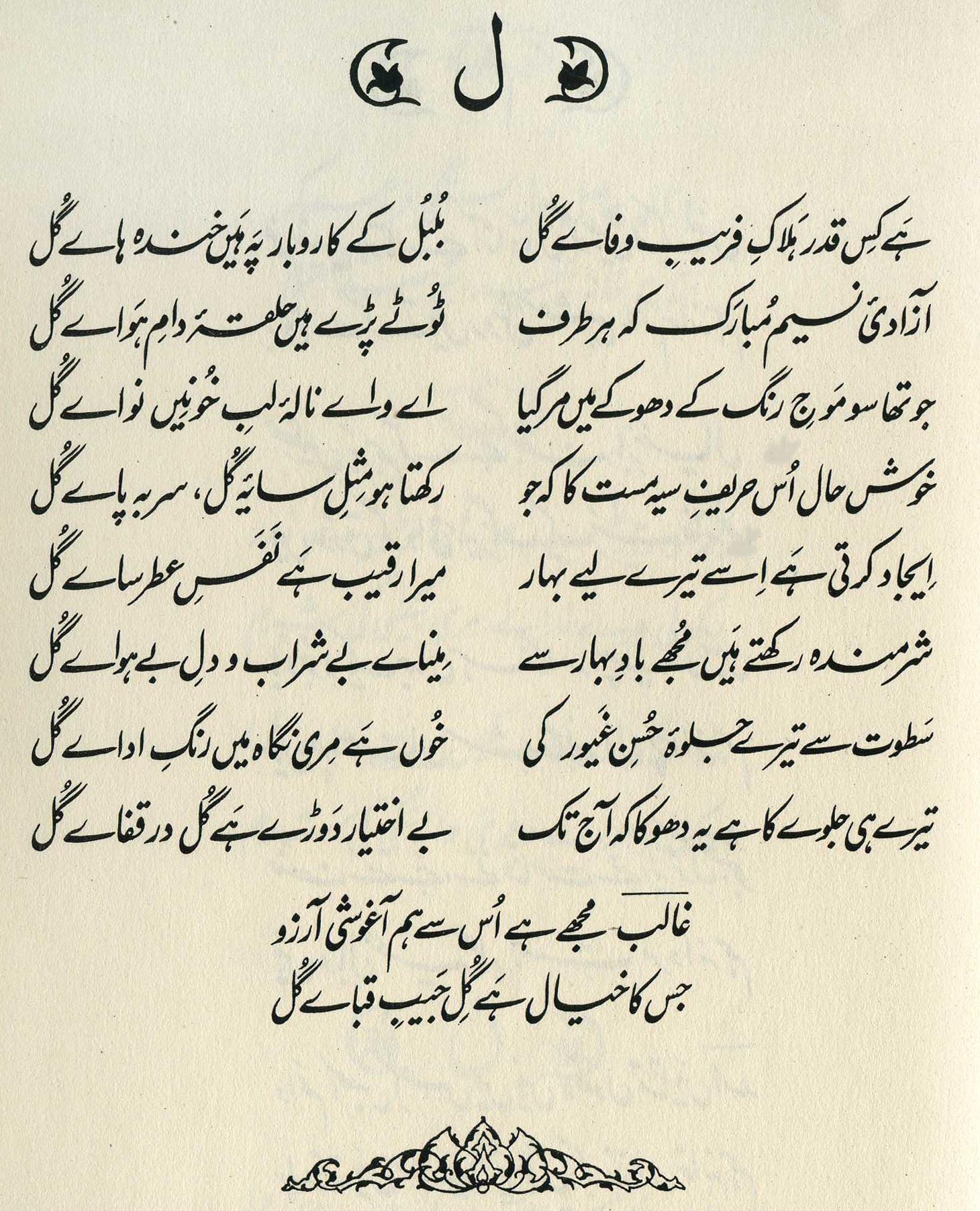
That is, that fortunate 'black-drunk' one who would put his head on the feet of the beloved and present his longing. What can be said about his state? For the beloved the simile of a rose has been used, and for the lover the simile of the shadow of the stem of the rose. (81)
== Nazm page 81

That 'black-drunk' rakish one [] is fortunate, who would put his head on the beloved's feet and present his longing.
[Or:] What can be said of that drunkard who is so sunk in intoxication that he considers the rose to be the beloved, and would fall at its feet and place his head there! (168)
That is, how fortunate is that individual who in the intoxication of drunkenness would fall at the beloved's feet and bend toward her the way the rose's shadow bends toward the rose's feet. By is meant ' Rival ' []. (166)
This is the first of three verses in this ghazal-- the others are 80,8 and 80,9 -- that echo the refrain by repeating in the second line. The word and idea of the 'rose' is one of the most (if not the single most) highly charged concepts in the ghazal universe. To repeat it, in a way that both contrasts and compares the two uses, is an extraordinarily effective device. All three verses are lyrical and resonant, with sound effects as well as an extra sense of rhythm (though the rhythm is conspicuously different in each of the three cases). They all feel like verses of mood .
A shadow is dark or even black, and the intoxicated Rival is 'black-drunk', an idiomatic expression for extreme drunkenness. To take refuge in the 'shadow' or 'shade' of some powerful person also idiomatically means to receive that person's shelter or protection in general-- which works well with the the submission and humility shown by the drunkard.
The rose's shadow touches only the base of its stem, but cannot be detached from it; the intoxicated one, even in his drunkenness, presumes no further than to touch the rose/beloved's feet-- but to those feet he is as tightly bonded as is the rose's shadow to the rose-stem. (One of the traditional forms of extreme supplication is to humbly fall at someone's feet and then refuse to rise-- or even to release the victim's feet from one's grasp-- until one's request is granted.) And of course, if the intoxicated one appears at the beloved's feet as a supplicant, what more would be the object of his plea than to be allowed always to remain at the beloved's feet?
The verse is in Ghalib's favorite mode, and its exclamatory force is of envy, admiration, even almost a form of approval not usually accorded to the Rival (who in this case may also be a comrade or fellow-lover; the neologism 'frenemy' is perfect). For the intoxicated one would be acting as a true lover should; in fact he would obviously be acting the way the lover himself longs to act. And after all the second line is in the habitual subjunctive ( ), so the whole scene may (habitually) take place only in the speaker's fevered imagination.
graphics/roseshadow.jpg