Verse 2after 1821aa-egul
G3
1 a
congratulations to the freedom of the spring-breeze!-- since [in] every direction
1 b
the freedom of the spring-breeze [is] auspicious/welcome-- since [in] every direction
2
have collapsed/fallen, broken, the meshes/circles of the net of desire/breeze of the rose
'A circle, a ring, hoop, link, loop ...; a company (of people), assembly, fraternity; a circle, a circuit (of a village, &c.)'.
'Air, wind, gentle gale;... —a gas; —affection, favour, love, mind, desire, passionate fondness; lust, carnal desire, concupiscence; —an empty or worthless thing'.
To fall, drop; to fall down, drop down; to lie, lie down, recline, repose; to lie idle, useless, or unoccupied; to be set or laid aside; to be laid up, be prostrated, be bed-ridden; to fall to the lot (of, - ); to be tied (to)'.
| References | |
|---|---|
| Arshi, Imtiyaz Ali | Ghazal# 80 |
| Raza, Kalidas Gupta | 358 |
| Nuskhah-e-Hamidiyah | 132-133 |
| Asi, Abdul Bari | 148-149 |
| Gyan Chand | 250 |
| Hamid Ali Khan | Open Image |
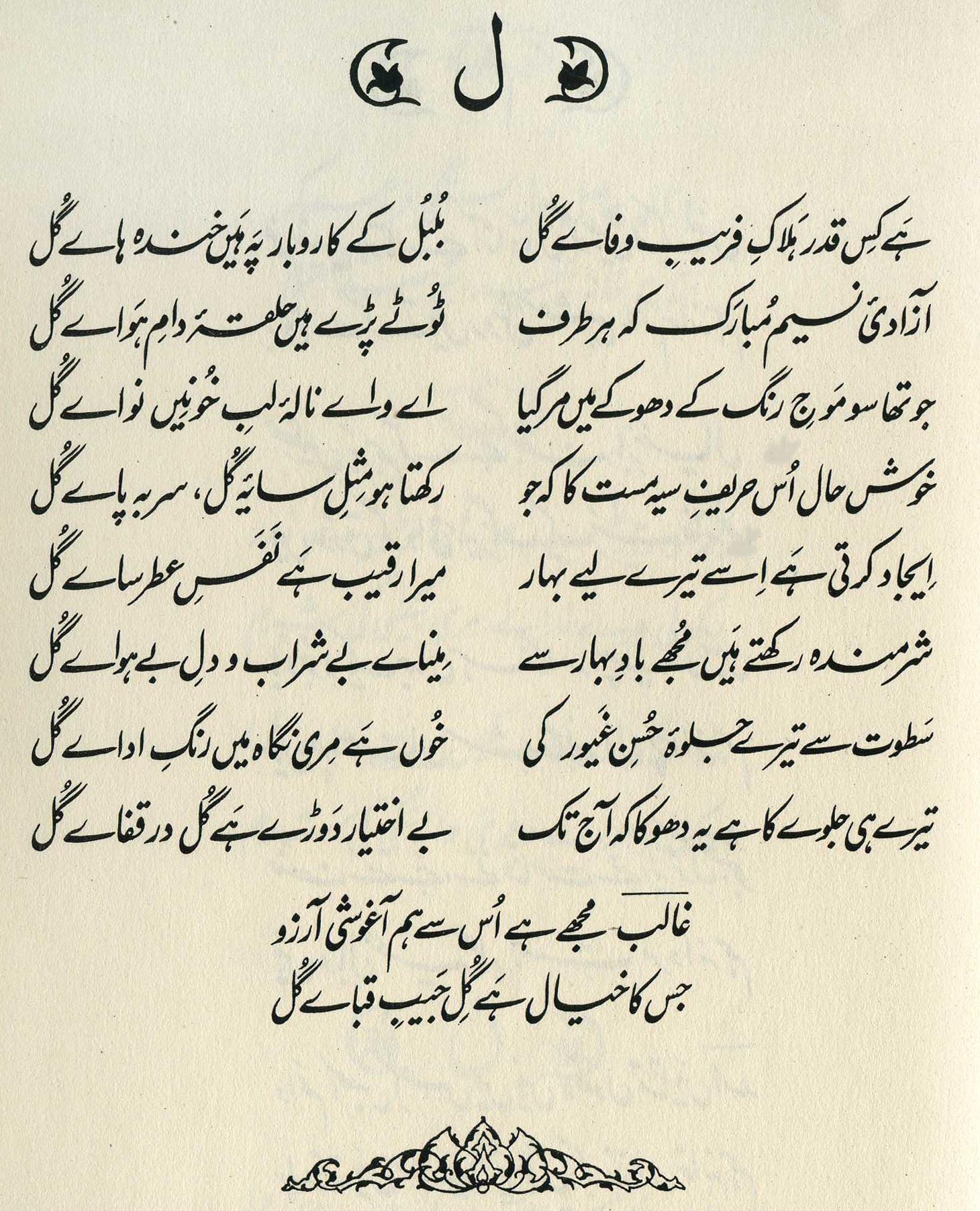
means 'ardor of the rose'. He has given for a withered rose the simile of the broken links of a net. And by the spring breeze is meant 'perfume', which breaks the links of the rose's net of ardor and becomes free. That is, congratulations to the rose-scent on its freedom, for all the flowers have been broken. (81)
== Nazm page 81

May the freedom of the spring breeze be auspicious for those ardent for rose-scent, for the links in the net of ardor of spring lie broken. That is, the kindness of the spring breeze is that now the rose-scent itself is reaching the ardent ones. Now there's no longer any need for them to reach the rose itself. (167)
That is, the desire for a stroll among the flowers was a net. Those whose hearts were given to recreation were ensnared in this net. The forceful hand of time broke those nooses apart. All the prisoners emerged from that net. Now in the garden no one is to be seen except the spring breeze. It alone, in complete freedom, has become master of the garden. May this freedom be auspicious for it. (166)
Here's a symphony of -mediated wordplay-- was the a net of 'desire for the rose' (a desire felt by others, which might ensnare them but which didn't necessarily involve any volition of the rose's)? Or was it a 'net of desire' deliberately made by the rose, in which it might ensnare, for example, the Nightingale ? Or was it a net of desire that was identical to the rose itself, that 'was' the rose? It might even have been a net of the rose's own desire, a longing felt by the rose for something or someone else (perhaps even for life itself, as its own death was approaching)?
Or, using the alternate meaning of (see the definition above), was it a 'net of the breeze' instead? If so, was it a net designed by the rose, as it used the exquisite scent of its petals to capture the breeze? Or was it a net designed by the rose to capture others, through causing the breeze to spread the rose's perfume throughout the garden? (And it was surely all these at once, for why should it not be? Ghalib is never a poet to settle for one meaning when he could just as well have several.) For more on , see 8,3 .
In the first line the speaker is either congratulating the (semi-personified) 'spring breeze' directly on its freedom (1a), or else privately expressing his own approval of what it has done with its freedom (1b). In both cases, the implications are rich. The fallen, scattered petals of the withered rose are symbols of liberation-- of several possible kinds:
=The breeze is now itself free from literal or metaphorical 'captivity' in the rose's 'desire/breeze net' and can blow as it wishes, since with the rose's death the net has fallen apart. The breeze is to be congratulated on its new freedom (1a).
=All lovers of the rose are now free from her deceptive and transitory charms, since the rose is dead, as the scattered petals prove. The speaker is grateful to the breeze for freeing the lovers by blowing apart the petals of the dying rose, and thus making clear, or even helping to bring about, her death. (1b).
Both these interpretations demand to be read in a rueful or ironic tone. For what kind of 'liberation' is it for the lover to lose the beloved? Does the breeze really want its freedom at that price? Does the Nightingale? Does the lover himself? The whole logic of the ghazal universe is about the willing, eager submission of the lover to the beloved, and his pursuit of this fatal destiny right up to the point of death (and even, of course, beyond it). This is a whistling-in-the-dark verse, putting a brave face on a terrible, irrevocable, unendurable loss. The lover knows the hollowness of his words, even as he speaks them. And we, the audience, share his painful awareness.
Note for grammar fans: How are we to read ? It could be of course be read as a normal present perfect form: the links 'have collapsed'. As a general rule, this finite-verb reading would take precedence, and that's how I've translated it above. But the could also be taken as parallel to the that precedes it, as an adverbial past participle with the omitted: on this reading, the links are 'in a state of having broken' and 'in a state of having collapsed'. And in the case of the participial usage is very common and very colloquial, so it has extra allure. Perhaps this idiomatic prevalence of the participial form is because speakers often want to emphasize the continuing state of collapsedness, etc. (see the definition above), rather than the one-shot moment of the collapse itself. For more discussion, see 115,2 .
graphics/fallenpetals.jpg