Verse 11xafter 1821aa-egul
G3
1
how would there be reach/access for a fragment of the liver, as far as the eyelashes?!
2
oh, alas, if the gaze would not be an acquaintance/familiar of the rose!
'Arriving; entrance, access; accessibleness; reach, compass'.
'Acquaintance; friend; associate; intimate friend, familiar; lover, sweetheart; paramour; mistress, concubine; —adj. Acquainted (with, -) , knowing, known; attached (to), fond (of)'.
| References | |
|---|---|
| Arshi, Imtiyaz Ali | Ghazal# 80 |
| Raza, Kalidas Gupta | 358 |
| Nuskhah-e-Hamidiyah | 132-133 |
| Asi, Abdul Bari | 148-149 |
| Gyan Chand | 250 |
| Hamid Ali Khan | Open Image |
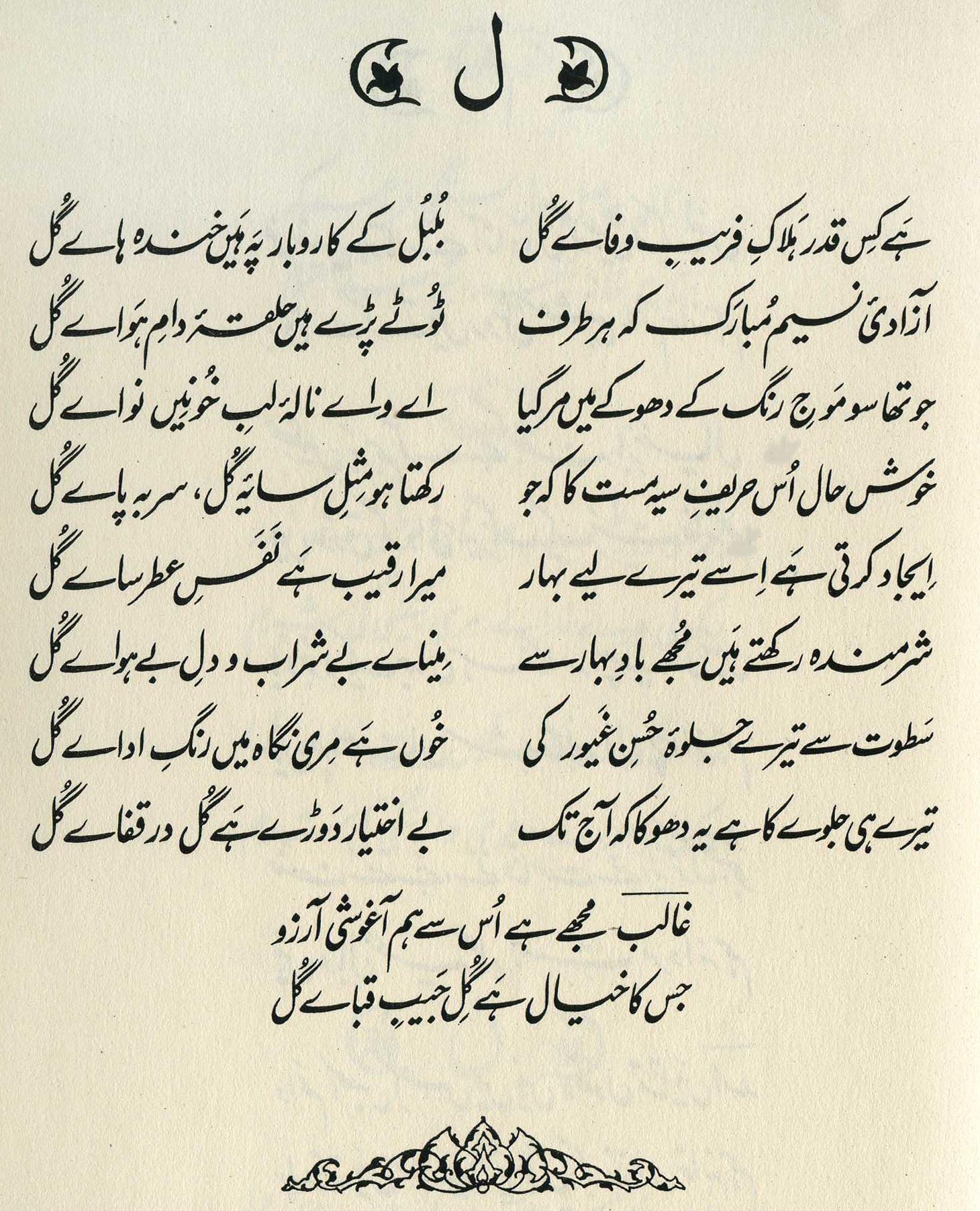
It's a great pity if our gaze would not be able to fall on the rose, because if it would not, then instead we could only look at a fragment of the liver and refresh our memory of the rose-- but how can there be access for a fragment of the liver, to the eyelashes? That is, how can a fragment of the liver come to the eyelashes? Its not coming to the eyelashes, whether it would be because of weakness or because of restraint-- in this there are various possibilities, think anything you please.
== Asi, p. 149
That is, in weeping, fragments of the liver do not come up to the eyelashes; it's as if the gaze is deprived of the sight of flowers. And the gaze that would be deprived of the sight of flowers-- its condition is pitiable!
== Zamin, p. 215
At the time of weeping, fragments of the liver do not come up to the eyelashes along with the tears. Alas, if the gaze would not be an acquaintance/familiar of flowers! For me, only/emphatically fragments of the liver were flowers. The gaze is deprived even of them.
== Gyan Chand, p. 250
For background see S. R. Faruqi's choices . This verse is NOT one of his choices; mostly for the sake of completeness, I have added it myself. For more on Ghalib's unpublished verses, see the discussion in 4,8x .
Here's an 'A,B' verse, in which we're left to decide for ourselves how the two lines should be connected to each other. And it's also a verse in which both lines are highly exclamatory and . The effect is one of obscurely extreme emotional pressure, the exact cause of which we are left to puzzle out for ourselves.
Since the two lines are entirely independent, we must look for ways to connect them. The most obvious way is by analogizing the 'fragment of the liver' and the 'rose'. Both are red, organic, and connected somehow with vision. But are they similar, or are they identical?
If they are similar, then the speaker apparently fears that if he would somehow be deprived of (visual?) access to the real rose, he would be unable to find a substitute for it in the form of sufficiently bloody tears, or of actual fragments of the liver that could somehow rise to his head and appear as red blobs in his eyeballs.
If they are identical, then what the speaker means by 'rose' is 'fragment of the liver', and what he fears is that 'roses', fragments of his liver, would not be available to his eyes (for viewing) or to his eyelashes (for producing bloody tears).
This second (and rather grotesque) possibility is the more piquant, because it tells us by implication that the speaker has never seen a real rose. Perhaps there might even be no 'real' roses in the world. Perhaps the only way lovers have visions of roses is by creating them, in some difficult and uncertain way, within their own bloody eyeballs. Verses like this always remind me of 62,8 , with its evocation of the lover's wounds as the sun.
graphics/bloodtears.jpg