Verse 10xafter 1821aa-egul
G3
1
the recourse/resource of madmen is the splendor of springtime
2
on/'in' the rose-branch is the hand/'five-fingers' of beautiful ones, instead of a rose
'Remedy, cure, expedient; redress, help, resource'.
'Illumination, light, brightness, splendour; flame; —glory, fame, honour'.
'An aggregate of five; ... —the hand with the fingers extended; claw, paw (of a tiger, &c.); clutch, grasp, possession, power'.
| References | |
|---|---|
| Arshi, Imtiyaz Ali | Ghazal# 80 |
| Raza, Kalidas Gupta | 358 |
| Nuskhah-e-Hamidiyah | 132-133 |
| Asi, Abdul Bari | 148-149 |
| Gyan Chand | 250 |
| Hamid Ali Khan | Open Image |
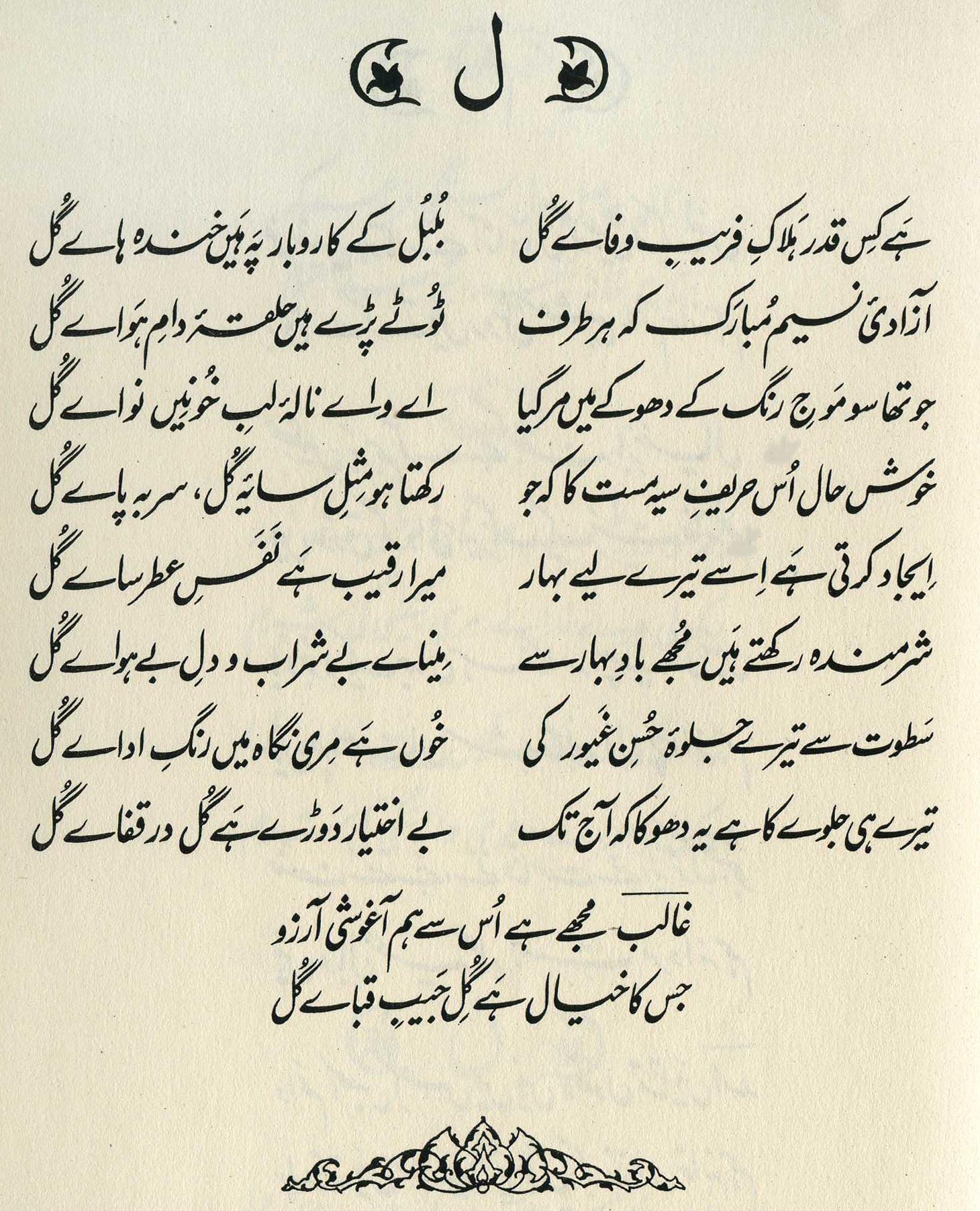
The cure for madmen is the coming of spring, and the flourishing verdure of spring. But do not be deceived into thinking that merely the spring in itself can cure them. The reason is that in the rose-branch the rose seems to be like the five fingers of beautiful ones; thus the madmen find peace/comfort in it. Otherwise, what cure can come to them from the spring?
== Asi, pp.148-149
Springtime has come, flowers have bloomed, the mad lovers consider them to be the beloved's hennaed hands and are happy; and with this sight their madness is diverted. It's as if the splendor of spring is a cure for madness....
What a true psychological problem it is, which the poet has versified in so few words-- and which has been struck out in favor of the previous one [ 80,3 ]! Just this is the situation of the whole divan .
== Zamin, p. 214
The cure for mad lovers is in the advancing of the spring-- that is, that in many places flowers would bloom. The flowers that are in the rose-branch seem to be like the hands of beautiful ones. Having seen the radiance of beautiful ones, the madmen will feel peace/ease; thus the more flowers bloom, the better it is for them.
== Gyan Chand, p. 250
For background see S. R. Faruqi's choices . This verse is NOT one of his choices; I thought it was interesting and have added it myself. For more on Ghalib's unpublished verses, see the discussion in 4,8x .
This verse reminds me of King Lear , and especially of Kent's perfectly framed words (Act 2, Scene 2), 'Nothing almost sees miracles / But misery.' (Shakespeare here uses a 'midpoint' device-- is it 'almost nothing', or 'almost sees'?) It's worth noting in the present verse that the second line gives us what appears to be a very flat statement of fact-- not 'madmen think there are', but 'there are'. Are these wretched madmen 'seeing' miracles (because the overpowering splendor of the spring has actually transformed the world), or are they 'almost seeing' them (in their joyously heightened madness)?
In the real world, only madmen can look at ravishing roses and see in them the hands of beautiful ones. Madmen-- or those with Sufistic insight into the ' oneness of existence ' []. Compare, for example, the pantheistic perspective of the lyrical 96,1 .
graphics/rosehands.jpg