Verse 8after 1821aa-egul
G3
1
this is an illusion of only/emphatically your glory/appearance-- that until today
2
involuntarily/uncontrollably, the rose runs after/'to the neck of' the rose
'Deceit, deception, delusion; blunder, mistake; disappointment, baulking; doubt, hesitation; alarm, panic; anything that may deceive or mislead, false appearance, a scarecrow; anything imaginary or unreal, a mirage; an object or form indistinctly seen at a distance'.
'Without choice, involuntary, constrained, forced, compelled; without self-possession, control, or authority; —involuntarily, against (one's) will, in spite of oneself, perforce'.
is an archaic form of ( GRAMMAR )
'The back of the head; nape of the neck;-- adv. Behind, after; in pursuit'.
| References | |
|---|---|
| Arshi, Imtiyaz Ali | Ghazal# 80 |
| Raza, Kalidas Gupta | 358 |
| Nuskhah-e-Hamidiyah | 132-133 |
| Asi, Abdul Bari | 148-149 |
| Gyan Chand | 250 |
| Hamid Ali Khan | Open Image |
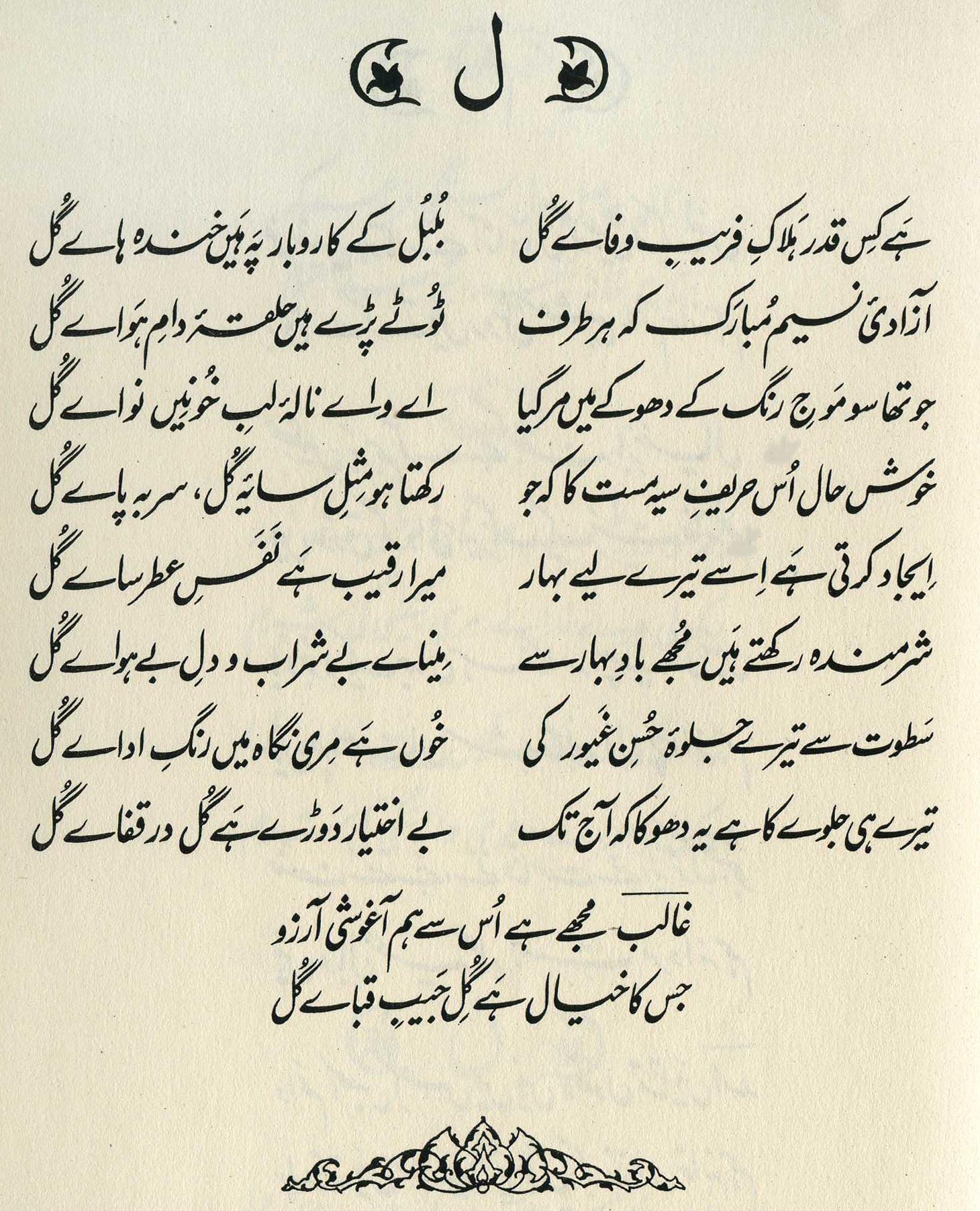
That is, seeing one flower in bloom, then when the next flower emerges, it has the illusion that you have manifested yourself. (81-82)
== Nazm page 81 ; Nazm page 82


He says, when a flower blooms, then other buds consider that you have manifested yourself in the guise of a flower. The flowers begin to bloom in sequence [], and seeing this sequence, it is proved that one flower keeps running after another flower. (130)
Seeing one flower bloom after another, a monotheistic lover has had the thought that every rose considers another rose to be the [divine] Beloved; for this reason it advances so uncontrollably toward it. (169)
This is the second of three verses in this ghazal-- the others are 80,4 and 80,9 -- that repeat in the second line. For discussion, see 80 ,4 .
This verse also offers a lovely bit of word-and-meaning play involving the word . A rose-bush is full of roses that bloom one after the other, so that as each of them blooms it 'runs after' its predecessor as though it thinks it is pursuing the beloved herself. Thus a sequence is formed in time, with each rose blooming 'in pursuit of' the next. This is the obvious meaning that the commentators prefer. And sometimes roses grow on long vines, so that the sequence may be spatial as well.
But the word also has the meaning of the back of the head, or the nape of the neck-- where beautiful women place flowers when they twine them into their hair. Roses on a rose-bush bloom in very close proximity, and sway toward each other when the breeze blows, so it's easy to imagine that each one is trying to reach the next one's neck, thinking it to be the beloved's neck, longing to be woven into the beloved's hair.
We thus have another example of ' elegance in assigning a cause '. We might have thought that roses bloomed at random, but now we know that 'to this day' they bloom in pursuit of each other, reaching for each other, under the illusion that they are thus approaching the beloved.
And how much of an illusion is it, really? If we go with Bekhud Mohani and read the verse mystically, then of course it's an illusion, since Muslims know that God is not to be found directly manifest in physical form in this world. But if we go with the other commentators, then we know that the rose is to the garden what the human beloved is to the lover, and the two radiant presences can readily be conflated.
The ghazal world offers ample precedents for both identification and differentiation, and each verse chooses its own way of presenting the possibilities. Does the rose naively pursue another rose, or does it pursue the Rose-- no more naively than any of us pursue any (ultimately deceptive, because unattainable) vision of the Rose? A canny poet like Ghalib leaves the door ajar, so that both possibilities can meet and mingle as they do here.
graphics/roseclimbing.jpg
graphics/roselover.jpg