Verse 1after 1821aa-egul
G3
1
to what extent there is destruction/ruin from the deceit/trick/beguilement of the faithfulness of the rose!
2
at the doings of the Nightingale , are the smiles of the rose
'Perishing; being lost; —perdition, destruction, ruin; —slaughter; death'.
'Deception, deceit, fraud, trick, duplicity, treachery, imposture, delusion, fallacy; allurement, beguilement, &c.'.
| References | |
|---|---|
| Arshi, Imtiyaz Ali | Ghazal# 80 |
| Raza, Kalidas Gupta | 358 |
| Nuskhah-e-Hamidiyah | 132-133 |
| Asi, Abdul Bari | 148-149 |
| Gyan Chand | 250 |
| Hamid Ali Khan | Open Image |
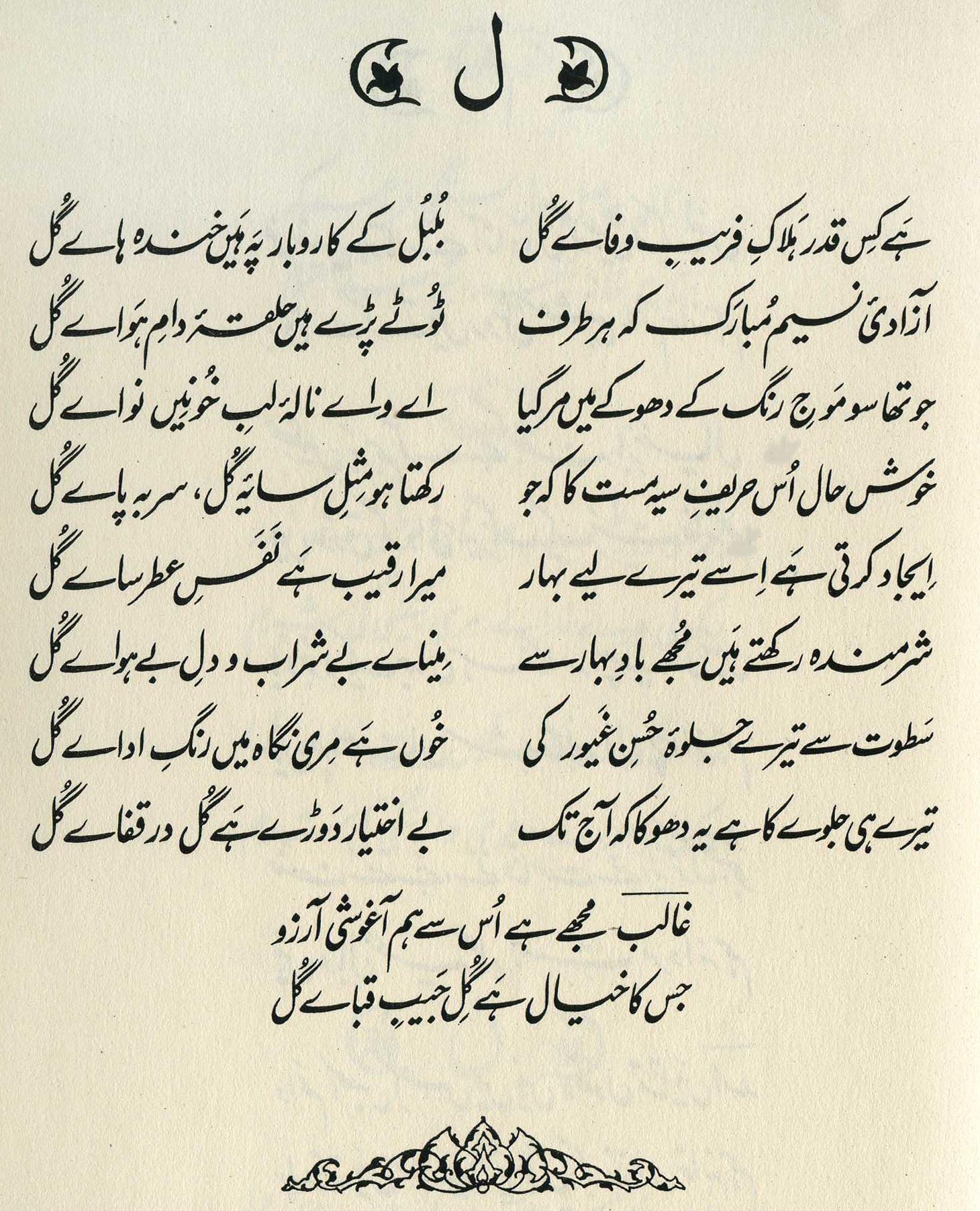
That is, the Nightingale dies of the illusion that the rose's color is lasting. The rose laughs at this misunderstanding. Exactly this line has already passed in another place: 33,3 . (81)
== Nazm page 81

He says, the Nightingale gives his life in the deceit/trick and illusion that the quality of faithfulness is firm and established in the rose. Look at the flowers-- they are smiling at this misunderstanding of the Nightingale's. The meaning is that every lover's eyes, every beloved is an undying being. (128)
The flowers are laughing. The Nightingale is absorbed in the deceit/trick of faithfulness. He considers that the flowers are laughing in the fervor of joy at seeing him. Although they laugh at his simplicity and foolish behavior. (167)
Compare 33,3 . (214)
Nazm and Arshi are right to call attention to 33,3 ; its second line is word-for-word identical with the first line of this verse. As far as I can tell, the only conclusion to be drawn from this repetition is that Ghalib probably liked this line. For more on this kind of repetition, see 49,1 .
As the commentators point out, the rose's 'trickery' or 'beguilement' implies a promise of faithfulness-- which, as we in the ghazal world all know, the rose is radically unable to fulfill. On the complexities of , see 71,3 .
For the 'smile' or 'laughter' of the rose is an expression of its full bloom, which immediately precedes its withering and death. So the rose's smiling or laughing at the Nightingale's folly might not be cruel or callous. It might rather be rueful, melancholy, resigned-- the rose's acceptance of its own mortality. For after all, through the , the 'slaughter/ruin' is really that 'of' the rose's illusory 'faithfulness'; it thus obviously may include the death of the rose itself.
We might also ask a further question: if what the rose smiles at is the doings of the Nightingale, would the rose not smile in their absence? Is it possible that it's only the Nightingale's romantic folly that brings us the glory of the roses in the spring? The verse certainly leaves that possibility open.
I once had a go at translating this whole lovely ghazal.
graphics/rose.jpg